

2.2 Acoustic Doppler Technology
Acoustic Doppler current profiler (ADCP) allows accurate measurements of
streamflow from a boat, bridge, or cableway. The ADCP uses the Doppler effect
to determine water velocity by sending a sound pulse into the water and measuring
the change in frequency of the sound pulse reflected back to the ADCP by
suspended sediment or other particulates transported in surface water. The change
in frequency, or Doppler shift, measured by the ADCP, is translated into water
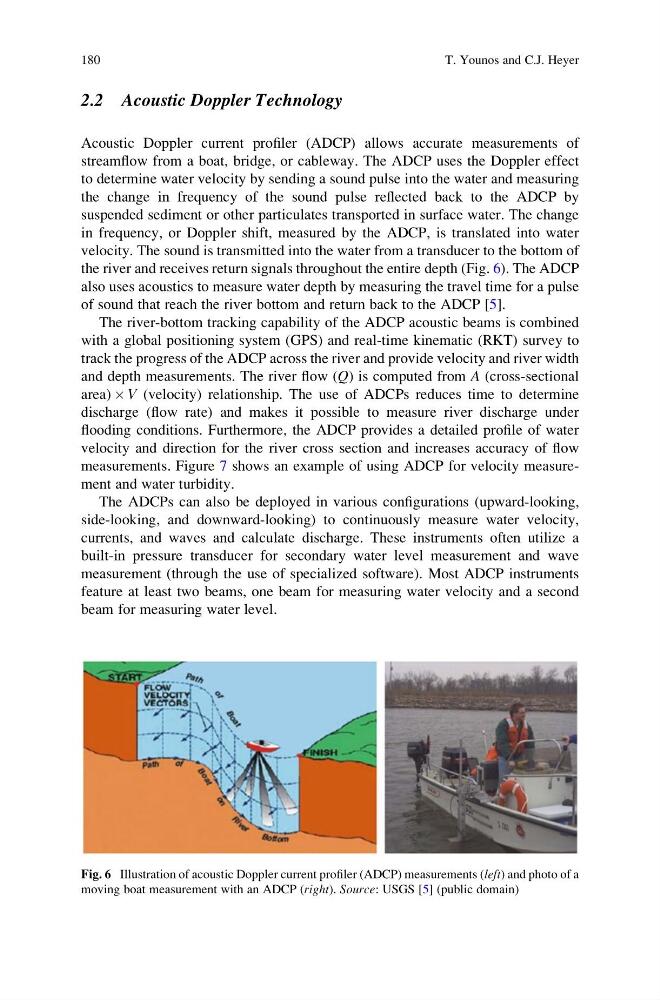
velocity. The sound is transmitted into the water from a transducer to the bottom of
the river and receives return signals throughout the entire depth (Fig. 6). The ADCP
also uses acoustics to measure water depth by measuring the travel time for a pulse
of sound that reach the river bottom and return back to the ADCP [5].
The river-bottom tracking capability of the ADCP acoustic beams is combined
with a global positioning system (GPS) and real-time kinematic (RKT) survey to
track the progress of the ADCP across the river and provide velocity and river width
and depth measurements. The river flow (Q) is computed from A (cross-sectional
area) Â V (velocity) relationship. The use of ADCPs reduces time to determine
discharge (flow rate) and makes it possible to measure river discharge under
flooding conditions. Furthermore, the ADCP provides a detailed profile of water
velocity and direction for the river cross section and increases accuracy of flow
measurements. Figure 7 shows an example of using ADCP for velocity measurement and water turbidity.
The ADCPs can also be deployed in various configurations (upward-looking,
side-looking, and downward-looking) to continuously measure water velocity,
currents, and waves and calculate discharge. These instruments often utilize a
built-in pressure transducer for secondary water level measurement and wave
measurement (through the use of specialized software). Most ADCP instruments
feature at least two beams, one beam for measuring water velocity and a second
beam for measuring water level.
Fig. 6 Illustration of acoustic Doppler current profiler (ADCP) measurements (left) and photo of a
moving boat measurement with an ADCP (right). Source: USGS [5] (public domain)
180
T. Younos and C.J. Heyer
Acoustic Doppler current profiler (ADCP) allows accurate measurements of
streamflow from a boat, bridge, or cableway. The ADCP uses the Doppler effect
to determine water velocity by sending a sound pulse into the water and measuring
the change in frequency of the sound pulse reflected back to the ADCP by
suspended sediment or other particulates transported in surface water. The change
in frequency, or Doppler shift, measured by the ADCP, is translated into water
velocity. The sound is transmitted into the water from a transducer to the bottom of
the river and receives return signals throughout the entire depth (Fig. 6). The ADCP
also uses acoustics to measure water depth by measuring the travel time for a pulse
of sound that reach the river bottom and return back to the ADCP [5].
The river-bottom tracking capability of the ADCP acoustic beams is combined
with a global positioning system (GPS) and real-time kinematic (RKT) survey to
track the progress of the ADCP across the river and provide velocity and river width
and depth measurements. The river flow (Q) is computed from A (cross-sectional
area) Â V (velocity) relationship. The use of ADCPs reduces time to determine
discharge (flow rate) and makes it possible to measure river discharge under
flooding conditions. Furthermore, the ADCP provides a detailed profile of water
velocity and direction for the river cross section and increases accuracy of flow
measurements. Figure 7 shows an example of using ADCP for velocity measurement and water turbidity.
The ADCPs can also be deployed in various configurations (upward-looking,
side-looking, and downward-looking) to continuously measure water velocity,
currents, and waves and calculate discharge. These instruments often utilize a
built-in pressure transducer for secondary water level measurement and wave
measurement (through the use of specialized software). Most ADCP instruments
feature at least two beams, one beam for measuring water velocity and a second
beam for measuring water level.
Fig. 6 Illustration of acoustic Doppler current profiler (ADCP) measurements (left) and photo of a
moving boat measurement with an ADCP (right). Source: USGS [5] (public domain)
180
T. Younos and C.J. Heyer