

619
Resident waterfowl may feed on different species
of aquatic vegetation year-round.
29.1.2.4 Wetlands as Habitats
for Wildlife (Value as Habitat
for Wildlife)
Many plant and animal species either are confi ned to a particular wetland habitat or are greatly
dependent on them for survival.
29.1.2.5 Wetland Value as Source
of Economically Important
Biota: Wetland with Regard
to Fish Yield
Many wetland plants are used by men as food,
fi bre, fuel, feed, e.g. Trapa bispinosa , Nelumbo
nucifera and Cyperus esculentus .
Among the animals, fi sh is the most important
animal resource for direct human consumption.
Wetland with Regard to Fish Yield
As a typical example, in Sone Beel alone, 70 species of fi shes belonging to 49 genera under 24
families and 11 orders have been recorded.
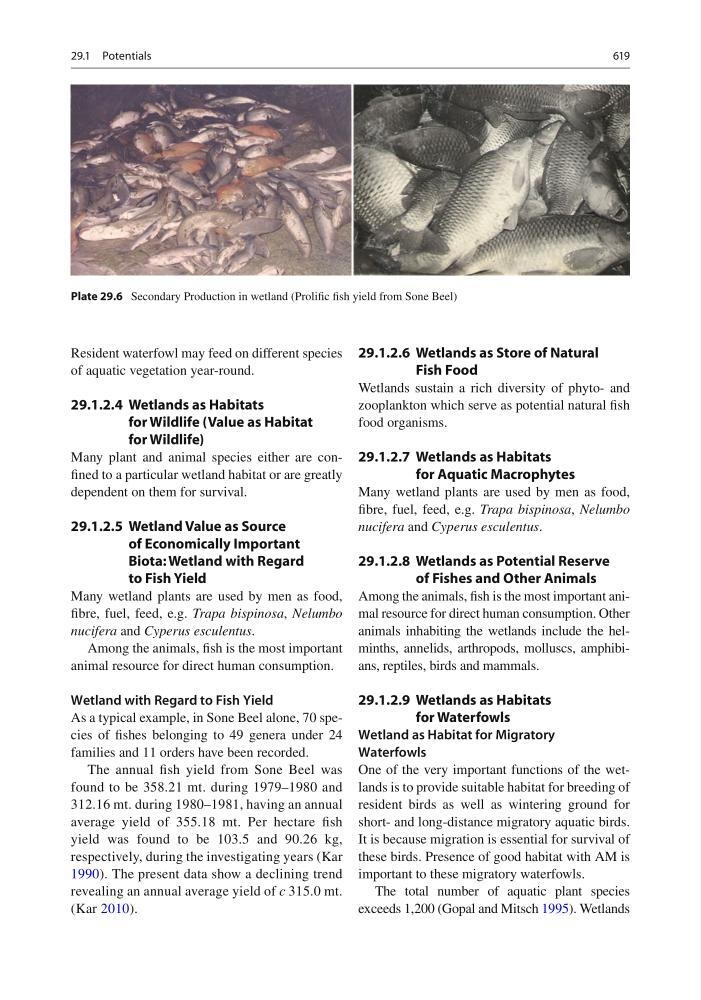
The annual fi sh yield from Sone Beel was
found to be 358.21 mt. during 1979–1980 and
312.16 mt. during 1980–1981, having an annual
average yield of 355.18 mt. Per hectare fi sh
yield was found to be 103.5 and 90.26 kg,
respectively, during the investigating years (Kar
1990 ). The present data show a declining trend
revealing an annual average yield of c 315.0 mt.
(Kar 2010 ).
29.1.2.6 Wetlands as Store of Natural
Fish Food
Wetlands sustain a rich diversity of phyto- and
zooplankton which serve as potential natural fi sh
food organisms.
29.1.2.7 Wetlands as Habitats
for Aquatic Macrophytes
Many wetland plants are used by men as food,
fi bre, fuel, feed, e.g. Trapa bispinosa , Nelumbo
nucifera and Cyperus esculentus .
29.1.2.8 Wetlands as Potential Reserve
of Fishes and Other Animals
Among the animals, fi sh is the most important animal resource for direct human consumption. Other
animals inhabiting the wetlands include the helminths, annelids, arthropods, molluscs, amphibians, reptiles, birds and mammals.
29.1.2.9 Wetlands as Habitats
for Waterfowls
Wetland as Habitat for Migratory
Waterfowls
One of the very important functions of the wetlands is to provide suitable habitat for breeding of
resident birds as well as wintering ground for
short- and long-distance migratory aquatic birds.
It is because migration is essential for survival of
these birds. Presence of good habitat with AM is
important to these migratory waterfowls.
The total number of aquatic plant species
exceeds 1,200 (Gopal and Mitsch 1995 ). Wetlands
Plate 29.6 Secondary Production in wetland (Prolifi c fi sh yield from Sone Beel)
29.1 Potentials