

620
are also important as resting sites for migratory
birds. Aquatic vegetation is a valuable source of
food, especially for waterfowl. In the winter,
migratory waterfowls search the sediment for
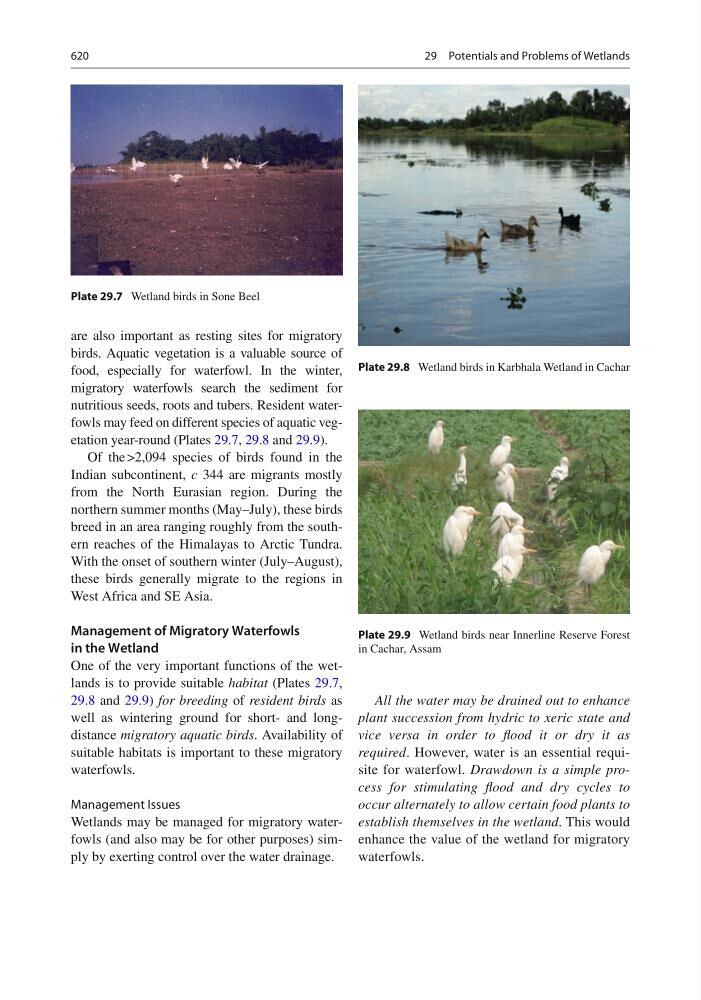
nutritious seeds, roots and tubers. Resident waterfowls may feed on different species of aquatic vegetation year-round (Plates 29.7 , 29.8 and 29.9 ).
Of the >2,094 species of birds found in the
Indian subcontinent, c 344 are migrants mostly
from the North Eurasian region. During the
northern summer months (May–July), these birds
breed in an area ranging roughly from the southern reaches of the Himalayas to Arctic Tundra.
With the onset of southern winter (July–August),
these birds generally migrate to the regions in
West Africa and SE Asia.
Management of Migratory Waterfowls
in the Wetland
One of the very important functions of the wetlands is to provide suitable habitat (Plates 29.7 ,
29.8 and 29.9 ) for breeding of resident birds as
well as wintering ground for short- and longdistance migratory aquatic birds . Availability of
suitable habitats is important to these migratory
waterfowls.
Management Issues
Wetlands may be managed for migratory waterfowls (and also may be for other purposes) simply by exerting control over the water drainage.
All the water may be drained out to enhance
plant succession from hydric to xeric state and
vice versa in order to fl ood it or dry it as
required . However, water is an essential requisite for waterfowl. Drawdown is a simple process for stimulating fl ood and dry cycles to
occur alternately to allow certain food plants to
establish themselves in the wetland . This would
enhance the value of the wetland for migratory
waterfowls.
Plate 29.7 Wetland birds in Sone Beel
Plate 29.8 Wetland birds in Karbhala Wetland in Cachar
Plate 29.9 Wetland birds near Innerline Reserve Forest
in Cachar, Assam
29 Potentials and Problems of Wetlands