

618
carbon, nitrogen and sulphur (Armentano 1990 ).
Wetlands with anaerobic organic elements also
produce methane which may infl uence the global
climate.
29.1.1.4 Wetlands for Ecological
Benefi ts
Ecological Benefi ts
Wetlands, being one of the most biologically productive natural ecosystems, are vital for the survival
of diverse fl ora and fauna, including many threatened and endangered species by providing shelter,
food, etc., and forming a part of the complex food
web. It is estimated (Wetlands in Asia, 1997) that
about 20 % of the known species of life rely directly
or indirectly on wetlands for their survival, as they
are their primary and important seasonal habitats.
29.1.2 Biological Potentials
of Wetlands
Wetlands have tremendous biological potential,
notably serving as habitats for different types of
biota.
29.1.2.1 Primary Production
in Wetlands
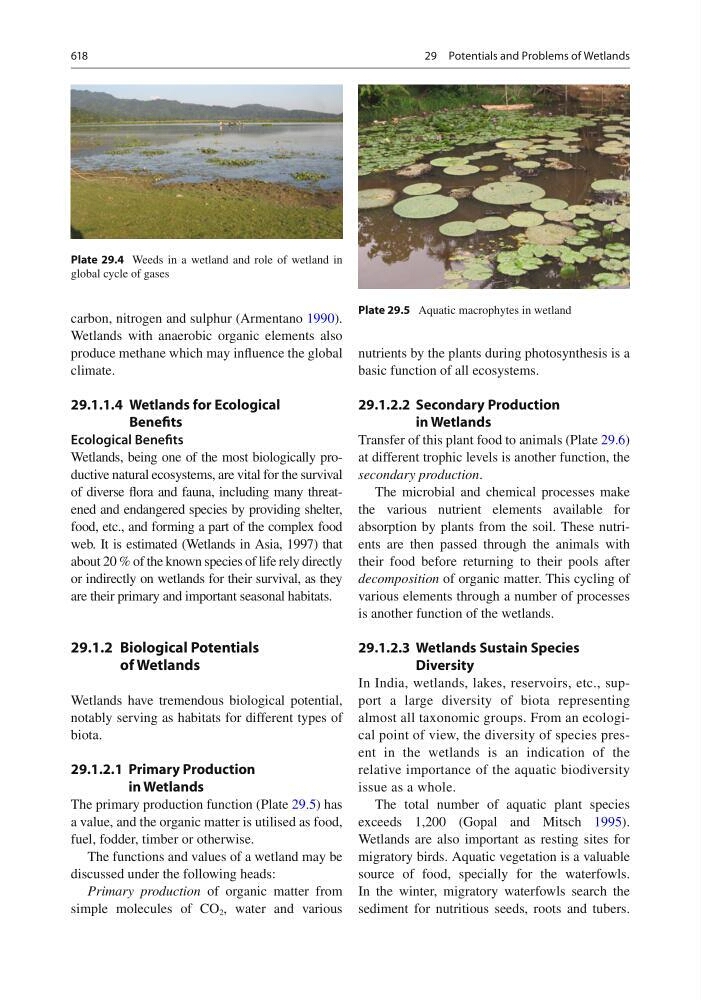
The primary production function (Plate 29.5 ) has
a value, and the organic matter is utilised as food,
fuel, fodder, timber or otherwise.
The functions and values of a wetland may be
discussed under the following heads:
Primary production of organic matter from
simple molecules of CO 2 , water and various
nutrients by the plants during photosynthesis is a
basic function of all ecosystems.
29.1.2.2 Secondary Production
in Wetlands
Transfer of this plant food to animals (Plate 29.6 )
at different trophic levels is another function, the
secondary production .
The microbial and chemical processes make
the various nutrient elements available for
absorption by plants from the soil. These nutrients are then passed through the animals with
their food before returning to their pools after
decomposition of organic matter. This cycling of
various elements through a number of processes
is another function of the wetlands.
29.1.2.3 Wetlands Sustain Species
Diversity
In India, wetlands, lakes, reservoirs, etc., support a large diversity of biota representing
almost all taxonomic groups. From an ecological point of view, the diversity of species present in the wetlands is an indication of the
relative importance of the aquatic biodiversity
issue as a whole.
The total number of aquatic plant species
exceeds 1,200 (Gopal and Mitsch 1995 ).
Wetlands are also important as resting sites for
migratory birds. Aquatic vegetation is a valuable
source of food, specially for the waterfowls.
In the winter, migratory waterfowls search the
sediment for nutritious seeds, roots and tubers.
Plate 29.4 Weeds in a wetland and role of wetland in
global cycle of gases
Plate 29.5 Aquatic macrophytes in wetland
29 Potentials and Problems of Wetlands