

617
Water Quality
Wetlands play an important role in improving the
water quality by fi ltering sediments and nutrients
from surface water. Aquatic vegetation helps in
removing 90 % of the dissolved nutrients like nitrogen and phosphorus and also in adsorption of
heavy metals. Dissolved materials may be retained
in wetlands, and the water quality may vary seasonally or from year to year. Removal of sediment
load is also valuable because sediments often transport absorbed nutrients, pesticides, heavy metals
and other toxins that pollute the water.
29.1.1.6 Wetlands for Shoreline
Stabilisation and Erosion
Control
Wetland vegetation can reduce shoreline erosion
in several ways, including increasing durability
of the sediment through binding.
29.1.1.7 Wetlands for Dampening
Waves Through Friction
Reducing current velocity through friction improves
water quality. Coastal wetlands, particularly mangroves, help in shoreline stabilisation and storm
protection by dissipating the force and, thereby,
reducing the damage by wind and wave action.
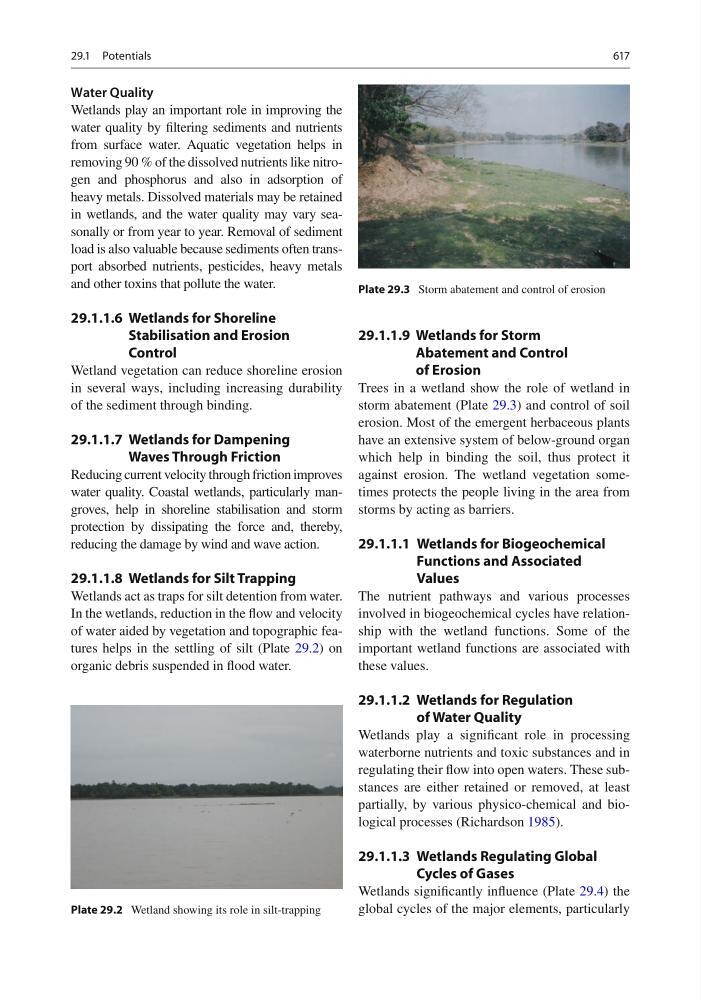
29.1.1.8 Wetlands for Silt Trapping
Wetlands act as traps for silt detention from water.
In the wetlands, reduction in the fl ow and velocity
of water aided by vegetation and topographic features helps in the settling of silt (Plate 29.2 ) on
organic debris suspended in fl ood water.
29.1.1.9 Wetlands for Storm
Abatement and Control
of Erosion
Trees in a wetland show the role of wetland in
storm abatement (Plate 29.3 ) and control of soil
erosion. Most of the emergent herbaceous plants
have an extensive system of below-ground organ
which help in binding the soil, thus protect it
against erosion. The wetland vegetation sometimes protects the people living in the area from
storms by acting as barriers.
29.1.1.1 Wetlands for Biogeochemical
Functions and Associated
Values
The nutrient pathways and various processes
involved in biogeochemical cycles have relationship with the wetland functions. Some of the
important wetland functions are associated with
these values.
29.1.1.2 Wetlands for Regulation
of Water Quality
Wetlands play a signifi cant role in processing
waterborne nutrients and toxic substances and in
regulating their fl ow into open waters. These substances are either retained or removed, at least
partially, by various physico-chemical and biological processes ( Richardson 1985 ).
29.1.1.3 Wetlands Regulating Global
Cycles of Gases
Wetlands signifi cantly infl uence (Plate 29.4 ) the
global cycles of the major elements, particularly
Plate 29.2 Wetland showing its role in silt-trapping
Plate 29.3 Storm abatement and control of erosion
29.1 Potentials