

616
29.1.1.1 Wetlands Recharge
Groundwater
Wetlands may contribute to recharge of groundwater aquifers which is of great importance, as
the water can be extracted for human consumption, for agriculture, etc.
Periodically inundated wetlands are very effective in storing rainwater and have innate capacity to recharge the groundwaters. Groundwater
recharge occurs through mineral soils found primarily around the edges of wetlands. The extent
of groundwater recharge depends on the type
of soil and its permeability, vegetation, sediment
accumulation in the lake bed, surface area to volume ratio and water table gradient.
29.1.1.2 Hydrological Functions and
Associated Values: Wetlands
for Flood Mitigation
Many wetlands are connected to the rivers either
directly or indirectly. As such, the excess river
water during fl oods is generally diverted to the
wetlands, which could very well mitigate fl oods.
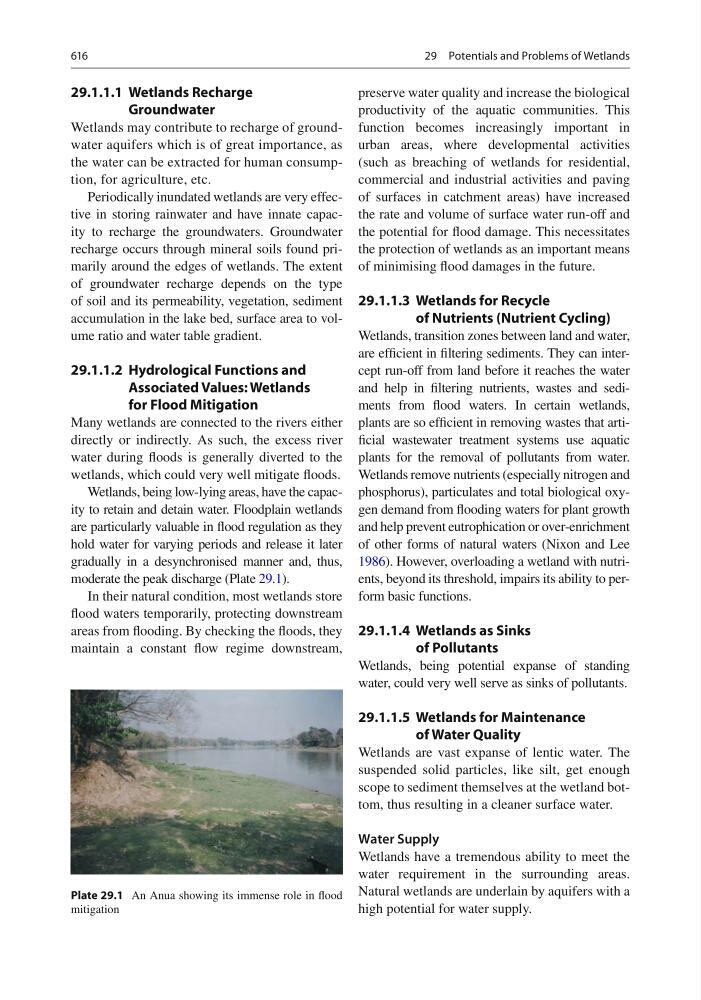
Wetlands, being low-lying areas, have the capacity to retain and detain water. Floodplain wetlands
are particularly valuable in fl ood regulation as they
hold water for varying periods and release it later
gradually in a desynchronised manner and, thus,
moderate the peak discharge (Plate 29.1 ).
In their natural condition, most wetlands store
fl ood waters temporarily, protecting downstream
areas from fl ooding. By checking the fl oods, they
maintain a constant fl ow regime downstream,
preserve water quality and increase the biological
productivity of the aquatic communities. This
function becomes increasingly important in
urban areas, where developmental activities
(such as breaching of wetlands for residential,
commercial and industrial activities and paving
of surfaces in catchment areas) have increased
the rate and volume of surface water run-off and
the potential for fl ood damage. This necessitates
the protection of wetlands as an important means
of minimising fl ood damages in the future.
29.1.1.3 Wetlands for Recycle
of Nutrients (Nutrient Cycling)
Wetlands, transition zones between land and water,
are effi cient in fi ltering sediments. They can intercept run-off from land before it reaches the water
and help in fi ltering nutrients, wastes and sediments from fl ood waters. In certain wetlands,
plants are so effi cient in removing wastes that artifi cial wastewater treatment systems use aquatic
plants for the removal of pollutants from water.
Wetlands remove nutrients (especially nitrogen and
phosphorus), particulates and total biological oxygen demand from fl ooding waters for plant growth
and help prevent eutrophication or over-enrichment
of other forms of natural waters (Nixon and Lee
1986 ). However, overloading a wetland with nutrients, beyond its threshold, impairs its ability to perform basic functions.
29.1.1.4 Wetlands as Sinks
of Pollutants
Wetlands, being potential expanse of standing
water, could very well serve as sinks of pollutants.
29.1.1.5 Wetlands for Maintenance
of Water Quality
Wetlands are vast expanse of lentic water. The
suspended solid particles, like silt, get enough
scope to sediment themselves at the wetland bottom, thus resulting in a cleaner surface water.
Water Supply
Wetlands have a tremendous ability to meet the
water requirement in the surrounding areas.
Natural wetlands are underlain by aquifers with a
high potential for water supply.
Plate 29.1 An Anua showing its immense role in fl ood
mitigation
29 Potentials and Problems of Wetlands