

599
the area of the fi shing centre. The fi shes, which are
obstructed in the fi shing centre, sometimes, try to
escape by jumping over the ‘Khati’. In doing so,
they are trapped in the pouches of the Fal jal when
they are caught by the fi shermen.
In Sone Beel, Fal jal is seen in operation generally from September to March mainly for
catching different types of big fi shes.
27.3.12 Impoundment
This is a device of trapping fi shes by raising
small embankments out of bottom soil of the
Beel. The fi shes could also be trapped by other
kinds of devices of impoundment. In Sone Beel,
impoundments could be of the following kinds:
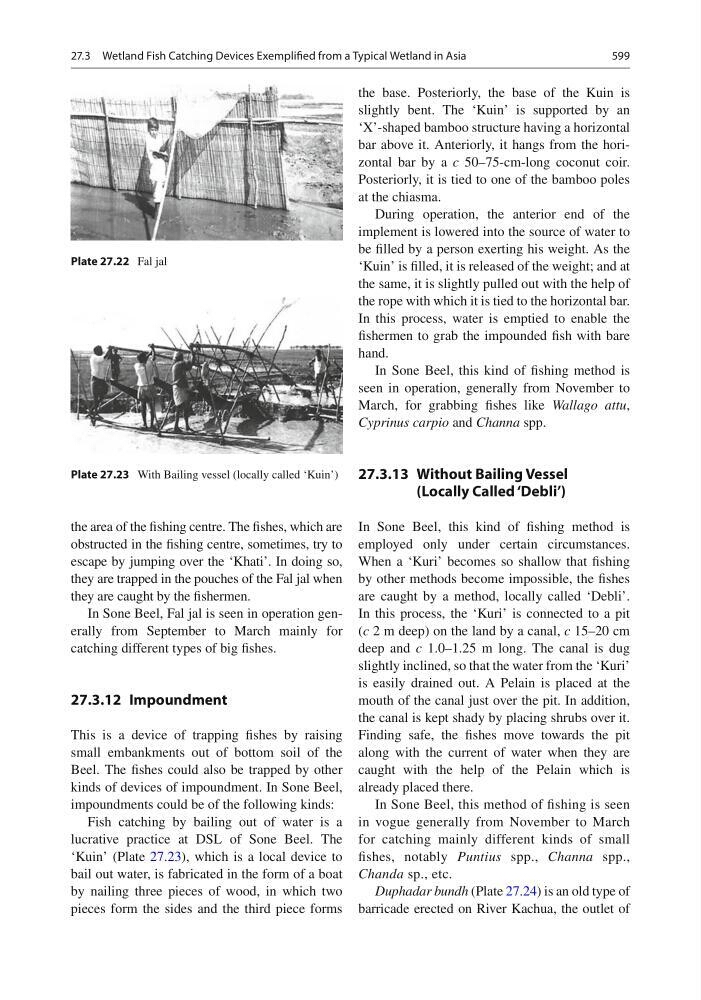
Fish catching by bailing out of water is a
lucrative practice at DSL of Sone Beel. The
‘Kuin’ (Plate 27.23 ), which is a local device to
bail out water, is fabricated in the form of a boat
by nailing three pieces of wood, in which two
pieces form the sides and the third piece forms
the base. Posteriorly, the base of the Kuin is
slightly bent. The ‘Kuin’ is supported by an
‘X’-shaped bamboo structure having a horizontal
bar above it. Anteriorly, it hangs from the horizontal bar by a c 50–75-cm-long coconut coir.
Posteriorly, it is tied to one of the bamboo poles
at the chiasma.
During operation, the anterior end of the
implement is lowered into the source of water to
be fi lled by a person exerting his weight. As the
‘Kuin’ is fi lled, it is released of the weight; and at
the same, it is slightly pulled out with the help of
the rope with which it is tied to the horizontal bar.
In this process, water is emptied to enable the
fi shermen to grab the impounded fi sh with bare
hand.
In Sone Beel, this kind of fi shing method is
seen in operation, generally from November to
March, for grabbing fi shes like Wallago attu ,
Cyprinus carpio and Channa spp.
27.3.13 Without Bailing Vessel
(Locally Called ‘Debli’)
In Sone Beel, this kind of fi shing method is
employed only under certain circumstances.
When a ‘Kuri’ becomes so shallow that fi shing
by other methods become impossible, the fi shes
are caught by a method, locally called ‘Debli’.
In this process, the ‘Kuri’ is connected to a pit
( c 2 m deep) on the land by a canal, c 15–20 cm
deep and c 1.0–1.25 m long. The canal is dug
slightly inclined, so that the water from the ‘Kuri’
is easily drained out. A Pelain is placed at the
mouth of the canal just over the pit. In addition,
the canal is kept shady by placing shrubs over it.
Finding safe, the fi shes move towards the pit
along with the current of water when they are
caught with the help of the Pelain which is
already placed there.
In Sone Beel, this method of fi shing is seen
in vogue generally from November to March
for catching mainly different kinds of small
fi shes, notably Puntius spp., Channa spp.,
Chanda sp., etc.
Duphadar bundh (Plate 27.24 ) is an old type of
barricade erected on River Kachua, the outlet of
Plate 27.22 Fal jal
Plate 27.23 With Bailing vessel (locally called ‘Kuin’)
27.3 Wetland Fish Catching Devices Exemplifi ed from a Typical Wetland in Asia