

598
while Dal jal and Rekh jal are operated
mainly during the winter. Chat jal and Ghuran
jal are seen to be operated during both the
seasons. Jhaki jal has no seasonality and is
used throughout the year.
Studies on gear specifi city to fi shermen portrayed that both occasional and part-time
classes of fi shermen use mainly the Jhaki jal,
while the professional class of fi shermen (Kar
2007a , b , c ) use all the types of encircling gears
with tendency to operate Maha jal, Chat jal and
Ghuran jal intensively. Indeed, operation of
Maha jal, Chat jal, Ghuran jal and Tana jal are
restricted exclusively to the Kaibartas, who
constitute c 55 % of the professional class (Kar
and Dey 1991 ). Nevertheless, the Maimals,
who constitute c 5.54 % of the professional
class (Kar and Dey 1996 ), are very effi cient in
operating the Rekh jal.
Effi cacy of the encircling gears and other relevant informations are tabulated below:
Analysis of effi cacy of the encircling gears
through CPGH, as shown in the above table,
reveals that Jhaki jal seems to be by far the most
effi cacious encircling gear. The table also refl ects
highly signifi cant differences between the different kinds of encircling gears with regard to their
CPGH. Effi cacy of the Jhaki jal is also refl ected
from its high HC value. On the other hand, analysis of MI portrayed that Maha jal possesses the
highest value of MI. Also, high value of MI of
Jhaki jal makes it a popular gear, and its extensive
use in Sone Beel is refl ected by its highest value
of niche’ width among the different varieties of
encircling gears (Kar and Dey 1993a , b ).
27.3.11 Miscellaneous Types
of Gears
In Sone Beel, fi shes from deeper portions
(locally called ‘Kuri’) are sometimes seen to be
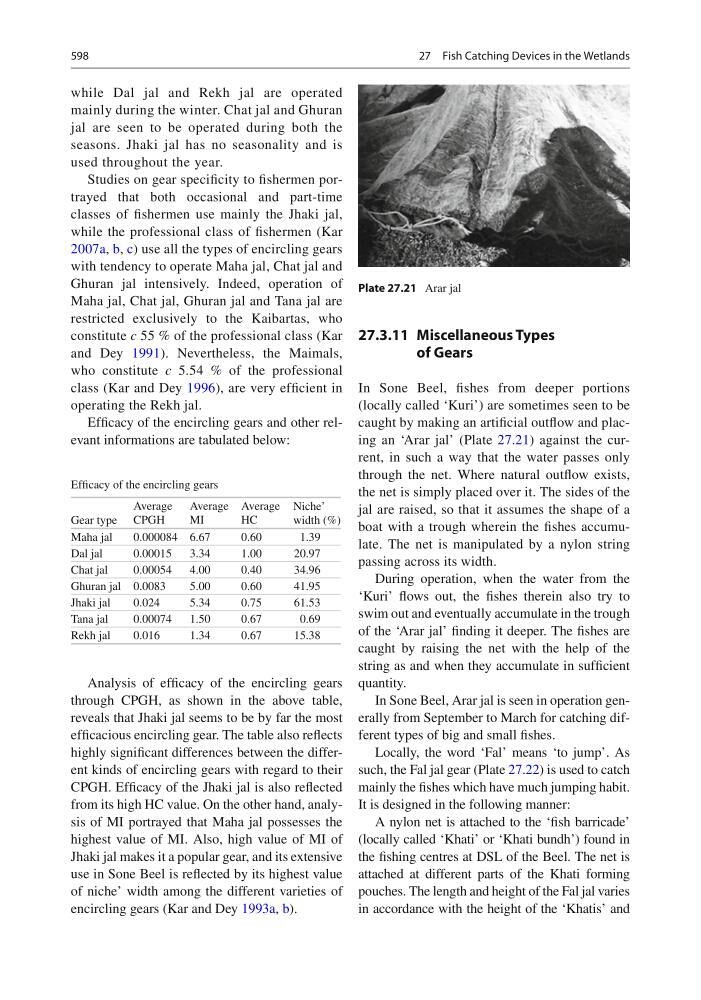
caught by making an artifi cial outfl ow and placing an ‘Arar jal’ (Plate 27.21 ) against the current, in such a way that the water passes only
through the net. Where natural outfl ow exists,
the net is simply placed over it. The sides of the
jal are raised, so that it assumes the shape of a
boat with a trough wherein the fi shes accumulate. The net is manipulated by a nylon string
passing across its width.
During operation, when the water from the
‘Kuri’ fl ows out, the fi shes therein also try to
swim out and eventually accumulate in the trough
of the ‘Arar jal’ fi nding it deeper. The fi shes are
caught by raising the net with the help of the
string as and when they accumulate in suffi cient
quantity.
In Sone Beel, Arar jal is seen in operation generally from September to March for catching different types of big and small fi shes.
Locally, the word ‘Fal’ means ‘to jump’. As
such, the Fal jal gear (Plate 27.22 ) is used to catch
mainly the fi shes which have much jumping habit.
It is designed in the following manner:
A nylon net is attached to the ‘fi sh barricade’
(locally called ‘Khati’ or ‘Khati bundh’) found in
the fi shing centres at DSL of the Beel. The net is
attached at different parts of the Khati forming
pouches. The length and height of the Fal jal varies
in accordance with the height of the ‘Khatis’ and
Plate 27.21 Arar jal
Effi cacy of the encircling gears
Gear type
Average
CPGH
Average
MI
Average
HC
Niche’
width (%)
Maha jal
0.000084 6.67
0.60
1.39
Dal jal
0.00015
3.34
1.00
20.97
Chat jal
0.00054
4.00
0.40
34.96
Ghuran jal 0.0083
5.00
0.60
41.95
Jhaki jal
0.024
5.34
0.75
61.53
Tana jal
0.00074
1.50
0.67
0.69
Rekh jal
0.016
1.34
0.67
15.38
27 Fish Catching Devices in the Wetlands