

600
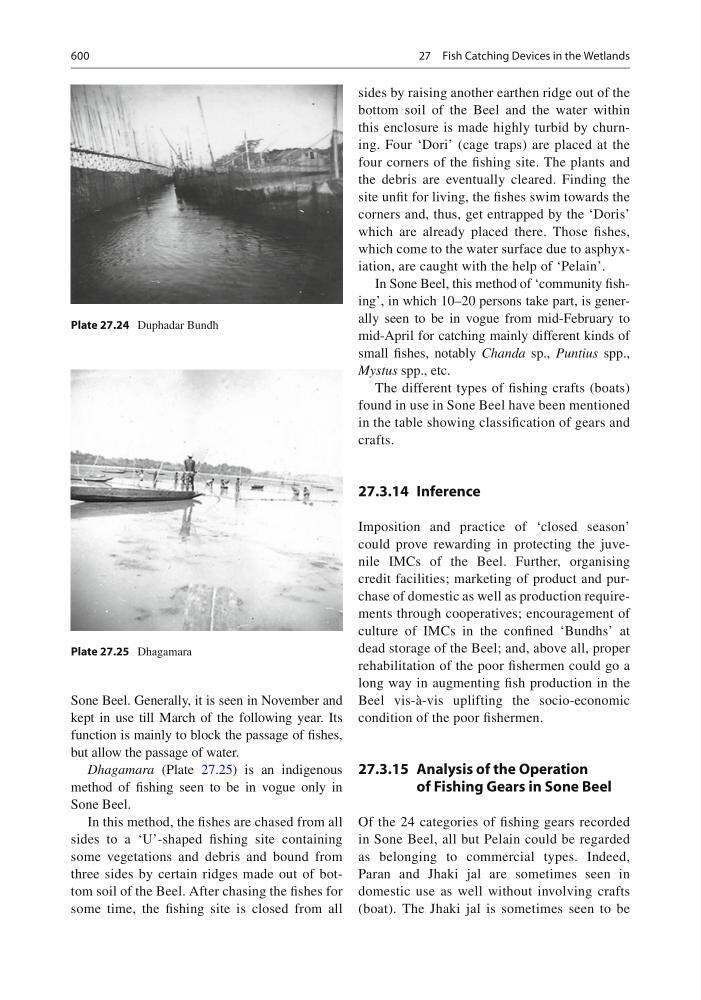
Sone Beel. Generally, it is seen in November and
kept in use till March of the following year. Its
function is mainly to block the passage of fi shes,
but allow the passage of water.
Dhagamara (Plate 27.25 ) is an indigenous
method of fi shing seen to be in vogue only in
Sone Beel.
In this method, the fi shes are chased from all
sides to a ‘U’-shaped fi shing site containing
some vegetations and debris and bound from
three sides by certain ridges made out of bottom soil of the Beel. After chasing the fi shes for
some time, the fi shing site is closed from all
sides by raising another earthen ridge out of the
bottom soil of the Beel and the water within
this enclosure is made highly turbid by churning. Four ‘Dori’ (cage traps) are placed at the
four corners of the fi shing site. The plants and
the debris are eventually cleared. Finding the
site unfi t for living, the fi shes swim towards the
corners and, thus, get entrapped by the ‘Doris’
which are already placed there. Those fi shes,
which come to the water surface due to asphyxiation, are caught with the help of ‘Pelain’.
In Sone Beel, this method of ‘community fi shing’, in which 10–20 persons take part, is generally seen to be in vogue from mid-February to
mid-April for catching mainly different kinds of
small fi shes, notably Chanda sp., Puntius spp.,
Mystus spp., etc.
The different types of fi shing crafts (boats)
found in use in Sone Beel have been mentioned
in the table showing classifi cation of gears and
crafts.
27.3.14 Inference
Imposition and practice of ‘closed season’
could prove rewarding in protecting the juvenile IMCs of the Beel. Further, organising
credit facilities; marketing of product and purchase of domestic as well as production requirements through cooperatives; encouragement of
culture of IMCs in the confi ned ‘Bundhs’ at
dead storage of the Beel; and, above all, proper
rehabilitation of the poor fi shermen could go a
long way in augmenting fi sh production in the
Beel vis-à-vis uplifting the socio-economic
condition of the poor fi shermen.
27.3.15 Analysis of the Operation
of Fishing Gears in Sone Beel
Of the 24 categories of fi shing gears recorded
in Sone Beel, all but Pelain could be regarded
as belonging to commercial types. Indeed,
Paran and Jhaki jal are sometimes seen in
domestic use as well without involving crafts
(boat). The Jhaki jal is sometimes seen to be
Plate 27.24 Duphadar Bundh
Plate 27.25 Dhagamara
27 Fish Catching Devices in the Wetlands