

593
27.3.8 Impact of Gill Nets on the
Fishery of Sone Beel
Dey and Kar ( 1990 ) reported that catch by Patan
jal consist, on average, of 0.01 % of Labeo spp.,
0.083 % of Wallago attu , 0.012 % of Hilsa
( Tenualosa ) ilisha , 0.23 % of Channa striata and
16.9 % of Puntius spp. Conversely, Haran jal
hauls usually include 0.004 % of Sperata seenghala and 0.018 % of Mastacembelus armatus in
addition to 18.4 % of trash fi shes. This indicates
that judicious use of gill nets could help in harvesting good quantity of trash fi shes from the
Beel. Moreover, exploitation of the predatory catfi shes, which are quite vulnerable to gill nets,
could give scope to the IMCs to breed and thrive
in large numbers.
27.3.9 Cost-Return Analysis
and Effi cacy of Gill Nets
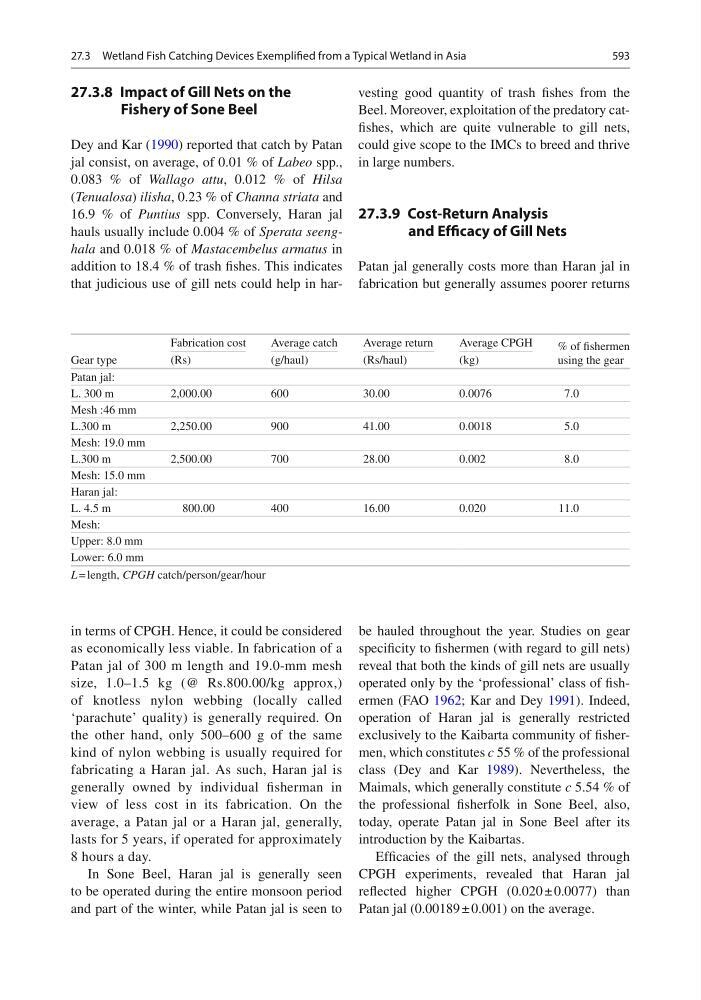
Patan jal generally costs more than Haran jal in
fabrication but generally assumes poorer returns
in terms of CPGH. Hence, it could be considered
as economically less viable. In fabrication of a
Patan jal of 300 m length and 19.0-mm mesh
size, 1.0–1.5 kg (@ Rs.800.00/kg approx,)
of knotless nylon webbing (locally called
‘parachute’ quality) is generally required. On
the other hand, only 500–600 g of the same
kind of nylon webbing is usually required for
fabricating a Haran jal. As such, Haran jal is
generally owned by individual fi sherman in
view of less cost in its fabrication. On the
average, a Patan jal or a Haran jal, generally,
lasts for 5 years, if operated for approximately
8 hours a day.
In Sone Beel, Haran jal is generally seen
to be operated during the entire monsoon period
and part of the winter, while Patan jal is seen to
be hauled throughout the year. Studies on gear
specifi city to fi shermen (with regard to gill nets)
reveal that both the kinds of gill nets are usually
operated only by the ‘professional’ class of fi shermen (FAO 1962 ; Kar and Dey 1991 ). Indeed,
operation of Haran jal is generally restricted
exclusively to the Kaibarta community of fi shermen, which constitutes c 55 % of the professional
class (Dey and Kar 1989 ). Nevertheless, the
Maimals, which generally constitute c 5.54 % of
the professional fi sherfolk in Sone Beel, also,
today, operate Patan jal in Sone Beel after its
introduction by the Kaibartas.
Effi cacies of the gill nets, analysed through
CPGH experiments, revealed that Haran jal
refl ected higher CPGH (0.020 ± 0.0077) than
Patan jal (0.00189 ± 0.001) on the average.
Fabrication cost
Average catch
Average return
Average CPGH
% of fi shermen
using the gear
Gear type
(Rs)
(g/haul)
(Rs/haul)
(kg)
Patan jal:
L. 300 m
2,000.00
600
30.00
0.0076
7.0
Mesh :46 mm
L.300 m
2,250.00
900
41.00
0.0018
5.0
Mesh: 19.0 mm
L.300 m
2,500.00
700
28.00
0.002
8.0
Mesh: 15.0 mm
Haran jal:
L. 4.5 m
800.00
400
16.00
0.020
11.0
Mesh:
Upper: 8.0 mm
Lower: 6.0 mm
L = length, CPGH catch/person/gear/hour
27.3 Wetland Fish Catching Devices Exemplifi ed from a Typical Wetland in Asia