

592
27.3.7 Entangling Gears
These are popularly called ‘gill nets’ and locally
called ‘Patan jal’ and ‘Haran jal’. In Sone Beel,
these were introduced by the Kaibarta community of fi shermen during the 1950s (Dey and Kar
1989 ). Nevertheless, today, fi shermen belonging
to other communities of fi shermen do also use the
gill nets in Sone Beel (Kar and Dey 1991 ).
The principal types of gill nets, seen in operation in Sone Beel, are briefl y described below:
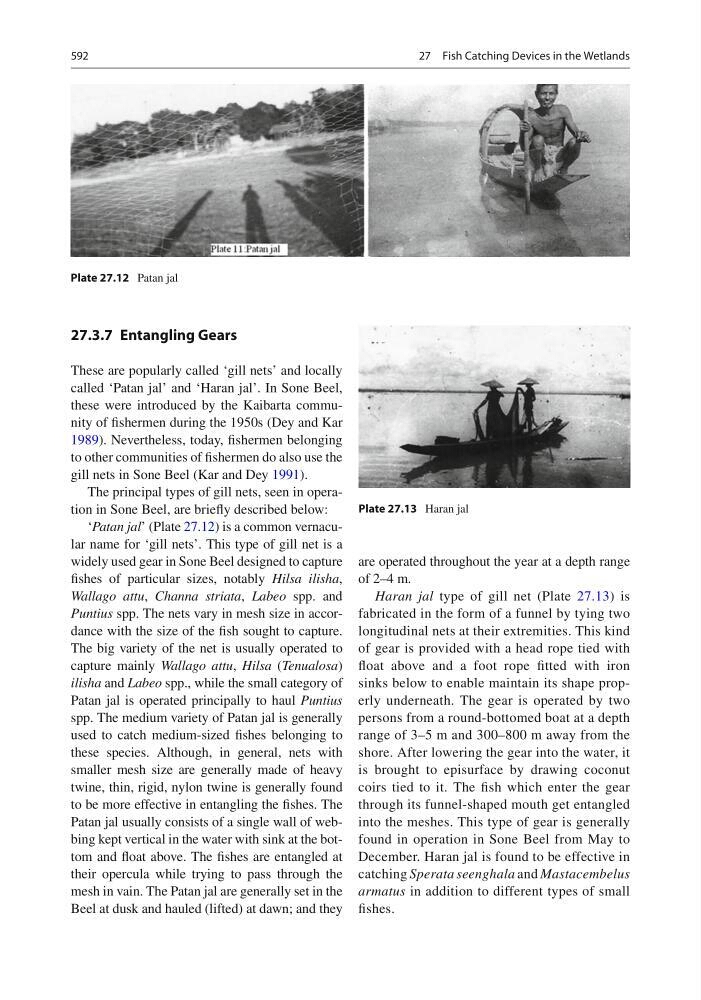
‘ Patan jal ’ (Plate 27.12 ) is a common vernacular name for ‘gill nets’. This type of gill net is a
widely used gear in Sone Beel designed to capture
fi shes of particular sizes, notably Hilsa ilisha ,
Wallago attu , Channa striata , Labeo spp. and
Puntius spp. The nets vary in mesh size in accordance with the size of the fi sh sought to capture.
The big variety of the net is usually operated to
capture mainly Wallago attu , Hilsa ( Tenualosa )
ilisha and Labeo spp., while the small category of
Patan jal is operated principally to haul Puntius
spp. The medium variety of Patan jal is generally
used to catch medium-sized fi shes belonging to
these species. Although, in general, nets with
smaller mesh size are generally made of heavy
twine, thin, rigid, nylon twine is generally found
to be more effective in entangling the fi shes. The
Patan jal usually consists of a single wall of webbing kept vertical in the water with sink at the bottom and fl oat above. The fi shes are entangled at
their opercula while trying to pass through the
mesh in vain. The Patan jal are generally set in the
Beel at dusk and hauled (lifted) at dawn; and they
are operated throughout the year at a depth range
of 2–4 m.
Haran jal type of gill net (Plate 27.13 ) is
fabricated in the form of a funnel by tying two
longitudinal nets at their extremities. This kind
of gear is provided with a head rope tied with
fl oat above and a foot rope fi tted with iron
sinks below to enable maintain its shape properly underneath. The gear is operated by two
persons from a round-bottomed boat at a depth
range of 3–5 m and 300–800 m away from the
shore. After lowering the gear into the water, it
is brought to episurface by drawing coconut
coirs tied to it. The fi sh which enter the gear
through its funnel- shaped mouth get entangled
into the meshes. This type of gear is generally
found in operation in Sone Beel from May to
December. Haran jal is found to be effective in
catching Sperata seenghala and Mastacembelus
armatus in addition to different types of small
fi shes.
Plate 27.12 Patan jal
Plate 27.13 Haran jal
27 Fish Catching Devices in the Wetlands