

591
Macrobrachium sp. from Sone Beel. This gear is
also totally ineffective to LGF.
Investment-return analysis of the scooping
gears, as given below, show that among the three
scooping gears, Dheki jal costs the highest in its
fabrication, but accounted for poor return in terms
of CPGH, thus portraying economically less viable. Conversely, Kuchrung jal costs the least but
found to have high CPGH and more viability in
terms of its economics. This is also refl ected by
the highest % of fi shermen operating this gear.
In Sone Beel, the scooping gears also exhibit
seasonality in their operation. Dorar jal is the
monsoon variety. Kuchrung jal has no seasonality and is operated throughout the year. Studies
on gear specifi city to fi shermen revealed that
both the occasional and part-time classes of fi shermen (Dey and Kar 1989 ) use mainly the Dheki
jal and the Dorar jal, while the professional class
of fi shermen use all the three types of scooping
gears with a tendency towards extensive operation of the Kuchrung jal being restricted to the
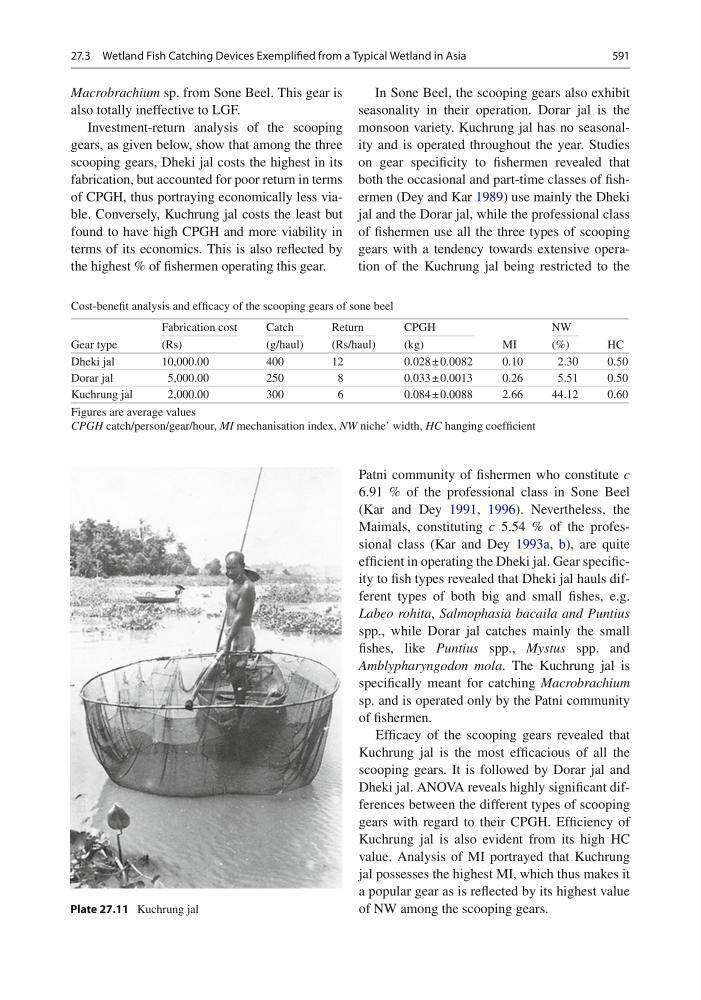
Plate 27.11 Kuchrung jal
Patni community of fi shermen who constitute c
6.91 % of the professional class in Sone Beel
(Kar and Dey 1991 , 1996 ). Nevertheless, the
Maimals, constituting c 5.54 % of the professional class (Kar and Dey 1993a , b ), are quite
effi cient in operating the Dheki jal. Gear specifi city to fi sh types revealed that Dheki jal hauls different types of both big and small fi shes, e.g.
Labeo rohita , Salmophasia bacaila and Puntius
spp., while Dorar jal catches mainly the small
fi shes, like Puntius spp., Mystus spp. and
Amblypharyngodon mola . The Kuchrung jal is
specifi cally meant for catching Macrobrachium
sp. and is operated only by the Patni community
of fi shermen.
Effi cacy of the scooping gears revealed that
Kuchrung jal is the most effi cacious of all the
scooping gears. It is followed by Dorar jal and
Dheki jal. ANOVA reveals highly signifi cant differences between the different types of scooping
gears with regard to their CPGH. Effi ciency of
Kuchrung jal is also evident from its high HC
value. Analysis of MI portrayed that Kuchrung
jal possesses the highest MI, which thus makes it
a popular gear as is refl ected by its highest value
of NW among the scooping gears.
Cost-benefi t analysis and effi cacy of the scooping gears of sone beel
Fabrication cost
Catch
Return
CPGH
NW
Gear type
(Rs)
(g/haul)
(Rs/haul)
(kg)
MI
(%)
HC
Dheki jal
10,000.00
400
12
0.028 ± 0.0082
0.10
2.30
0.50
Dorar jal
5,000.00
250
8
0.033 ± 0.0013
0.26
5.51
0.50
Kuchrung jal
2,000.00
300
6
0.084 ± 0.0088
2.66
44.12
0.60
Figures are average values
CPGH catch/person/gear/hour, MI mechanisation index, NW niche’ width, HC hanging coeffi cient
27.3 Wetland Fish Catching Devices Exemplifi ed from a Typical Wetland in Asia