

590
ties of fi shermen since very ancient times for
exploiting the fi sh resources of the Beel (Kar
1990 ). The fi shermen belonging to the Kaibarta
community had migrated into Sone Beel during
the 1950s. They did not adopt this traditional
method of fi shing.
An account of the three types of scooping
gears in Sone Beel is given below:
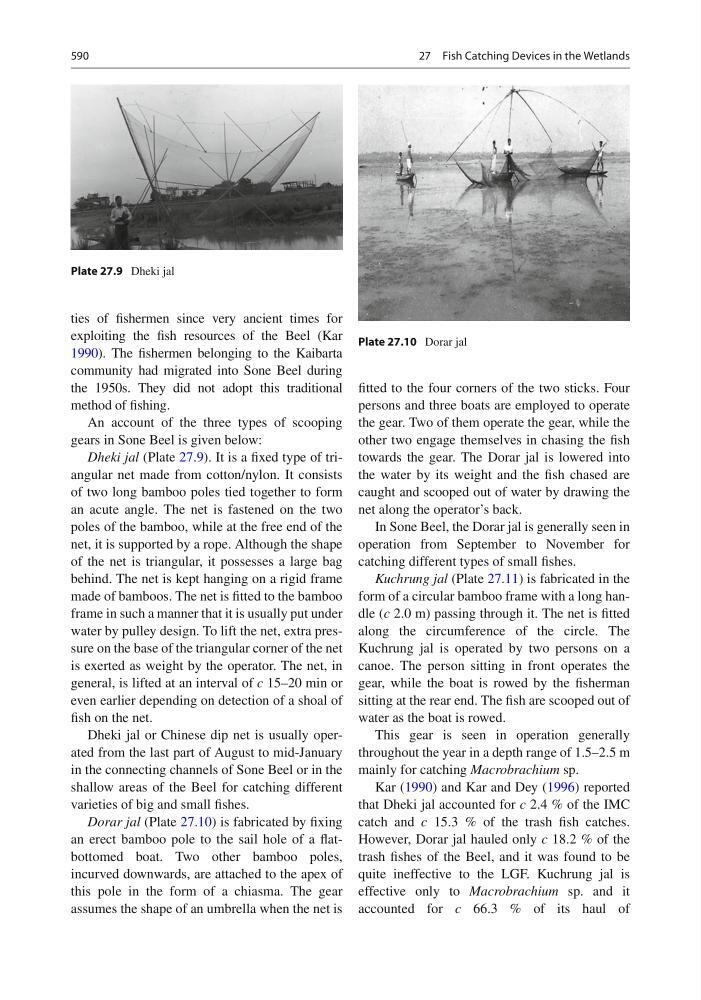
Dheki jal (Plate 27.9 ). It is a fi xed type of triangular net made from cotton/nylon. It consists
of two long bamboo poles tied together to form
an acute angle. The net is fastened on the two
poles of the bamboo, while at the free end of the
net, it is supported by a rope. Although the shape
of the net is triangular, it possesses a large bag
behind. The net is kept hanging on a rigid frame
made of bamboos. The net is fi tted to the bamboo
frame in such a manner that it is usually put under
water by pulley design. To lift the net, extra pressure on the base of the triangular corner of the net
is exerted as weight by the operator. The net, in
general, is lifted at an interval of c 15–20 min or
even earlier depending on detection of a shoal of
fi sh on the net.
Dheki jal or Chinese dip net is usually operated from the last part of August to mid-January
in the connecting channels of Sone Beel or in the
shallow areas of the Beel for catching different
varieties of big and small fi shes.
Dorar jal (Plate 27.10 ) is fabricated by fi xing
an erect bamboo pole to the sail hole of a fl atbottomed boat. Two other bamboo poles,
incurved downwards, are attached to the apex of
this pole in the form of a chiasma. The gear
assumes the shape of an umbrella when the net is
fi tted to the four corners of the two sticks. Four
persons and three boats are employed to operate
the gear. Two of them operate the gear, while the
other two engage themselves in chasing the fi sh
towards the gear. The Dorar jal is lowered into
the water by its weight and the fi sh chased are
caught and scooped out of water by drawing the
net along the operator’s back.
In Sone Beel, the Dorar jal is generally seen in
operation from September to November for
catching different types of small fi shes.
Kuchrung jal (Plate 27.11 ) is fabricated in the
form of a circular bamboo frame with a long handle ( c 2.0 m) passing through it. The net is fi tted
along the circumference of the circle. The
Kuchrung jal is operated by two persons on a
canoe. The person sitting in front operates the
gear, while the boat is rowed by the fi sherman
sitting at the rear end. The fi sh are scooped out of
water as the boat is rowed.
This gear is seen in operation generally
throughout the year in a depth range of 1.5–2.5 m
mainly for catching Macrobrachium sp.
Kar ( 1990 ) and Kar and Dey ( 1996 ) reported
that Dheki jal accounted for c 2.4 % of the IMC
catch and c 15.3 % of the trash fi sh catches.
However, Dorar jal hauled only c 18.2 % of the
trash fi shes of the Beel, and it was found to be
quite ineffective to the LGF. Kuchrung jal is
effective only to Macrobrachium sp. and it
accounted for c 66.3 % of its haul of
Plate 27.9 Dheki jal
Plate 27.10 Dorar jal
27 Fish Catching Devices in the Wetlands