

594
27.3.10 Encircling Gears
The encircling gears in Sone Beel have been
introduced by the Kaibarta community of fi shermen during the early 1950s (Kar 1990 ). The fi shermen belonging to the other communities,
namely, the Patnis, the Maimals and the
Namasudras, had no knowledge of the mechanisation of the gears before initiation by the
Kaibartas (Dey and Kar 1989 ).
The seven different types of encircling gears
are seen in operation in Sone Beel. These are
briefl y described below:
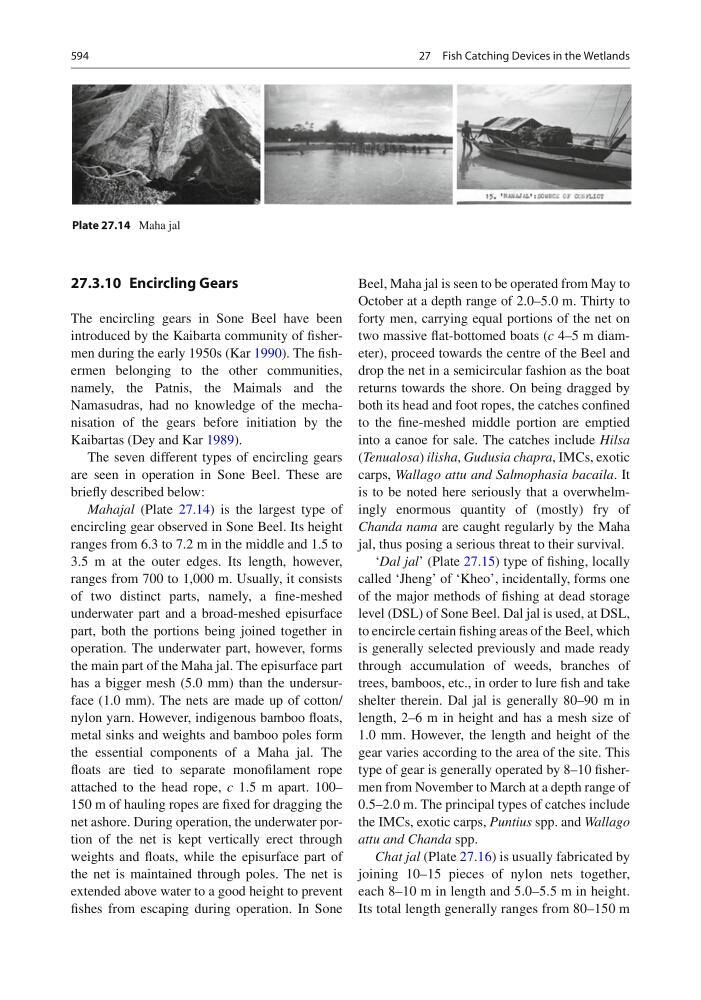
Mahajal (Plate 27.14 ) is the largest type of
encircling gear observed in Sone Beel. Its height
ranges from 6.3 to 7.2 m in the middle and 1.5 to
3.5 m at the outer edges. Its length, however,
ranges from 700 to 1,000 m. Usually, it consists
of two distinct parts, namely, a fi ne-meshed
underwater part and a broad-meshed episurface
part, both the portions being joined together in
operation. The underwater part, however, forms
the main part of the Maha jal. The episurface part
has a bigger mesh (5.0 mm) than the undersurface (1.0 mm). The nets are made up of cotton/
nylon yarn. However, indigenous bamboo fl oats,
metal sinks and weights and bamboo poles form
the essential components of a Maha jal. The
fl oats are tied to separate monofi lament rope
attached to the head rope, c 1.5 m apart. 100–
150 m of hauling ropes are fi xed for dragging the
net ashore. During operation, the underwater portion of the net is kept vertically erect through
weights and fl oats, while the episurface part of
the net is maintained through poles. The net is
extended above water to a good height to prevent
fi shes from escaping during operation. In Sone
Beel, Maha jal is seen to be operated from May to
October at a depth range of 2.0–5.0 m. Thirty to
forty men, carrying equal portions of the net on
two massive fl at-bottomed boats ( c 4–5 m diameter), proceed towards the centre of the Beel and
drop the net in a semicircular fashion as the boat
returns towards the shore. On being dragged by
both its head and foot ropes, the catches confi ned
to the fi ne-meshed middle portion are emptied
into a canoe for sale. The catches include Hilsa
( Tenualosa ) ilisha , Gudusia chapra , IMCs, exotic
carps, Wallago attu and Salmophasia bacaila . It
is to be noted here seriously that a overwhelmingly enormous quantity of (mostly) fry of
Chanda nama are caught regularly by the Maha
jal, thus posing a serious threat to their survival.
‘ Dal jal ’ (Plate 27.15 ) type of fi shing, locally
called ‘Jheng’ of ‘Kheo’, incidentally, forms one
of the major methods of fi shing at dead storage
level (DSL) of Sone Beel. Dal jal is used, at DSL,
to encircle certain fi shing areas of the Beel, which
is generally selected previously and made ready
through accumulation of weeds, branches of
trees, bamboos, etc., in order to lure fi sh and take
shelter therein. Dal jal is generally 80–90 m in
length, 2–6 m in height and has a mesh size of
1.0 mm. However, the length and height of the
gear varies according to the area of the site. This
type of gear is generally operated by 8–10 fi shermen from November to March at a depth range of
0.5–2.0 m. The principal types of catches include
the IMCs, exotic carps, Puntius spp. and Wallago
attu and Chanda spp.
Chat jal (Plate 27.16 ) is usually fabricated by
joining 10–15 pieces of nylon nets together,
each 8–10 m in length and 5.0–5.5 m in height.
Its total length generally ranges from 80–150 m
Plate 27.14 Maha jal
27 Fish Catching Devices in the Wetlands