

538
in size of about 1 m every year. Lake Chad has
no apparent outlet, but its water percolates into
the Soro and Bodélé depressions. The climate is
dry during most part of the year with occasional
rains from June to October.
24.3.7 History
Lake Chad gave its name to the country of Chad.
The name Chad is a local word meaning ‘large
expanse of water’, in other words, a ‘lake’. Lake
Chad is believed to be a remnant of a former
inland sea which has grown and reduced with
changes in climate over the past 13,000 years.
Probably, it had a water spread area of
400,000 km
2 , around 4000 BCE. Lake sediments
appear to indicate that Lake Chad had almost
completely dried up during the dry periods
around 8500 BC, 5500 BC, 2000 BC and 100 BC
and then again in 1908 and, of late, in 1984. As it
retreats every summer, recessional agriculture is
practiced. Nevertheless, the Buduma people fi sh
in the lake with canoes.
It was considered to be one of the largest lakes
in the world when fi rst surveyed by Europeans in
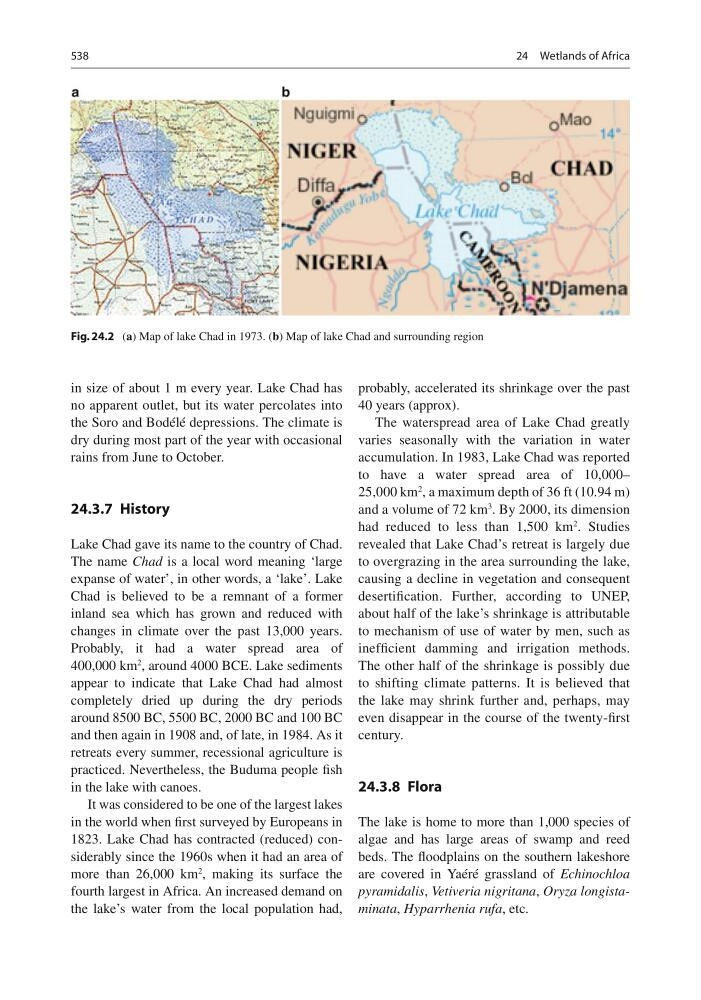
1823. Lake Chad has contracted (reduced) considerably since the 1960s when it had an area of
more than 26,000 km
2 , making its surface the
fourth largest in Africa. An increased demand on
the lake’s water from the local population had,
probably, accelerated its shrinkage over the past
40 years (approx).
The waterspread area of Lake Chad greatly
varies seasonally with the variation in water
accumulation. In 1983, Lake Chad was reported
to have a water spread area of 10,000–
25,000 km
2 , a maximum depth of 36 ft (10.94 m)
and a volume of 72 km
3 . By 2000, its dimension
had reduced to less than 1,500 km
2 . Studies
revealed that Lake Chad’s retreat is largely due
to overgrazing in the area surrounding the lake,
causing a decline in vegetation and consequent
desertifi cation. Further, according to UNEP,
about half of the lake’s shrinkage is attributable
to mechanism of use of water by men, such as
ineffi cient damming and irrigation methods.
The other half of the shrinkage is possibly due
to shifting climate patterns. It is believed that
the lake may shrink further and, perhaps, may
even disappear in the course of the twenty-fi rst
century.
24.3.8 Flora
The lake is home to more than 1,000 species of
algae and has large areas of swamp and reed
beds. The fl oodplains on the southern lakeshore
are covered in Yaéré grassland of Echinochloa
pyramidalis , Vetiveria nigritana , Oryza longistaminata , Hyparrhenia rufa , etc.
Fig. 24.2 ( a ) Map of lake Chad in 1973. ( b ) Map of lake Chad and surrounding region
24 Wetlands of Africa