

539
24.3.9 Fauna
There are many fl oating islands in the lake. It is
home to a wide variety of wildlife, including hippopotamus, crocodile (both on decline here) and
large communities of migratory birds including
wintering ducks, ruff ( Philomachus pugnax ) and
other waterfowls and shore birds. There are two
near-endemic birds, namely, River Prinia ( Prinia
fl uviatilis ) and the Rusty Lark ( Mirafra rufa ).
However, the shrinking of the lake is threatening
nesting sites of the Black Crowned Crane
( Balearica pavonina pavonina ). As could be
expected, during the wet season, the fi shes migrate
into the mineral-rich lake to breed and fi nd food.
24.3.10 Threats and Preservation
The UN Food and Agriculture Organization
(FAO) has labelled the lake as an ecological
catastrophe due to its alarming way of shrinkage during the recent decades. A number of
species are stressed and threatened due to
declining lake levels caused mainly by unsustainable extraction of Lake Chad water by the
growing human population. Notwithstanding
the above, the entire Lake Chad has been
declared a Ramsar site of international importance. In spite of this, the shrinking of the lake
area has also given rise to intercountry confl icts
about the right to use the remaining water. The
fi shermen, however, want the remaining water
in the lake to stay so that they can continue to
fi sh without any strain in the supply of fi sh.
Furthermore, with declining fi sh population,
the birds and other animals in the area could be
threatened, as the fi shes are important sources
of food for them. The human population, nevertheless, could also be affected with regard to
their nutrition and avocation.
24.3.11 Diversion Proposal
In view of the above, there was a proposal
(possibly in the 1960s) to divert the Ubangi River
into Lake Chad. The copious amount of water
from the Ubangi could have revitalised the dying
Lake Chad and provide livelihood in fi shing and
enhanced agriculture to tens of millions of central Africans and Sahelians.
24.4 Wetlands of Botswana
The wetlands in Botswana have a signifi cant
impact on the livelihood of the people. An
account is given below.
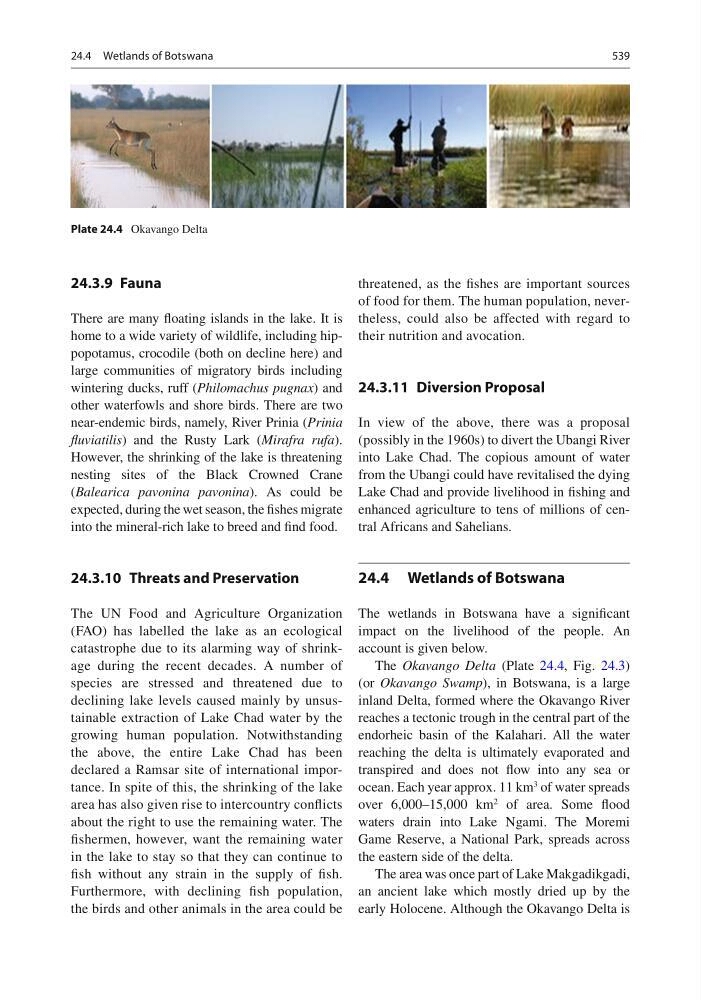
The Okavango Delta (Plate 24.4 , Fig. 24.3 )
(or Okavango Swamp ), in Botswana, is a large
inland Delta, formed where the Okavango River
reaches a tectonic trough in the central part of the
endorheic basin of the Kalahari. All the water
reaching the delta is ultimately evaporated and
transpired and does not fl ow into any sea or
ocean. Each year approx. 11 km
3 of water spreads
over 6,000–15,000 km
2 of area. Some fl ood
waters drain into Lake Ngami. The Moremi
Game Reserve, a National Park, spreads across
the eastern side of the delta.
The area was once part of Lake Makgadikgadi,
an ancient lake which mostly dried up by the
early Holocene. Although the Okavango Delta is
Plate 24.4 Okavango Delta
24.4 Wetlands of Botswana