

536
24.3 Wetlands of Nigeria
There are large number of lentic bodies in
Nigeria. An account is given below.
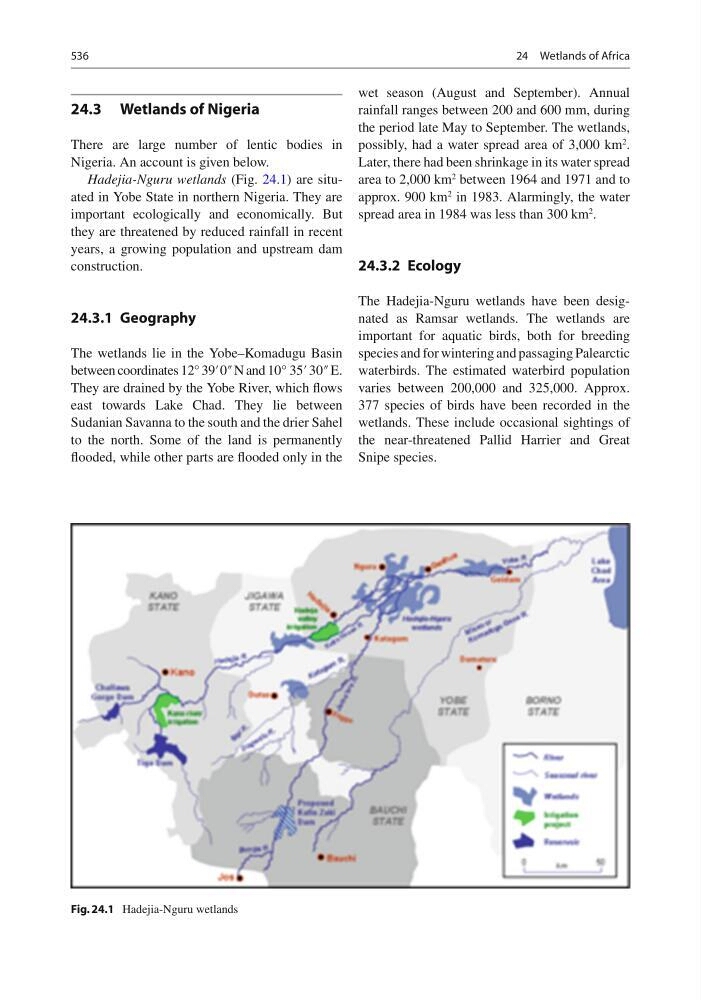
Hadejia-Nguru wetlands (Fig. 24.1 ) are situated in Yobe State in northern Nigeria. They are
important ecologically and economically. But
they are threatened by reduced rainfall in recent
years, a growing population and upstream dam
construction.
24.3.1 Geography
The wetlands lie in the Yobe–Komadugu Basin
between coordinates 12° 39′ 0″ N and 10° 35′ 30″ E.
They are drained by the Yobe River, which fl ows
east towards Lake Chad. They lie between
Sudanian Savanna to the south and the drier Sahel
to the north. Some of the land is permanently
fl ooded, while other parts are fl ooded only in the
wet season (August and September). Annual
rainfall ranges between 200 and 600 mm, during
the period late May to September. The wetlands,
possibly, had a water spread area of 3,000 km
2 .
Later, there had been shrinkage in its water spread
area to 2,000 km
2 between 1964 and 1971 and to
approx. 900 km
2 in 1983. Alarmingly, the water
spread area in 1984 was less than 300 km
2 .
24.3.2 Ecology
The Hadejia-Nguru wetlands have been designated as Ramsar wetlands. The wetlands are
important for aquatic birds, both for breeding
species and for wintering and passaging Palearctic
waterbirds. The estimated waterbird population
varies between 200,000 and 325,000. Approx.
377 species of birds have been recorded in the
wetlands. These include occasional sightings of
the near-threatened Pallid Harrier and Great
Snipe species.
Fig. 24.1 Hadejia-Nguru wetlands
24 Wetlands of Africa