

535
that live there are the Blue-breasted Bee- eater,
the Papyrus Gonolek, the Swamp Flycatcher, the
Papyrus Canary, the White- winged Warbler, the
Great Snapper and the Baillon’s Crake.
24.2.1 Lake Bogoria
It is a shallow saline, alkaline, meromictic lake,
situated at 990 m MSL between 0° 15′ N 36° 06′ E
and lies in a volcanic region in a half-graben
basin south of Lake Baringo, Kenya, a little north
of the equator. It has a maximum length, breadth
and depth of 34 km, 3.5 km and 10 m (approx.),
respectively. It has a catchment area of 700 ha,
and its primary infl ows are the rivers Sandai and
Emsos. Lake Bogoria, like the lakes Nakuru,
Elmenteita, Magadi and Logipi, is sometimes
considered as home for one of the world’s largest
populations of lesser fl amingos. The lake is a
Ramsar site and has been a protected National
Reserve since 29 November 1973. The reserve is
also famous for its geysers and hot springs.
The lake waters contain large concentrations
of Na
+ , HCO 3
− and CO 3
2− ions. They originate
from infl ow from the Sandai and Emsos rivers
and from about 200 alkaline hot springs that are
present at three onshore sites. Other springs discharge directly from the lake fl oor. Lake Bogoria
also contains the highest concentration of true
geysers in Africa (at least 18 are known). The
lake water is alkaline (pH:10.5) and saline (total
dissolved salts up to 100 g/l). The lake has no surface outlet. So the water becomes saline mainly
through evaporation, which is high in this semiarid region. The lake itself is meromictic (stratifi ed) with less dense surface waters lying on a
denser more saline bottom waters. Although
hypersaline, the lake is highly productive with
abundant cyanobacteria ( Arthrospira fusiformis )
which feed the fl amingos, but few other organisms also inhabit the lake.
Nevertheless, sediment cores from the lake
fl oor have shown that freshwater conditions
existed for quite a long period during the past
10,000 years and that lake level was up to about
9 m higher than its present level of about 990 m
above sea level. At times, it might have overfl owed northward towards Lake Baringo.
Further, at certain point of time during the late
Pleistocene, it might have been united with a
larger precursor of modern Lake Baringo, but
this is still uncertain.
The lake area was the traditional home of the
Endorois people, who were forced to leave the
area in the 1970s and are now challenging their
removal at the African Commission on Human
and Peoples’ Rights.
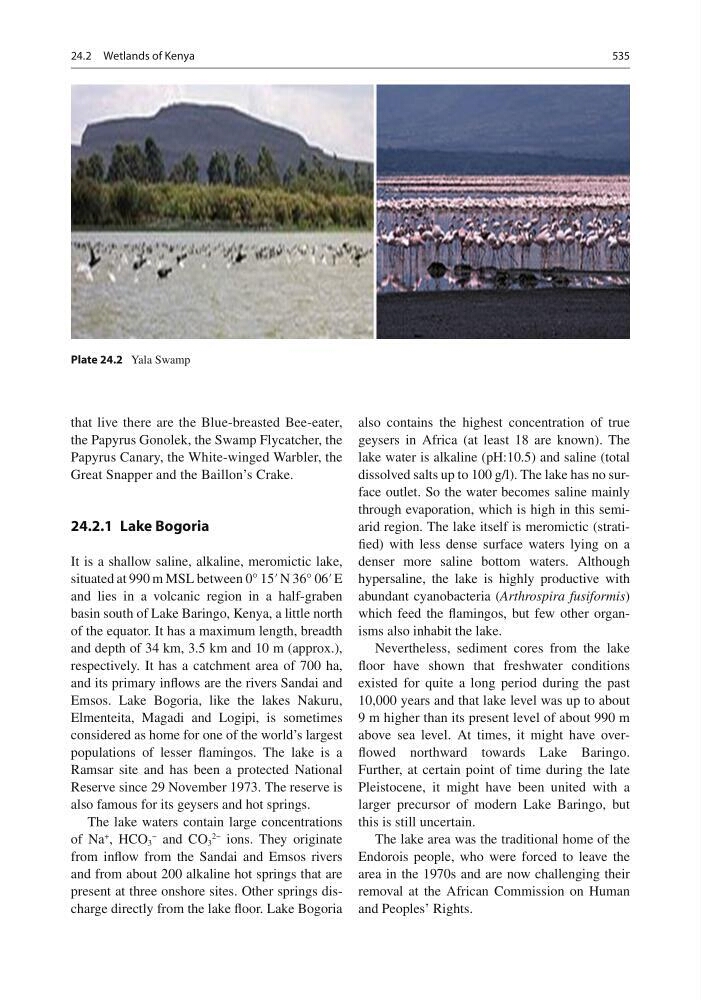
Plate 24.2 Yala Swamp
24.2 Wetlands of Kenya