

534
the mud fl ats. It is amazing to note that, in addition
to the fl amingos, an endemic species of fi sh, the
alkaline tilapia ( Oreochromis alcalicus ), thrives in
the waters at the edges of the hot spring inlets.
24.1.3 Threats and Preservation
A new threat to Lake Natron is the proposed construction of a soda ash plant on its shores. The
plant would pump water from the lake and would
extract the sodium carbonate to convert to washing powder for export. Accompanying the plant
would be housing for > (more than) 1,000 workers and a coal-fi red power station to provide
energy for the plant complex. Further, there could
be a possibility that the developers may introduce
a hybrid brine shrimp to increase the effi ciency of
extraction. According to Chris Magin, the
RSPB’s international offi cer for Africa, there is
less chance of the lesser fl amingos continuing to
breed in Natron wetland in the face of such hazards and the birds may face extinction in East
Africa. Currently a group of 20 East African conservation and environmental institutions are running a worldwide campaign to stop the planned
construction of the soda ash factory by Tata
Chemicals Ltd of Mumbai, India, and National
Development Corporation of Tanzania. The
group working under the umbrella name Lake
Natron Consultative Group is being coordinated
by Ken Mwathe, Head of Ecology at African
Conservation Centre.
Because of its unique biodiversity, Tanzania
named the Lake Natron Basin to the Ramsar List
of Wetlands of International Importance on 4
July 2001. The wetland is also the World Wildlife
Fund East African halophytics ecoregion.
24.2 Wetlands of Kenya
In Kenya, there are a number of lentic bodies. An
account is given below.
The Yala Swamp (Plate 24.2 ) situated
between 0° 02′ 18″ N and 34° 04′ 01″ E is a c
20,000 ha wetland in western Kenya. The wetland covers the northeastern shore of Lake
Victoria in Siaya, Bondo and Busia districts in
Kenya. It acts as a fi lter for waters that fl ow into
Lake Victoria from two major rivers. It is sometimes considered as the source of the River Nile.
The swamp harbours endangered fi sh species
like Oreochromis esculentus and Oreochromis
variabilis that have disappeared from Lake
Victoria itself. The critically endangered sitatunga antelope ( Tragelaphus spekii ) still lives in
the swamp’s papyrus. Bird Life International
classifi es the Yala Swamp amongst Kenya’s
sixty Important Bird Areas . Some of the birds
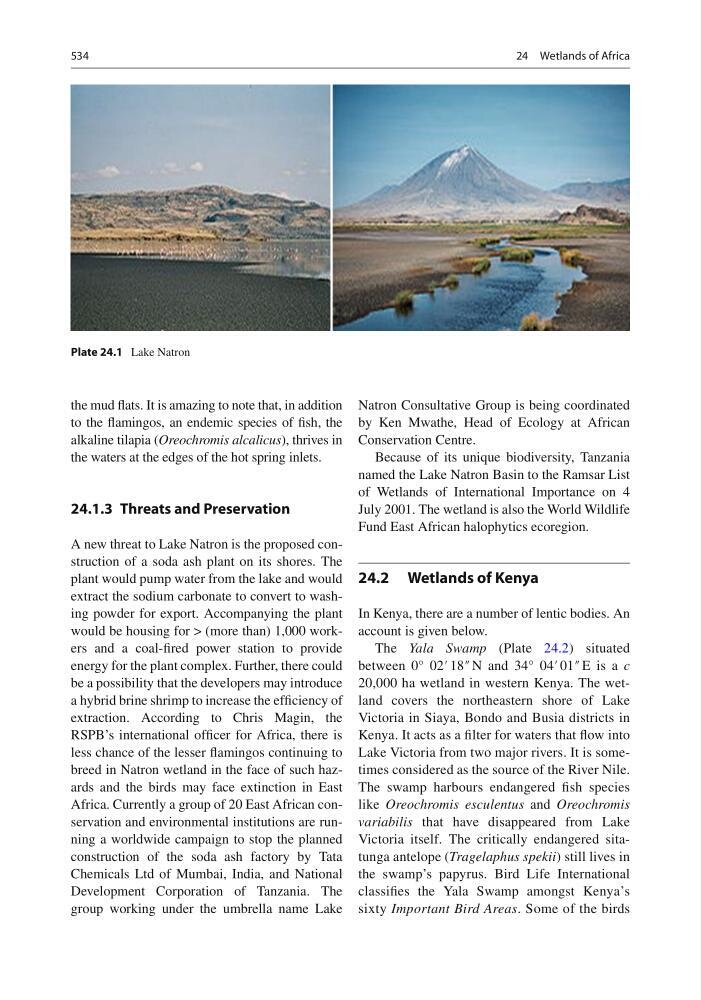
Plate 24.1 Lake Natron
24 Wetlands of Africa