

515
23.4 Wetlands of Mexico
In Mexico, there are many wetlands. An account
is given below.
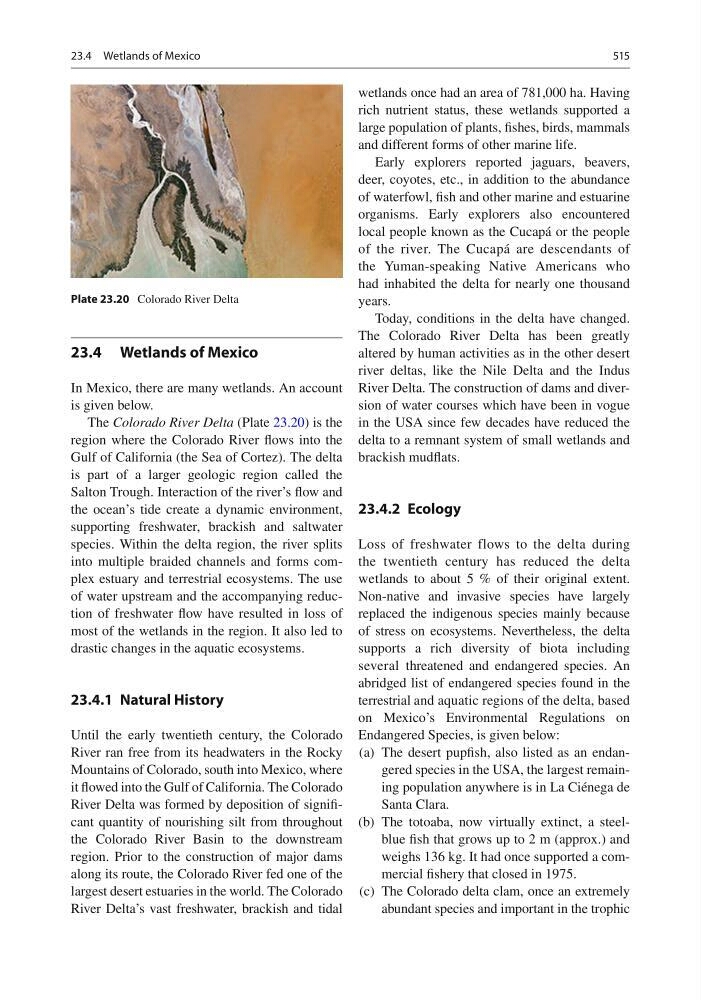
The Colorado River Delta (Plate 23.20 ) is the
region where the Colorado River fl ows into the
Gulf of California (the Sea of Cortez). The delta
is part of a larger geologic region called the
Salton Trough. Interaction of the river’s fl ow and
the ocean’s tide create a dynamic environment,
supporting freshwater, brackish and saltwater
species. Within the delta region, the river splits
into multiple braided channels and forms complex estuary and terrestrial ecosystems. The use
of water upstream and the accompanying reduction of freshwater fl ow have resulted in loss of
most of the wetlands in the region. It also led to
drastic changes in the aquatic ecosystems.
23.4.1 Natural History
Until the early twentieth century, the Colorado
River ran free from its headwaters in the Rocky
Mountains of Colorado, south into Mexico, where
it fl owed into the Gulf of California. The Colorado
River Delta was formed by deposition of signifi -
cant quantity of nourishing silt from throughout
the Colorado River Basin to the downstream
region. Prior to the construction of major dams
along its route, the Colorado River fed one of the
largest desert estuaries in the world. The Colorado
River Delta’s vast freshwater, brackish and tidal
wetlands once had an area of 781,000 ha . Having
rich nutrient status, these wetlands supported a
large population of plants, fi shes, birds, mammals
and different forms of other marine life.
Early explorers reported jaguars, beavers,
deer, coyotes, etc., in addition to the abundance
of waterfowl, fi sh and other marine and estuarine
organisms. Early explorers also encountered
local people known as the Cucapá or the people
of the river. The Cucapá are descendants of
the Yuman- speaking Native Americans who
had inhabited the delta for nearly one thousand
years.
Today, conditions in the delta have changed.
The Colorado River Delta has been greatly
altered by human activities as in the other desert
river deltas, like the Nile Delta and the Indus
River Delta. The construction of dams and diversion of water courses which have been in vogue
in the USA since few decades have reduced the
delta to a remnant system of small wetlands and
brackish mudfl ats.
23.4.2 Ecology
Loss of freshwater flows to the delta during
the twentieth century has reduced the delta
wetlands to about 5 % of their original extent.
Non-native and invasive species have largely
replaced the indigenous species mainly because
of stress on ecosystems. Nevertheless, the delta
supports a rich diversity of biota including
several threatened and endangered species. An
abridged list of endangered species found in the
terrestrial and aquatic regions of the delta, based
on Mexico’s Environmental Regulations on
Endangered Species, is given below:
(a) The desert pupfi sh, also listed as an endangered species in the USA, the largest remaining population anywhere is in La Ciénega de
Santa Clara.
(b) The totoaba, now virtually extinct, a steelblue fi sh that grows up to 2 m (approx.) and
weighs 136 kg. It had once supported a commercial fi shery that closed in 1975.
(c) The Colorado delta clam, once an extremely
abundant species and important in the trophic
Plate 23.20 Colorado River Delta
23.4 Wetlands of Mexico
23.4 Wetlands of Mexico
In Mexico, there are many wetlands. An account
is given below.
The Colorado River Delta (Plate 23.20 ) is the
region where the Colorado River fl ows into the
Gulf of California (the Sea of Cortez). The delta
is part of a larger geologic region called the
Salton Trough. Interaction of the river’s fl ow and
the ocean’s tide create a dynamic environment,
supporting freshwater, brackish and saltwater
species. Within the delta region, the river splits
into multiple braided channels and forms complex estuary and terrestrial ecosystems. The use
of water upstream and the accompanying reduction of freshwater fl ow have resulted in loss of
most of the wetlands in the region. It also led to
drastic changes in the aquatic ecosystems.
23.4.1 Natural History
Until the early twentieth century, the Colorado
River ran free from its headwaters in the Rocky
Mountains of Colorado, south into Mexico, where
it fl owed into the Gulf of California. The Colorado
River Delta was formed by deposition of signifi -
cant quantity of nourishing silt from throughout
the Colorado River Basin to the downstream
region. Prior to the construction of major dams
along its route, the Colorado River fed one of the
largest desert estuaries in the world. The Colorado
River Delta’s vast freshwater, brackish and tidal
wetlands once had an area of 781,000 ha . Having
rich nutrient status, these wetlands supported a
large population of plants, fi shes, birds, mammals
and different forms of other marine life.
Early explorers reported jaguars, beavers,
deer, coyotes, etc., in addition to the abundance
of waterfowl, fi sh and other marine and estuarine
organisms. Early explorers also encountered
local people known as the Cucapá or the people
of the river. The Cucapá are descendants of
the Yuman- speaking Native Americans who
had inhabited the delta for nearly one thousand
years.
Today, conditions in the delta have changed.
The Colorado River Delta has been greatly
altered by human activities as in the other desert
river deltas, like the Nile Delta and the Indus
River Delta. The construction of dams and diversion of water courses which have been in vogue
in the USA since few decades have reduced the
delta to a remnant system of small wetlands and
brackish mudfl ats.
23.4.2 Ecology
Loss of freshwater flows to the delta during
the twentieth century has reduced the delta
wetlands to about 5 % of their original extent.
Non-native and invasive species have largely
replaced the indigenous species mainly because
of stress on ecosystems. Nevertheless, the delta
supports a rich diversity of biota including
several threatened and endangered species. An
abridged list of endangered species found in the
terrestrial and aquatic regions of the delta, based
on Mexico’s Environmental Regulations on
Endangered Species, is given below:
(a) The desert pupfi sh, also listed as an endangered species in the USA, the largest remaining population anywhere is in La Ciénega de
Santa Clara.
(b) The totoaba, now virtually extinct, a steelblue fi sh that grows up to 2 m (approx.) and
weighs 136 kg. It had once supported a commercial fi shery that closed in 1975.
(c) The Colorado delta clam, once an extremely
abundant species and important in the trophic
Plate 23.20 Colorado River Delta
23.4 Wetlands of Mexico