

514
Ecology
The Wye Marsh Wildlife Centre runs a breeding
programme for trumpeter swans. The swans had
been absent from the marsh until their reintroduction by Harry Lumsden in the 1980s, who
was an employee of the Ontario Department of
Natural Resources. Archaeological evidence collected by Jesuit missionaries in the 1600s suggests that the area previously had signifi cant
concentrations of trumpeter swans, and historical
references indicate the same. They were killed by
aboriginal hunters and later by the Europeans. By
1850, only small numbers of the swan remained
in eastern Canada. Amongst Ontarians, the Wye
Marsh Wildlife Centre is known as the Home of
the Trumpeter Swan . Further, the marsh is also an
important breeding site for black terns and least
bitterns. At least 1 % of the breeding pairs of
least bitterns in Canada nest in the Wye Marsh.
Other bird species known to inhabit the marsh
include red-winged blackbirds, common grackles, brown-headed cowbirds, sandhill cranes,
common mergansers, double-crested cormorants
and great blue herons. The marsh is also known
to support large amount of wild rice, which
served as an important source of food for the
waterfowls. The introduction of carp in the early
1900s signifi cantly reduced the amount of wild
rice and consequently the number of waterfowls.
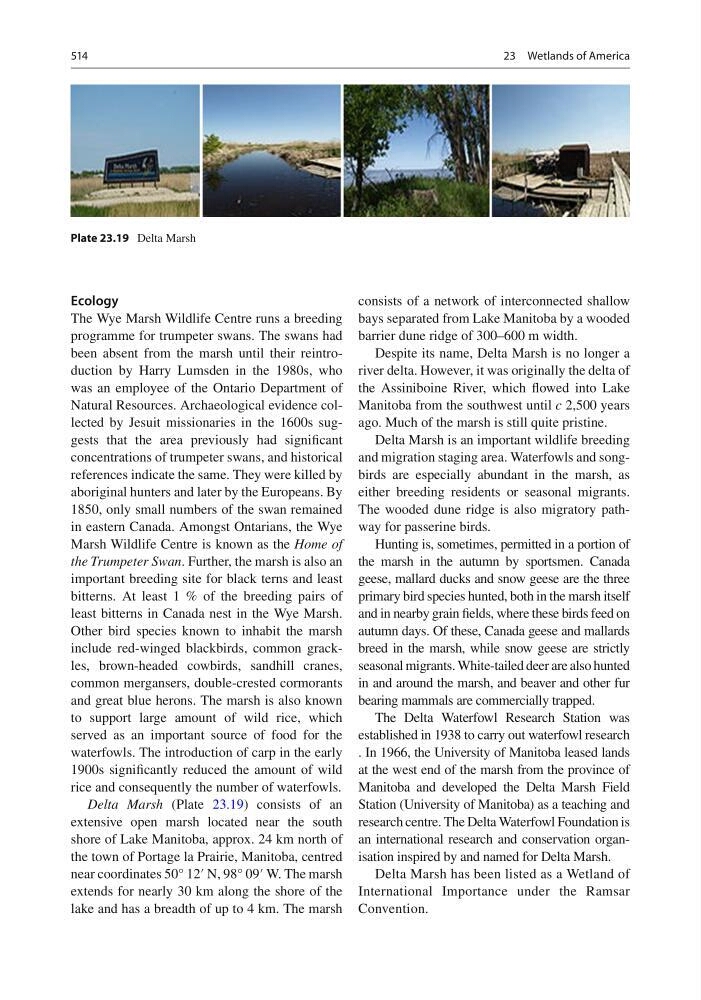
Delta Marsh (Plate 23.19 ) consists of an
extensive open marsh located near the south
shore of Lake Manitoba, approx. 24 km north of
the town of Portage la Prairie, Manitoba, centred
near coordinates 50° 12′ N, 98° 09′ W. The marsh
extends for nearly 30 km along the shore of the
lake and has a breadth of up to 4 km. The marsh
consists of a network of interconnected shallow
bays separated from Lake Manitoba by a wooded
barrier dune ridge of 300–600 m width.
Despite its name, Delta Marsh is no longer a
river delta. However, it was originally the delta of
the Assiniboine River, which fl owed into Lake
Manitoba from the southwest until c 2,500 years
ago. Much of the marsh is still quite pristine.
Delta Marsh is an important wildlife breeding
and migration staging area. Waterfowls and songbirds are especially abundant in the marsh, as
either breeding residents or seasonal migrants.
The wooded dune ridge is also migratory pathway for passerine birds.
Hunting is, sometimes, permitted in a portion of
the marsh in the autumn by sportsmen. Canada
geese, mallard ducks and snow geese are the three
primary bird species hunted, both in the marsh itself
and in nearby grain fi elds, where these birds feed on
autumn days. Of these, Canada geese and mallards
breed in the marsh, while snow geese are strictly
seasonal migrants. White-tailed deer are also hunted
in and around the marsh, and beaver and other fur
bearing mammals are commercially trapped.
The Delta Waterfowl Research Station was
established in 1938 to carry out waterfowl research
. In 1966, the University of Manitoba leased lands
at the west end of the marsh from the province of
Manitoba and developed the Delta Marsh Field
Station (University of Manitoba) as a teaching and
research centre. The Delta Waterfowl Foundation is
an international research and conservation organisation inspired by and named for Delta Marsh.
Delta Marsh has been listed as a Wetland of
International Importance under the Ramsar
Convention.
Plate 23.19 Delta Marsh
23 Wetlands of America
Ecology
The Wye Marsh Wildlife Centre runs a breeding
programme for trumpeter swans. The swans had
been absent from the marsh until their reintroduction by Harry Lumsden in the 1980s, who
was an employee of the Ontario Department of
Natural Resources. Archaeological evidence collected by Jesuit missionaries in the 1600s suggests that the area previously had signifi cant
concentrations of trumpeter swans, and historical
references indicate the same. They were killed by
aboriginal hunters and later by the Europeans. By
1850, only small numbers of the swan remained
in eastern Canada. Amongst Ontarians, the Wye
Marsh Wildlife Centre is known as the Home of
the Trumpeter Swan . Further, the marsh is also an
important breeding site for black terns and least
bitterns. At least 1 % of the breeding pairs of
least bitterns in Canada nest in the Wye Marsh.
Other bird species known to inhabit the marsh
include red-winged blackbirds, common grackles, brown-headed cowbirds, sandhill cranes,
common mergansers, double-crested cormorants
and great blue herons. The marsh is also known
to support large amount of wild rice, which
served as an important source of food for the
waterfowls. The introduction of carp in the early
1900s signifi cantly reduced the amount of wild
rice and consequently the number of waterfowls.
Delta Marsh (Plate 23.19 ) consists of an
extensive open marsh located near the south
shore of Lake Manitoba, approx. 24 km north of
the town of Portage la Prairie, Manitoba, centred
near coordinates 50° 12′ N, 98° 09′ W. The marsh
extends for nearly 30 km along the shore of the
lake and has a breadth of up to 4 km. The marsh
consists of a network of interconnected shallow
bays separated from Lake Manitoba by a wooded
barrier dune ridge of 300–600 m width.
Despite its name, Delta Marsh is no longer a
river delta. However, it was originally the delta of
the Assiniboine River, which fl owed into Lake
Manitoba from the southwest until c 2,500 years
ago. Much of the marsh is still quite pristine.
Delta Marsh is an important wildlife breeding
and migration staging area. Waterfowls and songbirds are especially abundant in the marsh, as
either breeding residents or seasonal migrants.
The wooded dune ridge is also migratory pathway for passerine birds.
Hunting is, sometimes, permitted in a portion of
the marsh in the autumn by sportsmen. Canada
geese, mallard ducks and snow geese are the three
primary bird species hunted, both in the marsh itself
and in nearby grain fi elds, where these birds feed on
autumn days. Of these, Canada geese and mallards
breed in the marsh, while snow geese are strictly
seasonal migrants. White-tailed deer are also hunted
in and around the marsh, and beaver and other fur
bearing mammals are commercially trapped.
The Delta Waterfowl Research Station was
established in 1938 to carry out waterfowl research
. In 1966, the University of Manitoba leased lands
at the west end of the marsh from the province of
Manitoba and developed the Delta Marsh Field
Station (University of Manitoba) as a teaching and
research centre. The Delta Waterfowl Foundation is
an international research and conservation organisation inspired by and named for Delta Marsh.
Delta Marsh has been listed as a Wetland of
International Importance under the Ramsar
Convention.
Plate 23.19 Delta Marsh
23 Wetlands of America