

516
dynamics of the ecosystem, is also not very
abundant today.
Although not extensively studied, the delta’s
signifi cance for migratory birds is indisputable, as
it is the principal FW marsh in the region. A total
of 358 bird species have been documented in the
Colorado River Delta and upper Gulf of California
region. Out of these, 2 are listed as endangered, 6
as threatened and 16 are under special protection
in Mexico. Two wintering species and fi ve breeding species have been locally extirpated, including the southwestern willow fl ycatcher, the
fulvous-whistling duck and the sandhill crane.
23.4.3 Biosphere Reserve
In 1974, the Mexican government designated
portions of the upper Gulf and lower Colorado
River Delta as a ‘Reserved Zone’. Further, the
UNESCO designated more than 1,200,000 ha of
the upper Gulf of California and the Colorado
River Delta as a Biosphere Reserve in June 1993.
The UNESCO considers areas for designation as
Biosphere Reserves only after the nation in which
the site is located submits a nomination. In addition, c 250,000 ha within Colorado River Delta
(Humedales del Delta del Río Colorado) are designated as a Ramsar Wetland under the UN
Convention on Wetlands. Ramsar wetlands are
wetlands of international importance in terms of
their ecology, botany, zoology, limnology and
hydrology. Notably, the UN designation is considered following a nomination by the nation in
which the site is located.
23.5 Wetlands of Cuba
There are a number of important wetlands in
Cuba. An account is given below.
Zapata Swamp (Spanish, Ciénaga de Zapata ) is
an IUCN Category II National Park located between
22° 24′ 26″ N and 81° 41′ 26″ W on the Zapata
Peninsula in the southern Matanzas province of
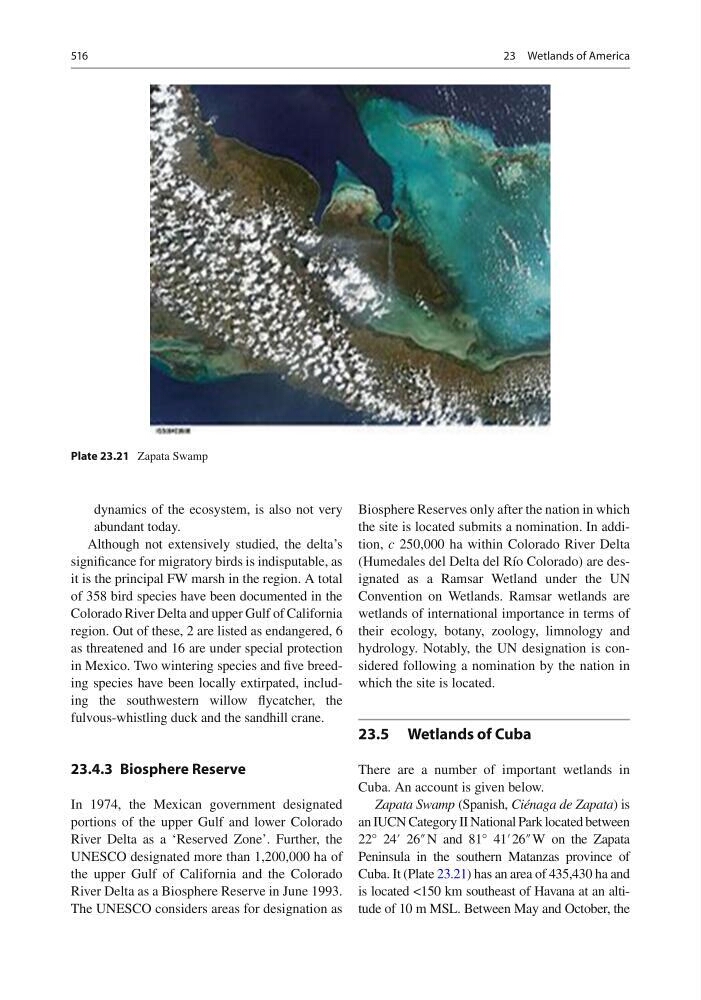
Cuba. It (Plate 23.21 ) has an area of 435,430 ha and
is located <150 km southeast of Havana at an altitude of 10 m MSL. Between May and October, the
Plate 23.21 Zapata Swamp
23 Wetlands of America
dynamics of the ecosystem, is also not very
abundant today.
Although not extensively studied, the delta’s
signifi cance for migratory birds is indisputable, as
it is the principal FW marsh in the region. A total
of 358 bird species have been documented in the
Colorado River Delta and upper Gulf of California
region. Out of these, 2 are listed as endangered, 6
as threatened and 16 are under special protection
in Mexico. Two wintering species and fi ve breeding species have been locally extirpated, including the southwestern willow fl ycatcher, the
fulvous-whistling duck and the sandhill crane.
23.4.3 Biosphere Reserve
In 1974, the Mexican government designated
portions of the upper Gulf and lower Colorado
River Delta as a ‘Reserved Zone’. Further, the
UNESCO designated more than 1,200,000 ha of
the upper Gulf of California and the Colorado
River Delta as a Biosphere Reserve in June 1993.
The UNESCO considers areas for designation as
Biosphere Reserves only after the nation in which
the site is located submits a nomination. In addition, c 250,000 ha within Colorado River Delta
(Humedales del Delta del Río Colorado) are designated as a Ramsar Wetland under the UN
Convention on Wetlands. Ramsar wetlands are
wetlands of international importance in terms of
their ecology, botany, zoology, limnology and
hydrology. Notably, the UN designation is considered following a nomination by the nation in
which the site is located.
23.5 Wetlands of Cuba
There are a number of important wetlands in
Cuba. An account is given below.
Zapata Swamp (Spanish, Ciénaga de Zapata ) is
an IUCN Category II National Park located between
22° 24′ 26″ N and 81° 41′ 26″ W on the Zapata
Peninsula in the southern Matanzas province of
Cuba. It (Plate 23.21 ) has an area of 435,430 ha and
is located <150 km southeast of Havana at an altitude of 10 m MSL. Between May and October, the
Plate 23.21 Zapata Swamp
23 Wetlands of America