

511
Horicon National Wildlife Refuge
In 1927, the state legislature, after pressure from
conservationists beginning in 1921, passed the
Horicon Marsh Wildlife Refuge Bill. During the
1940s, the US Fish and Wildlife Service bought
the northern portions of the marsh. The wetland
supports many species of birds, especially ducks,
great blue herons and Canada geese which have
become increasingly common since the 1980s.
Millions of waterfowls, including over 200,000
Canada geese, migrate through the marsh. It also
contains many species of plants, insects, fi sh,
frogs, snakes, turtles and mammals.
23.3 Wetlands of Canada
The wetlands play a signifi cant role in the lives
and livelihood of the people of Canada.
23.3.1 Wetland Extent
There is about three times the area of wetlands in
Canada than is found in the lower 48 states of the
USA. According to an estimate, Canada has about
127.2 million ha of wetlands which is about 14 %
of the country (Zoltai 1988 ). Most of that area
(111.3 million ha) is considered as peatland.
However, the greatest concentration of Canadian
wetlands may be found in the provinces of
Manitoba and Ontario. The National Wetlands
Working Group (NWWG) ( 1988 ) usually provides
with a particularly comprehensive description of
the major regional wetlands in Canada. They had
estimated that there were 22.5 million ha and 29.2
million ha, respectively, of wetlands in these two
provinces. These account for c 41 % of the total
wetlands in Canada. Much of this total is boreal
peatlands, bogs and fens. Nevertheless, there are
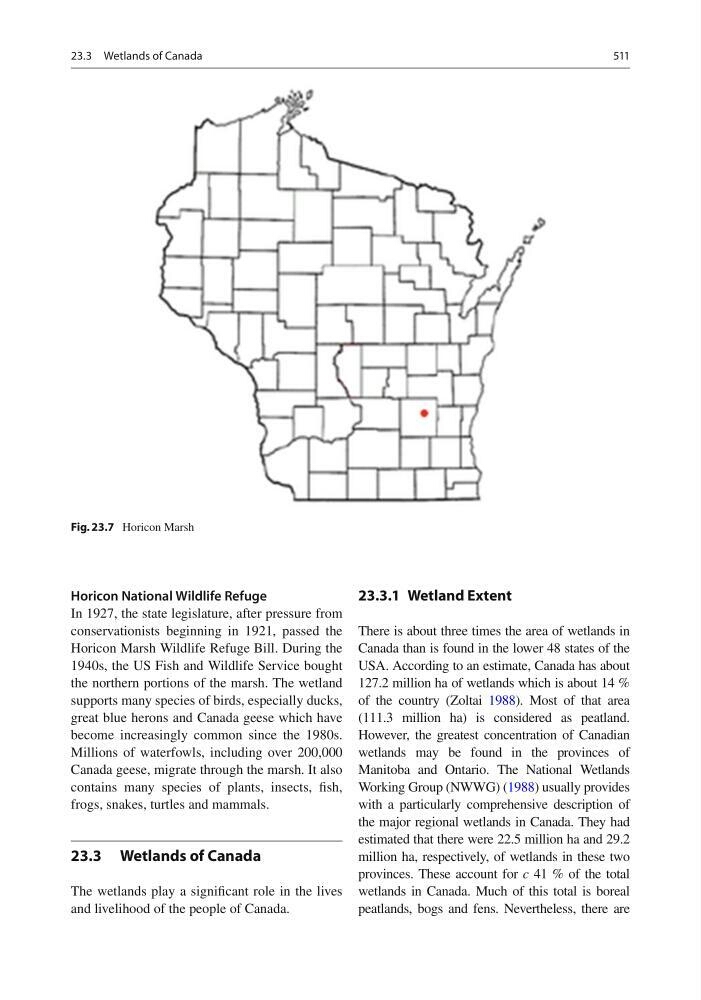
Fig. 23.7 Horicon Marsh
23.3 Wetlands of Canada
Horicon National Wildlife Refuge
In 1927, the state legislature, after pressure from
conservationists beginning in 1921, passed the
Horicon Marsh Wildlife Refuge Bill. During the
1940s, the US Fish and Wildlife Service bought
the northern portions of the marsh. The wetland
supports many species of birds, especially ducks,
great blue herons and Canada geese which have
become increasingly common since the 1980s.
Millions of waterfowls, including over 200,000
Canada geese, migrate through the marsh. It also
contains many species of plants, insects, fi sh,
frogs, snakes, turtles and mammals.
23.3 Wetlands of Canada
The wetlands play a signifi cant role in the lives
and livelihood of the people of Canada.
23.3.1 Wetland Extent
There is about three times the area of wetlands in
Canada than is found in the lower 48 states of the
USA. According to an estimate, Canada has about
127.2 million ha of wetlands which is about 14 %
of the country (Zoltai 1988 ). Most of that area
(111.3 million ha) is considered as peatland.
However, the greatest concentration of Canadian
wetlands may be found in the provinces of
Manitoba and Ontario. The National Wetlands
Working Group (NWWG) ( 1988 ) usually provides
with a particularly comprehensive description of
the major regional wetlands in Canada. They had
estimated that there were 22.5 million ha and 29.2
million ha, respectively, of wetlands in these two
provinces. These account for c 41 % of the total
wetlands in Canada. Much of this total is boreal
peatlands, bogs and fens. Nevertheless, there are
Fig. 23.7 Horicon Marsh
23.3 Wetlands of Canada