

510
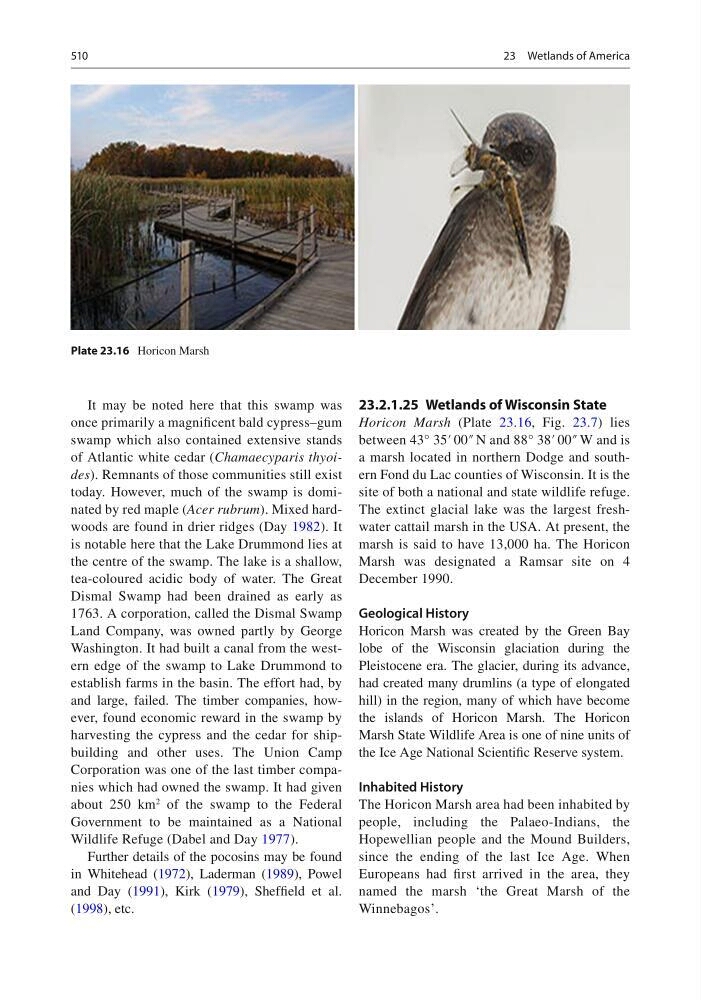
Plate 23.16 Horicon Marsh
It may be noted here that this swamp was
once primarily a magnifi cent bald cypress–gum
swamp which also contained extensive stands
of Atlantic white cedar ( Chamaecyparis thyoides ). Remnants of those communities still exist
today. However, much of the swamp is dominated by red maple ( Acer rubrum ). Mixed hardwoods are found in drier ridges (Day 1982 ). It
is notable here that the Lake Drummond lies at
the centre of the swamp. The lake is a shallow,
tea-coloured acidic body of water. The Great
Dismal Swamp had been drained as early as
1763. A corporation, called the Dismal Swamp
Land Company, was owned partly by George
Washington. It had built a canal from the western edge of the swamp to Lake Drummond to
establish farms in the basin. The effort had, by
and large, failed. The timber companies, however, found economic reward in the swamp by
harvesting the cypress and the cedar for shipbuilding and other uses. The Union Camp
Corporation was one of the last timber companies which had owned the swamp. It had given
about 250 km
2 of the swamp to the Federal
Government to be maintained as a National
Wildlife Refuge (Dabel and Day 1977 ).
Further details of the pocosins may be found
in Whitehead ( 1972 ), Laderman ( 1989 ), Powel
and Day ( 1991 ), Kirk ( 1979 ), Sheffi eld et al.
( 1998 ), etc.
23.2.1.25 Wetlands of Wisconsin State
Horicon Marsh (Plate 23.16 , Fig. 23.7 ) lies
between 43° 35′ 00″ N and 88° 38′ 00″ W and is
a marsh located in northern Dodge and southern Fond du Lac counties of Wisconsin. It is the
site of both a national and state wildlife refuge.
The extinct glacial lake was the largest freshwater cattail marsh in the USA. At present, the
marsh is said to have 13,000 ha. The Horicon
Marsh was designated a Ramsar site on 4
December 1990.
Geological History
Horicon Marsh was created by the Green Bay
lobe of the Wisconsin glaciation during the
Pleistocene era. The glacier, during its advance,
had created many drumlins (a type of elongated
hill) in the region, many of which have become
the islands of Horicon Marsh. The Horicon
Marsh State Wildlife Area is one of nine units of
the Ice Age National Scientifi c Reserve system.
Inhabited History
The Horicon Marsh area had been inhabited by
people, including the Palaeo-Indians, the
Hopewellian people and the Mound Builders,
since the ending of the last Ice Age. When
Europeans had fi rst arrived in the area, they
named the marsh ‘the Great Marsh of the
Winnebagos’.
23 Wetlands of America
Plate 23.16 Horicon Marsh
It may be noted here that this swamp was
once primarily a magnifi cent bald cypress–gum
swamp which also contained extensive stands
of Atlantic white cedar ( Chamaecyparis thyoides ). Remnants of those communities still exist
today. However, much of the swamp is dominated by red maple ( Acer rubrum ). Mixed hardwoods are found in drier ridges (Day 1982 ). It
is notable here that the Lake Drummond lies at
the centre of the swamp. The lake is a shallow,
tea-coloured acidic body of water. The Great
Dismal Swamp had been drained as early as
1763. A corporation, called the Dismal Swamp
Land Company, was owned partly by George
Washington. It had built a canal from the western edge of the swamp to Lake Drummond to
establish farms in the basin. The effort had, by
and large, failed. The timber companies, however, found economic reward in the swamp by
harvesting the cypress and the cedar for shipbuilding and other uses. The Union Camp
Corporation was one of the last timber companies which had owned the swamp. It had given
about 250 km
2 of the swamp to the Federal
Government to be maintained as a National
Wildlife Refuge (Dabel and Day 1977 ).
Further details of the pocosins may be found
in Whitehead ( 1972 ), Laderman ( 1989 ), Powel
and Day ( 1991 ), Kirk ( 1979 ), Sheffi eld et al.
( 1998 ), etc.
23.2.1.25 Wetlands of Wisconsin State
Horicon Marsh (Plate 23.16 , Fig. 23.7 ) lies
between 43° 35′ 00″ N and 88° 38′ 00″ W and is
a marsh located in northern Dodge and southern Fond du Lac counties of Wisconsin. It is the
site of both a national and state wildlife refuge.
The extinct glacial lake was the largest freshwater cattail marsh in the USA. At present, the
marsh is said to have 13,000 ha. The Horicon
Marsh was designated a Ramsar site on 4
December 1990.
Geological History
Horicon Marsh was created by the Green Bay
lobe of the Wisconsin glaciation during the
Pleistocene era. The glacier, during its advance,
had created many drumlins (a type of elongated
hill) in the region, many of which have become
the islands of Horicon Marsh. The Horicon
Marsh State Wildlife Area is one of nine units of
the Ice Age National Scientifi c Reserve system.
Inhabited History
The Horicon Marsh area had been inhabited by
people, including the Palaeo-Indians, the
Hopewellian people and the Mound Builders,
since the ending of the last Ice Age. When
Europeans had fi rst arrived in the area, they
named the marsh ‘the Great Marsh of the
Winnebagos’.
23 Wetlands of America