

509
consists of about 150 ha of tidal marsh, fl oodplain
and swamp forest. It is estimated that the marsh
once consisted of 260 ha. In the 1950s and
1960s, dredging had, possibly, reduced it to its
current size and confi guration. It was formed
about 5,000 to 7,000 years ago. Dyke Marsh is
the largest remaining piece of freshwater tidal
wetlands left in the Baltimore–Washington metropolitan area. The marsh is managed by the
National Park Service. Notably, the freshwater
of the upper Potomac mixes with the salt water
of the lower Potomac. The freshwater tends to
fl oat above the tidal salt water producing a tidal
freshwater marsh.
Wildlife
Dyke Marsh has an abundance of wildlife.
Evidence of a beaver population is visible. Little
brown bats and red fox may be seen at night. The
Dyke Marsh is the most obvious habitat of the
red-winged blackbird, with its distinct call.
Nearly 300 species of birds have been seen in
Dyke Marsh. The lower Potomac is a natural
migration route of aquatic birds.
Plants
More than 360 species of plants have been found
at Dyke Marsh. The narrow-leafed cattail is the
dominant species in the area. It normally develops its characteristic fl ower spike by June. Many
other species of plants occupy the marsh including several types of Sagittaria and wild rice. The
rice attracts animals such as the red-winged
blackbird and waterfowl.
Great Dismal Swamp National Wildlife
Refuge
This wetland ( also called ‘ the Great Dismal
Swamp ’) is one of the northernmost ‘southern’
swamps on the Atlantic coastal plain. It is also
one of the most studied and romanticised wetlands in the USA. It lies between 36° 35′ 00″ N
and 76° 27′ 00″ W. It was created in 1974 to help
protect and preserve a portion of the Great Dismal
Swamp, a marshy region on the coastal plain of
southeastern Virginia and northeastern North
Carolina between Norfolk, Virginia, and
Elizabeth City, North Carolina in the USA. The
swamp covers c 850 km
2 in SE Virginia and NE
North Carolina. It had once extended >2,000 km
2
(Day 1982 ). However, the swamp has been
severely affected by human intervention during
the past two centuries. Draining, ditching, logging and fi re had played a role in diminishing its
size and in altering its ecological communities
(Berkely and Berkely 1976 ).
The Great Dismal Swamp is a southern swamp
ecosystem having rich vegetative communities
and varied wildlife forms. It is one of the last
large wild areas remaining in the eastern USA.
Cypress, black gum, maple, Atlantic white
cedar and pine are the predominant trees found,
which support diverse types of wildlife within. The
swamp is a habitat for mammals like black bear,
bobcat, otter and weasel. About 70 species of reptiles, including alligators and many amphibians,
are also said to occur. Also, >200 species of birds
can be seen in the swamp throughout the year, of
which 96 are known to nest in the wetland.
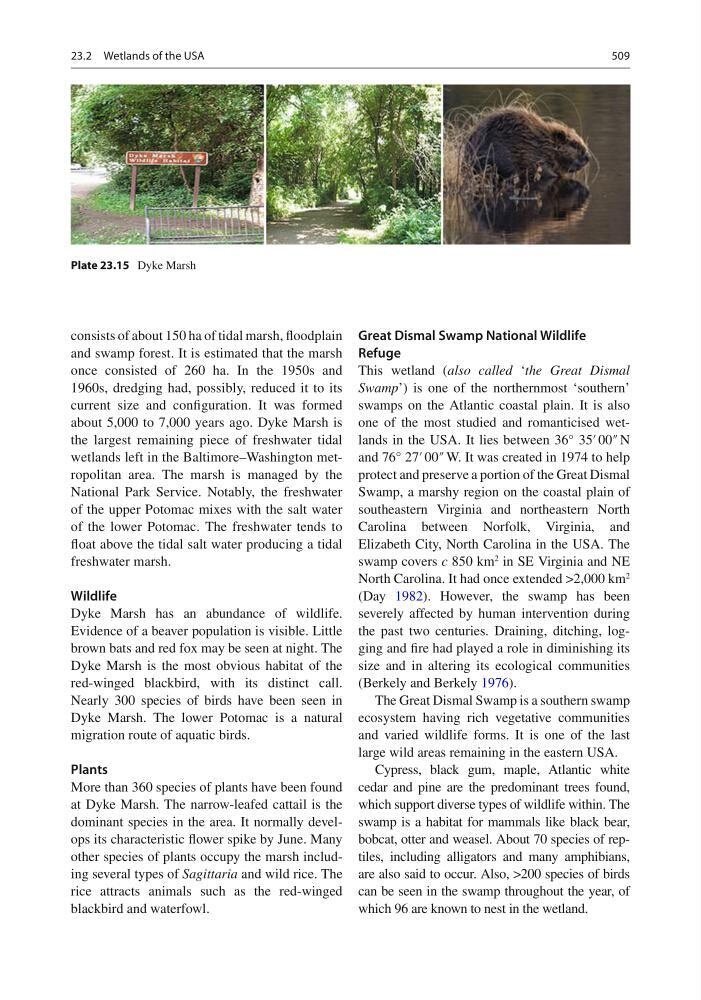
Plate 23.15 Dyke Marsh
23.2 Wetlands of the USA
consists of about 150 ha of tidal marsh, fl oodplain
and swamp forest. It is estimated that the marsh
once consisted of 260 ha. In the 1950s and
1960s, dredging had, possibly, reduced it to its
current size and confi guration. It was formed
about 5,000 to 7,000 years ago. Dyke Marsh is
the largest remaining piece of freshwater tidal
wetlands left in the Baltimore–Washington metropolitan area. The marsh is managed by the
National Park Service. Notably, the freshwater
of the upper Potomac mixes with the salt water
of the lower Potomac. The freshwater tends to
fl oat above the tidal salt water producing a tidal
freshwater marsh.
Wildlife
Dyke Marsh has an abundance of wildlife.
Evidence of a beaver population is visible. Little
brown bats and red fox may be seen at night. The
Dyke Marsh is the most obvious habitat of the
red-winged blackbird, with its distinct call.
Nearly 300 species of birds have been seen in
Dyke Marsh. The lower Potomac is a natural
migration route of aquatic birds.
Plants
More than 360 species of plants have been found
at Dyke Marsh. The narrow-leafed cattail is the
dominant species in the area. It normally develops its characteristic fl ower spike by June. Many
other species of plants occupy the marsh including several types of Sagittaria and wild rice. The
rice attracts animals such as the red-winged
blackbird and waterfowl.
Great Dismal Swamp National Wildlife
Refuge
This wetland ( also called ‘ the Great Dismal
Swamp ’) is one of the northernmost ‘southern’
swamps on the Atlantic coastal plain. It is also
one of the most studied and romanticised wetlands in the USA. It lies between 36° 35′ 00″ N
and 76° 27′ 00″ W. It was created in 1974 to help
protect and preserve a portion of the Great Dismal
Swamp, a marshy region on the coastal plain of
southeastern Virginia and northeastern North
Carolina between Norfolk, Virginia, and
Elizabeth City, North Carolina in the USA. The
swamp covers c 850 km
2 in SE Virginia and NE
North Carolina. It had once extended >2,000 km
2
(Day 1982 ). However, the swamp has been
severely affected by human intervention during
the past two centuries. Draining, ditching, logging and fi re had played a role in diminishing its
size and in altering its ecological communities
(Berkely and Berkely 1976 ).
The Great Dismal Swamp is a southern swamp
ecosystem having rich vegetative communities
and varied wildlife forms. It is one of the last
large wild areas remaining in the eastern USA.
Cypress, black gum, maple, Atlantic white
cedar and pine are the predominant trees found,
which support diverse types of wildlife within. The
swamp is a habitat for mammals like black bear,
bobcat, otter and weasel. About 70 species of reptiles, including alligators and many amphibians,
are also said to occur. Also, >200 species of birds
can be seen in the swamp throughout the year, of
which 96 are known to nest in the wetland.
Plate 23.15 Dyke Marsh
23.2 Wetlands of the USA