

508
it can be classed as an acid fen, as it receives
some groundwater fl ow. The site was designated
a National Natural Landmark in December 1974.
History
The bog began as a ‘kettle lake’ formed approximately 10,000 years ago by a portion of the
retreating Wisconsin Glacier. With restricted
air and nutrient fl ow, sphagnum moss grew out
into the lake, eventually forming a layer of peat
over 12 m thick.
Flora
Some of the plants are sphagnum moss, bog
rosemary, swamp loosestrife, parasitic plant dodder (on swamp loosestrife), insectivorous plants
pitcher plant, orchids, etc.
Fauna
Some of the animals are carnivores, notably black
bear, river otter (Cranberry Creek), beaver, etc.
Other animals which occur include breeding
birds, brown creeper, Nashville warbler, Canada
warbler and bog turtle.
23.2.1.22 Wetlands of South Carolina
State
Hell Hole Swamp
It lies between 33° 13′ 40″ N and 79° 42′ 12″ W
and is a swamp in northeastern Berkeley County,
South Carolina, USA. It is located entirely within
the Francis Marion National Forest and has an
area of 900 ha. The whole area is designated as an
IUCN Category Ib wilderness area.
23.2.1.23 Wetlands of Texas State
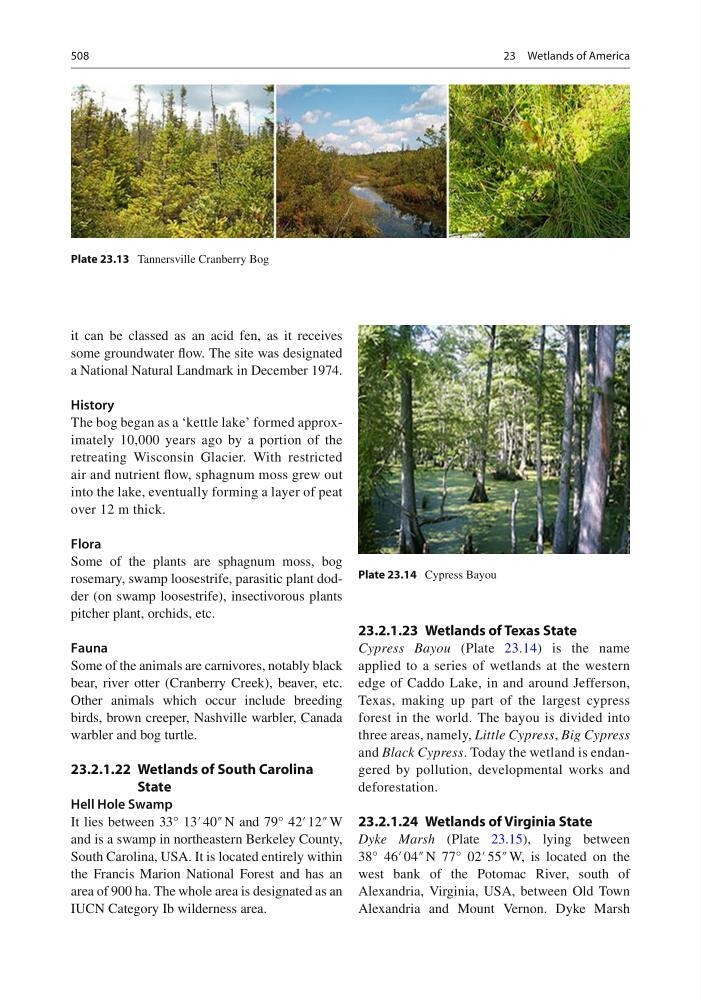
Cypress Bayou (Plate 23.14 ) is the name
applied to a series of wetlands at the western
edge of Caddo Lake, in and around Jefferson,
Texas, making up part of the largest cypress
forest in the world. The bayou is divided into
three areas, namely, Little Cypress , Big Cypress
and Black Cypress . Today the wetland is endangered by pollution, developmental works and
deforestation.
23.2.1.24 Wetlands of Virginia State
Dyke Marsh (Plate 23.15 ), lying between
38° 46′ 04″ N 77° 02′ 55″ W, is located on the
west bank of the Potomac River, south of
Alexandria, Virginia, USA, between Old Town
Alexandria and Mount Vernon. Dyke Marsh
Plate 23.14 Cypress Bayou
Plate 23.13 Tannersville Cranberry Bog
23 Wetlands of America
it can be classed as an acid fen, as it receives
some groundwater fl ow. The site was designated
a National Natural Landmark in December 1974.
History
The bog began as a ‘kettle lake’ formed approximately 10,000 years ago by a portion of the
retreating Wisconsin Glacier. With restricted
air and nutrient fl ow, sphagnum moss grew out
into the lake, eventually forming a layer of peat
over 12 m thick.
Flora
Some of the plants are sphagnum moss, bog
rosemary, swamp loosestrife, parasitic plant dodder (on swamp loosestrife), insectivorous plants
pitcher plant, orchids, etc.
Fauna
Some of the animals are carnivores, notably black
bear, river otter (Cranberry Creek), beaver, etc.
Other animals which occur include breeding
birds, brown creeper, Nashville warbler, Canada
warbler and bog turtle.
23.2.1.22 Wetlands of South Carolina
State
Hell Hole Swamp
It lies between 33° 13′ 40″ N and 79° 42′ 12″ W
and is a swamp in northeastern Berkeley County,
South Carolina, USA. It is located entirely within
the Francis Marion National Forest and has an
area of 900 ha. The whole area is designated as an
IUCN Category Ib wilderness area.
23.2.1.23 Wetlands of Texas State
Cypress Bayou (Plate 23.14 ) is the name
applied to a series of wetlands at the western
edge of Caddo Lake, in and around Jefferson,
Texas, making up part of the largest cypress
forest in the world. The bayou is divided into
three areas, namely, Little Cypress , Big Cypress
and Black Cypress . Today the wetland is endangered by pollution, developmental works and
deforestation.
23.2.1.24 Wetlands of Virginia State
Dyke Marsh (Plate 23.15 ), lying between
38° 46′ 04″ N 77° 02′ 55″ W, is located on the
west bank of the Potomac River, south of
Alexandria, Virginia, USA, between Old Town
Alexandria and Mount Vernon. Dyke Marsh
Plate 23.14 Cypress Bayou
Plate 23.13 Tannersville Cranberry Bog
23 Wetlands of America