

480
southern and northwest England) had been
observed in this area.
22.6 Wetlands of France
There are quite a large number of lentic bodies in
France. An account of some of the signifi cant
lentic bodies in France is briefl y given below.
22.6.1 The Camargue
The Rhône River Delta created France’s most
important wetland, the Camargue (Plate 22.12 ,
Fig. 22.2 ). It is an expanse of wetlands centred
around 9,000-ha E’rang du Vaccar’es. A species
of bull of this region is said to have inhabited the
Gaul several thousands of years ago before they
were driven south by the encroaching human
settlements. The Camargue is also home to one
of the world’s 25 major fl amingo nesting sites
and France’s only such site. Both aquatic and
terrestrial vegetations differ distinctly from those
of northern Europe or tropical Africa. It is, possibly, because of the landscape transitions from
dune to lagoon, to marshland, to grassland and
then to forest. Nevertheless, some of the agricultural policies in Europe call for restoration of
some of the ricefi elds in the Camargue ( Mesle’ard
et al. 1995).
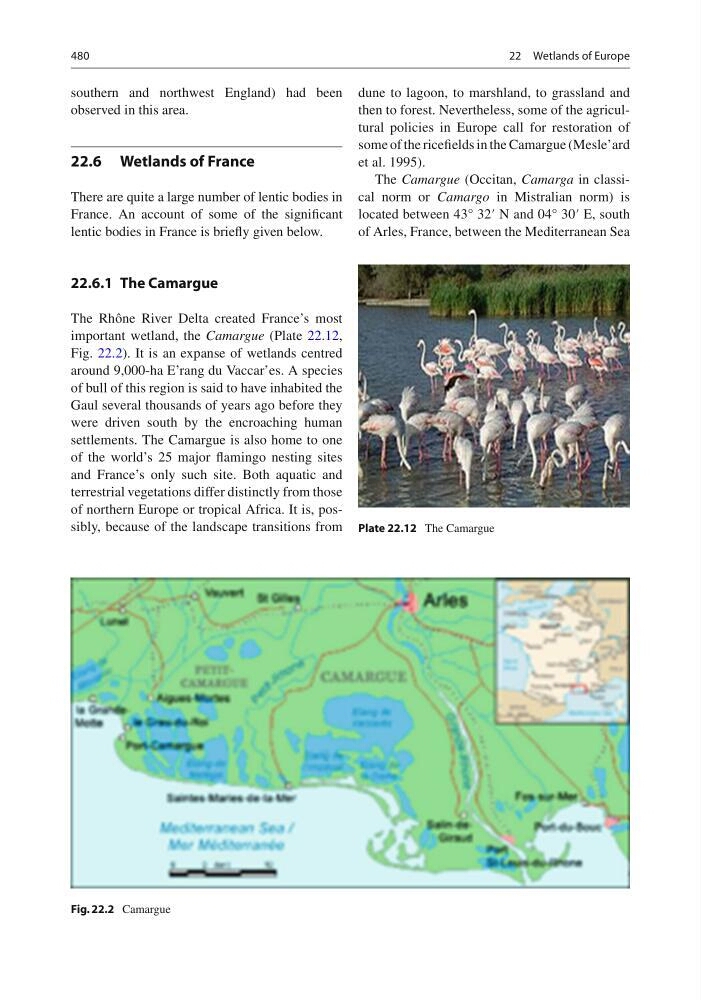
The Camargue (Occitan, Camarga in classical norm or Camargo in Mistralian norm) is
located between 43° 32′ N and 04° 30′ E, south
of Arles, France, between the Mediterranean Sea
Plate 22.12 The Camargue
Fig. 22.2 Camargue
22 Wetlands of Europe
southern and northwest England) had been
observed in this area.
22.6 Wetlands of France
There are quite a large number of lentic bodies in
France. An account of some of the signifi cant
lentic bodies in France is briefl y given below.
22.6.1 The Camargue
The Rhône River Delta created France’s most
important wetland, the Camargue (Plate 22.12 ,
Fig. 22.2 ). It is an expanse of wetlands centred
around 9,000-ha E’rang du Vaccar’es. A species
of bull of this region is said to have inhabited the
Gaul several thousands of years ago before they
were driven south by the encroaching human
settlements. The Camargue is also home to one
of the world’s 25 major fl amingo nesting sites
and France’s only such site. Both aquatic and
terrestrial vegetations differ distinctly from those
of northern Europe or tropical Africa. It is, possibly, because of the landscape transitions from
dune to lagoon, to marshland, to grassland and
then to forest. Nevertheless, some of the agricultural policies in Europe call for restoration of
some of the ricefi elds in the Camargue ( Mesle’ard
et al. 1995).
The Camargue (Occitan, Camarga in classical norm or Camargo in Mistralian norm) is
located between 43° 32′ N and 04° 30′ E, south
of Arles, France, between the Mediterranean Sea
Plate 22.12 The Camargue
Fig. 22.2 Camargue
22 Wetlands of Europe