

479
22.5.11.1 Romney Marsh Sheep
The economy and landscape of Romney Marsh in
the nineteenth century was dominated mainly by
sheep. Improved methods of pasture management
and husbandry meant that the marsh could sustain
a stock density greater than anywhere else in the
world. The Romney Marsh sheep became one of
the most successful and important breeds of sheep.
22.5.12 Ings
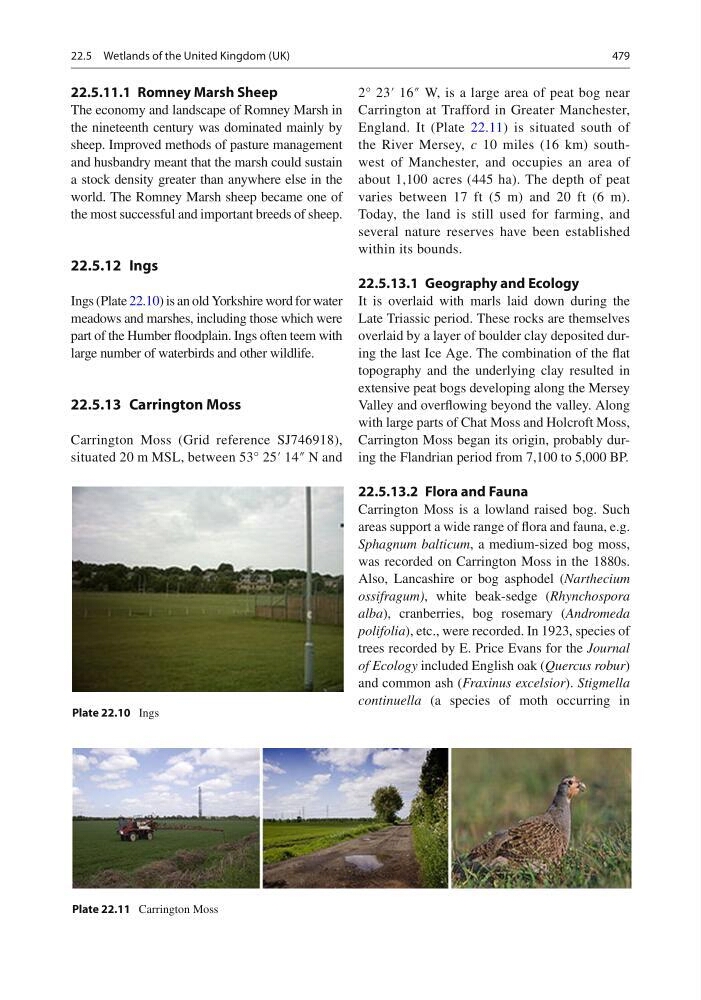
Ings (Plate 22.10 ) is an old Yorkshire word for water
meadows and marshes, including those which were
part of the Humber fl oodplain. Ings often teem with
large number of waterbirds and other wildlife.
22.5.13 Carrington Moss
Carrington Moss (Grid reference SJ746918),
situated 20 m MSL, between 53° 25′ 14″ N and
2° 23′ 16″ W, is a large area of peat bog near
Carrington at Trafford in Greater Manchester,
England. It (Plate 22.11 ) is situated south of
the River Mersey, c 10 miles (16 km) southwest of Manchester, and occupies an area of
about 1,100 acres (445 ha). The depth of peat
varies between 17 ft (5 m) and 20 ft (6 m).
Today, the land is still used for farming, and
several nature reserves have been established
within its bounds.
22.5.13.1 Geography and Ecology
It is overlaid with marls laid down during the
Late Triassic period. These rocks are themselves
overlaid by a layer of boulder clay deposited during the last Ice Age. The combination of the fl at
topography and the underlying clay resulted in
extensive peat bogs developing along the Mersey
Valley and overfl owing beyond the valley. Along
with large parts of Chat Moss and Holcroft Moss,
Carrington Moss began its origin, probably during the Flandrian period from 7,100 to 5,000 BP.
22.5.13.2 Flora and Fauna
Carrington Moss is a lowland raised bog. Such
areas support a wide range of fl ora and fauna, e.g.
Sphagnum balticum , a medium-sized bog moss,
was recorded on Carrington Moss in the 1880s.
Also, Lancashire or bog asphodel ( Narthecium
ossifragum) , white beak-sedge ( Rhynchospora
alba ), cranberries, bog rosemary ( Andromeda
polifolia ), etc., were recorded. In 1923, species of
trees recorded by E. Price Evans for the Journal
of Ecology included English oak ( Quercus robur )
and common ash ( Fraxinus excelsior ). Stigmella
continuella (a species of moth occurring in
Plate 22.10 Ings
Plate 22.11 Carrington Moss
22.5 Wetlands of the United Kingdom (UK)
22.5.11.1 Romney Marsh Sheep
The economy and landscape of Romney Marsh in
the nineteenth century was dominated mainly by
sheep. Improved methods of pasture management
and husbandry meant that the marsh could sustain
a stock density greater than anywhere else in the
world. The Romney Marsh sheep became one of
the most successful and important breeds of sheep.
22.5.12 Ings
Ings (Plate 22.10 ) is an old Yorkshire word for water
meadows and marshes, including those which were
part of the Humber fl oodplain. Ings often teem with
large number of waterbirds and other wildlife.
22.5.13 Carrington Moss
Carrington Moss (Grid reference SJ746918),
situated 20 m MSL, between 53° 25′ 14″ N and
2° 23′ 16″ W, is a large area of peat bog near
Carrington at Trafford in Greater Manchester,
England. It (Plate 22.11 ) is situated south of
the River Mersey, c 10 miles (16 km) southwest of Manchester, and occupies an area of
about 1,100 acres (445 ha). The depth of peat
varies between 17 ft (5 m) and 20 ft (6 m).
Today, the land is still used for farming, and
several nature reserves have been established
within its bounds.
22.5.13.1 Geography and Ecology
It is overlaid with marls laid down during the
Late Triassic period. These rocks are themselves
overlaid by a layer of boulder clay deposited during the last Ice Age. The combination of the fl at
topography and the underlying clay resulted in
extensive peat bogs developing along the Mersey
Valley and overfl owing beyond the valley. Along
with large parts of Chat Moss and Holcroft Moss,
Carrington Moss began its origin, probably during the Flandrian period from 7,100 to 5,000 BP.
22.5.13.2 Flora and Fauna
Carrington Moss is a lowland raised bog. Such
areas support a wide range of fl ora and fauna, e.g.
Sphagnum balticum , a medium-sized bog moss,
was recorded on Carrington Moss in the 1880s.
Also, Lancashire or bog asphodel ( Narthecium
ossifragum) , white beak-sedge ( Rhynchospora
alba ), cranberries, bog rosemary ( Andromeda
polifolia ), etc., were recorded. In 1923, species of
trees recorded by E. Price Evans for the Journal
of Ecology included English oak ( Quercus robur )
and common ash ( Fraxinus excelsior ). Stigmella
continuella (a species of moth occurring in
Plate 22.10 Ings
Plate 22.11 Carrington Moss
22.5 Wetlands of the United Kingdom (UK)