

459
wetlands remain undervalued by users, due, in no
small part, to highly sectoral approaches to wetland management. Reclamation of wetlands for
the expansion of rice production and other forms
of environmental degradation are expected to
increase in future, especially as agricultural and
industrial activities undergo intensifi cation and
expansion. Nevertheless, the legislative framework in Vietnam provides a solid basis for the
conservation and sustainable use of resources.
21.14.1 Geographical Focus of WAP
Activities in Vietnam
Although there are numerous wetland ecosystems
in Vietnam, the Wetlands Alliance Programme
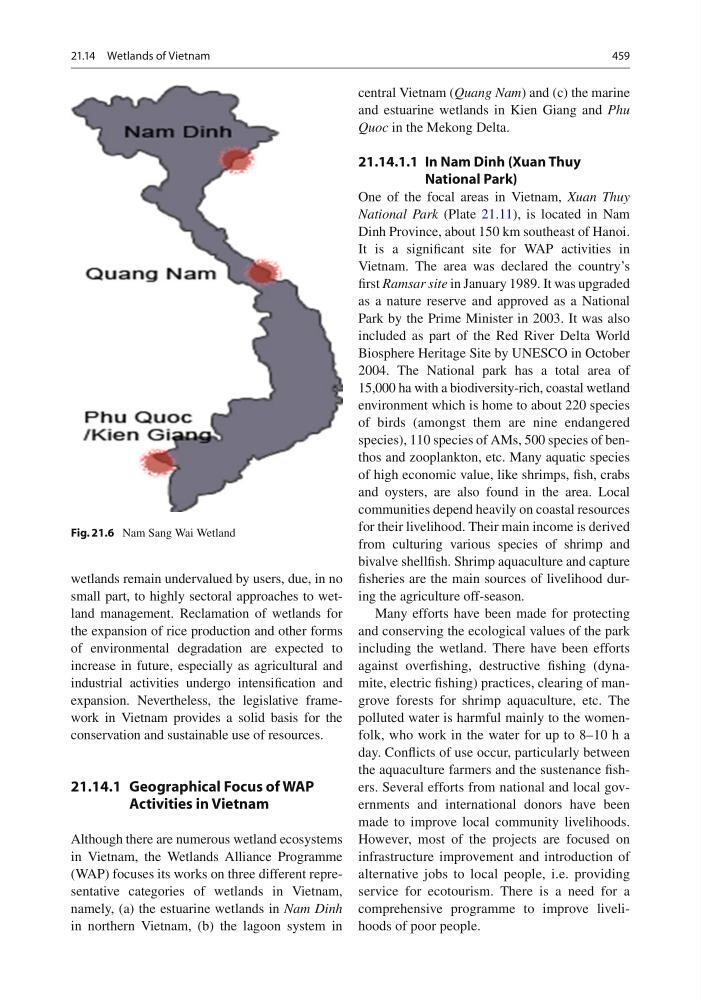
(WAP) focuses its works on three different representative categories of wetlands in Vietnam,
namely, (a) the estuarine wetlands in Nam Dinh
in northern Vietnam, (b) the lagoon system in
central Vietnam ( Quang Nam ) and (c) the marine
and estuarine wetlands in Kien Giang and Phu
Quoc in the Mekong Delta.
21.14.1.1 In Nam Dinh (Xuan Thuy
National Park)
One of the focal areas in Vietnam, Xuan Thuy
National Park (Plate 21.11 ), is located in Nam
Dinh Province, about 150 km southeast of Hanoi.
It is a signifi cant site for WAP activities in
Vietnam. The area was declared the country’s
fi rst Ramsar site in January 1989. It was upgraded
as a nature reserve and approved as a National
Park by the Prime Minister in 2003. It was also
included as part of the Red River Delta World
Biosphere Heritage Site by UNESCO in October
2004. The National park has a total area of
15,000 ha with a biodiversity-rich, coastal wetland
environment which is home to about 220 species
of birds (amongst them are nine endangered
species), 110 species of AMs, 500 species of benthos and zooplankton, etc. Many aquatic species
of high economic value, like shrimps, fi sh, crabs
and oysters, are also found in the area. Local
communities depend heavily on coastal resources
for their livelihood. Their main income is derived
from culturing various species of shrimp and
bivalve shellfi sh. Shrimp aquaculture and capture
fi sheries are the main sources of livelihood during the agriculture off-season.
Many efforts have been made for protecting
and conserving the ecological values of the park
including the wetland. There have been efforts
against overfi shing, destructive fi shing (dynamite, electric fi shing) practices, clearing of mangrove forests for shrimp aquaculture, etc. The
polluted water is harmful mainly to the womenfolk, who work in the water for up to 8–10 h a
day. Confl icts of use occur, particularly between
the aquaculture farmers and the sustenance fi shers. Several efforts from national and local governments and international donors have been
made to improve local community livelihoods.
However, most of the projects are focused on
infrastructure improvement and introduction of
alternative jobs to local people, i.e. providing
service for ecotourism. There is a need for a
comprehensive programme to improve livelihoods of poor people.
Fig. 21.6 Nam Sang Wai Wetland
21.14 Wetlands of Vietnam
wetlands remain undervalued by users, due, in no
small part, to highly sectoral approaches to wetland management. Reclamation of wetlands for
the expansion of rice production and other forms
of environmental degradation are expected to
increase in future, especially as agricultural and
industrial activities undergo intensifi cation and
expansion. Nevertheless, the legislative framework in Vietnam provides a solid basis for the
conservation and sustainable use of resources.
21.14.1 Geographical Focus of WAP
Activities in Vietnam
Although there are numerous wetland ecosystems
in Vietnam, the Wetlands Alliance Programme
(WAP) focuses its works on three different representative categories of wetlands in Vietnam,
namely, (a) the estuarine wetlands in Nam Dinh
in northern Vietnam, (b) the lagoon system in
central Vietnam ( Quang Nam ) and (c) the marine
and estuarine wetlands in Kien Giang and Phu
Quoc in the Mekong Delta.
21.14.1.1 In Nam Dinh (Xuan Thuy
National Park)
One of the focal areas in Vietnam, Xuan Thuy
National Park (Plate 21.11 ), is located in Nam
Dinh Province, about 150 km southeast of Hanoi.
It is a signifi cant site for WAP activities in
Vietnam. The area was declared the country’s
fi rst Ramsar site in January 1989. It was upgraded
as a nature reserve and approved as a National
Park by the Prime Minister in 2003. It was also
included as part of the Red River Delta World
Biosphere Heritage Site by UNESCO in October
2004. The National park has a total area of
15,000 ha with a biodiversity-rich, coastal wetland
environment which is home to about 220 species
of birds (amongst them are nine endangered
species), 110 species of AMs, 500 species of benthos and zooplankton, etc. Many aquatic species
of high economic value, like shrimps, fi sh, crabs
and oysters, are also found in the area. Local
communities depend heavily on coastal resources
for their livelihood. Their main income is derived
from culturing various species of shrimp and
bivalve shellfi sh. Shrimp aquaculture and capture
fi sheries are the main sources of livelihood during the agriculture off-season.
Many efforts have been made for protecting
and conserving the ecological values of the park
including the wetland. There have been efforts
against overfi shing, destructive fi shing (dynamite, electric fi shing) practices, clearing of mangrove forests for shrimp aquaculture, etc. The
polluted water is harmful mainly to the womenfolk, who work in the water for up to 8–10 h a
day. Confl icts of use occur, particularly between
the aquaculture farmers and the sustenance fi shers. Several efforts from national and local governments and international donors have been
made to improve local community livelihoods.
However, most of the projects are focused on
infrastructure improvement and introduction of
alternative jobs to local people, i.e. providing
service for ecotourism. There is a need for a
comprehensive programme to improve livelihoods of poor people.
Fig. 21.6 Nam Sang Wai Wetland
21.14 Wetlands of Vietnam