

458
perhaps, arise from intense urbanisation, especially
in recent years.
Studies revealed that the wetland supports
about 55,000 migratory birds, including
Saunders’ Gull and a quarter of world’s blackfaced spoonbill population. It also has intertidal
mangroves along with 24 traditionally operated
shrimp ponds (called Gei Wai locally) to provide
food for the birds. Further, Mai Po Nature
Reserve is a restricted area (requiring ‘Mai Po
Marshes Entry Permit’ from the Agriculture,
Fisheries and Conservation department of the
Govt. of Hong Kong) under the Wild Animals
Protection Ordinance (Chap. 170 ) in order to
minimise disturbance to wildlife. One needs to
enter the reserve.
21.12.3 Avian Flu Outbreak
In February 2008, the Hong Kong government
closed Mai Po for 21 days following the discovery of a great egret infected with H5N1, also
known as avian fl u.
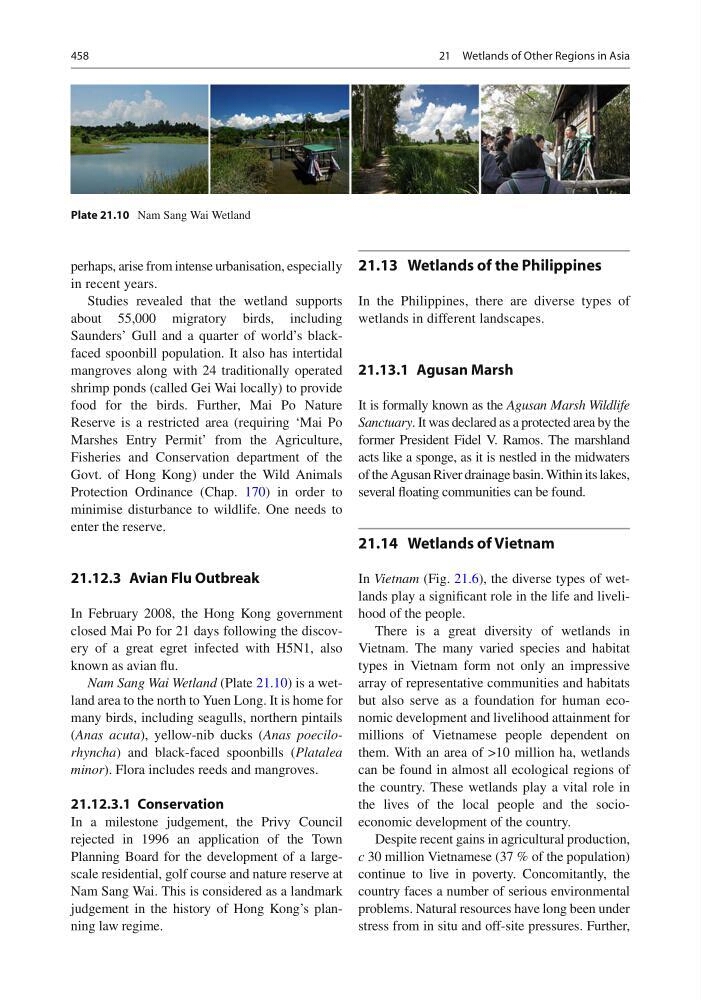
Nam Sang Wai Wetland (Plate 21.10 ) is a wetland area to the north to Yuen Long. It is home for
many birds, including seagulls, northern pintails
( Anas acuta ), yellow-nib ducks ( Anas poecilorhyncha ) and black-faced spoonbills ( Platalea
minor ). Flora includes reeds and mangroves.
21.12.3.1 Conservation
In a milestone judgement, the Privy Council
rejected in 1996 an application of the Town
Planning Board for the development of a largescale residential, golf course and nature reserve at
Nam Sang Wai. This is considered as a landmark
judgement in the history of Hong Kong’s planning law regime.
21.13 Wetlands of the Philippines
In the Philippines, there are diverse types of
wetlands in different landscapes.
21.13.1 Agusan Marsh
It is formally known as the Agusan Marsh Wildlife
Sanctuary . It was declared as a protected area by the
former President Fidel V. Ramos. The marshland
acts like a sponge, as it is nestled in the midwaters
of the Agusan River drainage basin. Within its lakes,
several fl oating communities can be found.
21.14 Wetlands of Vietnam
In Vietnam (Fig. 21.6 ), the diverse types of wetlands play a signifi cant role in the life and livelihood of the people.
There is a great diversity of wetlands in
Vietnam. The many varied species and habitat
types in Vietnam form not only an impressive
array of representative communities and habitats
but also serve as a foundation for human economic development and livelihood attainment for
millions of Vietnamese people dependent on
them. With an area of >10 million ha, wetlands
can be found in almost all ecological regions of
the country. These wetlands play a vital role in
the lives of the local people and the socioeconomic development of the country.
Despite recent gains in agricultural production,
c 30 million Vietnamese (37 % of the population)
continue to live in poverty. Concomitantly, the
country faces a number of serious environmental
problems. Natural resources have long been under
stress from in situ and off-site pressures. Further,
Plate 21.10 Nam Sang Wai Wetland
21 Wetlands of Other Regions in Asia
perhaps, arise from intense urbanisation, especially
in recent years.
Studies revealed that the wetland supports
about 55,000 migratory birds, including
Saunders’ Gull and a quarter of world’s blackfaced spoonbill population. It also has intertidal
mangroves along with 24 traditionally operated
shrimp ponds (called Gei Wai locally) to provide
food for the birds. Further, Mai Po Nature
Reserve is a restricted area (requiring ‘Mai Po
Marshes Entry Permit’ from the Agriculture,
Fisheries and Conservation department of the
Govt. of Hong Kong) under the Wild Animals
Protection Ordinance (Chap. 170 ) in order to
minimise disturbance to wildlife. One needs to
enter the reserve.
21.12.3 Avian Flu Outbreak
In February 2008, the Hong Kong government
closed Mai Po for 21 days following the discovery of a great egret infected with H5N1, also
known as avian fl u.
Nam Sang Wai Wetland (Plate 21.10 ) is a wetland area to the north to Yuen Long. It is home for
many birds, including seagulls, northern pintails
( Anas acuta ), yellow-nib ducks ( Anas poecilorhyncha ) and black-faced spoonbills ( Platalea
minor ). Flora includes reeds and mangroves.
21.12.3.1 Conservation
In a milestone judgement, the Privy Council
rejected in 1996 an application of the Town
Planning Board for the development of a largescale residential, golf course and nature reserve at
Nam Sang Wai. This is considered as a landmark
judgement in the history of Hong Kong’s planning law regime.
21.13 Wetlands of the Philippines
In the Philippines, there are diverse types of
wetlands in different landscapes.
21.13.1 Agusan Marsh
It is formally known as the Agusan Marsh Wildlife
Sanctuary . It was declared as a protected area by the
former President Fidel V. Ramos. The marshland
acts like a sponge, as it is nestled in the midwaters
of the Agusan River drainage basin. Within its lakes,
several fl oating communities can be found.
21.14 Wetlands of Vietnam
In Vietnam (Fig. 21.6 ), the diverse types of wetlands play a signifi cant role in the life and livelihood of the people.
There is a great diversity of wetlands in
Vietnam. The many varied species and habitat
types in Vietnam form not only an impressive
array of representative communities and habitats
but also serve as a foundation for human economic development and livelihood attainment for
millions of Vietnamese people dependent on
them. With an area of >10 million ha, wetlands
can be found in almost all ecological regions of
the country. These wetlands play a vital role in
the lives of the local people and the socioeconomic development of the country.
Despite recent gains in agricultural production,
c 30 million Vietnamese (37 % of the population)
continue to live in poverty. Concomitantly, the
country faces a number of serious environmental
problems. Natural resources have long been under
stress from in situ and off-site pressures. Further,
Plate 21.10 Nam Sang Wai Wetland
21 Wetlands of Other Regions in Asia