

384
various causes. However, some of the environmentalist groups and the government agencies
are trying to improve the condition of the lake.
Environmental Conditions
The Hussain Sagar Lake ecosystem has been
degrading during the past few years mainly due to
heavy anthropogenic pressures. The water quality
has deteriorated. There have been undesirable
changes in the structure of biological communities of the lake. Some of the important species
have either declined or completely disappeared.
Further, the lake has become shallow due to siltation and accumulation of plant debris. As such,
the APPCB in association with NLCP has been
formulating measures for reclamation of the lake.
Conservation
A project feasibility report had been prepared for
the conservation and restoration of Hussain Sagar
Lake under the National Lake Conservation Plan.
The Hussain Sagar Lake has been the centre of
Hyderabad culture and is amongst the most beautiful national heritage sites. It has been playing a
major role in the economy of the province of
Andhra Pradesh through its attraction of tourists
as well as its use as a source of fi sh and water.
As with other urban lakes in India, the Hussain
Sagar now serves as one of the main sewage collection zones of the twin cities.
20.3.2 Wetlands of the Andaman
and Nicobar Islands
They lie between 6° 45′ and 13° 41′ N and 92°
12′ and 92° 57′ E around the Bay of Bengal
between continental India and Myanmar. The
altitude is 70 m MSL. However, there is 77,769 ha
of mangrove forests. Much of the most extensive
wetland habitats are mangrove swamps. Also,
many small freshwater ponds and marshes present throughout the islets are of considerable
interest. The climate is humid tropical with an
average annual rainfall of 3,180 mm. There is
rainfall from both SW monsoon and NE monsoon. The temperature ranges from 16 to 33 °C.
The fl ora include about 3,000 plant species.
Many of these are endemic to the islands. Threats
arise due to clearing of c 12,000 ha of mangroves
mainly for fi rewood. This had adverse effects on
the offshore fi sheries. Further, there is sometimes
poaching of the estuarine crocodiles. The mangrove swamps serve as breeding ground for many
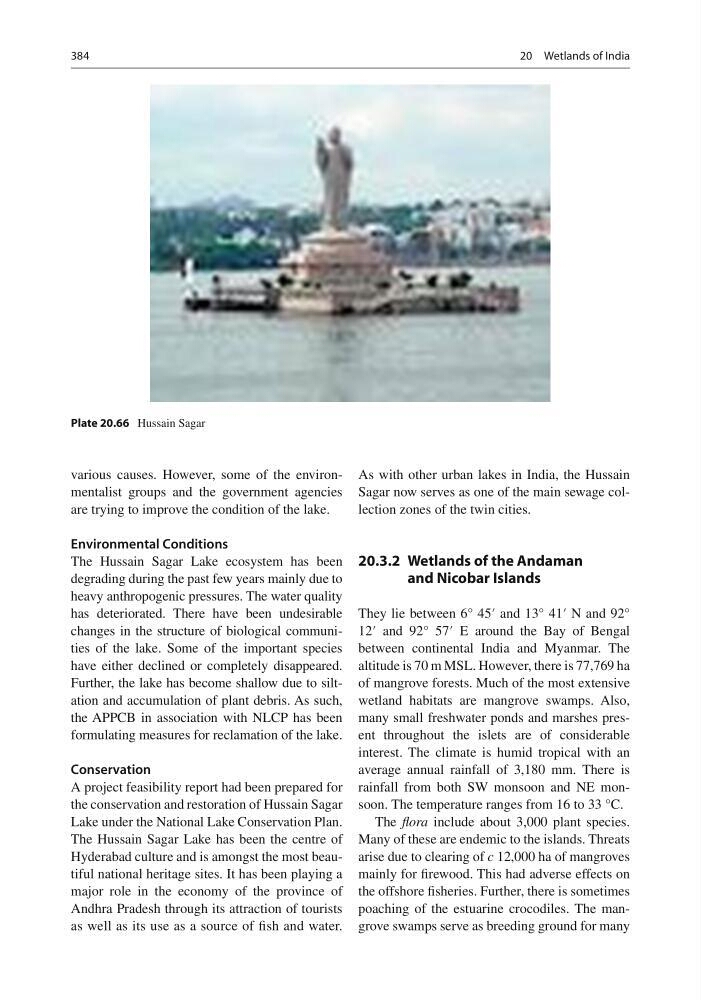
Plate 20.66 Hussain Sagar
20 Wetlands of India
various causes. However, some of the environmentalist groups and the government agencies
are trying to improve the condition of the lake.
Environmental Conditions
The Hussain Sagar Lake ecosystem has been
degrading during the past few years mainly due to
heavy anthropogenic pressures. The water quality
has deteriorated. There have been undesirable
changes in the structure of biological communities of the lake. Some of the important species
have either declined or completely disappeared.
Further, the lake has become shallow due to siltation and accumulation of plant debris. As such,
the APPCB in association with NLCP has been
formulating measures for reclamation of the lake.
Conservation
A project feasibility report had been prepared for
the conservation and restoration of Hussain Sagar
Lake under the National Lake Conservation Plan.
The Hussain Sagar Lake has been the centre of
Hyderabad culture and is amongst the most beautiful national heritage sites. It has been playing a
major role in the economy of the province of
Andhra Pradesh through its attraction of tourists
as well as its use as a source of fi sh and water.
As with other urban lakes in India, the Hussain
Sagar now serves as one of the main sewage collection zones of the twin cities.
20.3.2 Wetlands of the Andaman
and Nicobar Islands
They lie between 6° 45′ and 13° 41′ N and 92°
12′ and 92° 57′ E around the Bay of Bengal
between continental India and Myanmar. The
altitude is 70 m MSL. However, there is 77,769 ha
of mangrove forests. Much of the most extensive
wetland habitats are mangrove swamps. Also,
many small freshwater ponds and marshes present throughout the islets are of considerable
interest. The climate is humid tropical with an
average annual rainfall of 3,180 mm. There is
rainfall from both SW monsoon and NE monsoon. The temperature ranges from 16 to 33 °C.
The fl ora include about 3,000 plant species.
Many of these are endemic to the islands. Threats
arise due to clearing of c 12,000 ha of mangroves
mainly for fi rewood. This had adverse effects on
the offshore fi sheries. Further, there is sometimes
poaching of the estuarine crocodiles. The mangrove swamps serve as breeding ground for many
Plate 20.66 Hussain Sagar
20 Wetlands of India