

383
lake might have been originated due to earthquake. The lake is an important habitat for
approx. 20 million residents and migratory
birds, including the grey or spot- billed pelican
( Pelecanus Philippines ). The lake was notifi ed
as a wildlife sanctuary in November 1999 under
India’s Wildlife Protection Act of 1972. Later, it
was designated a Ramsar wetland of international importance in November 2002. Unlawful
aquaculture and agriculture are the major threats
to this wetland. Satellite images taken on 9
February 2001 by the Indian remote- sensing satellite revealed that c 42 % of the 245- km
2 lake
was engaged by aquaculture (consisting of 1,050
fi sh ponds within the lake and 38 dried- up fi sh
ponds, which together cover an area of 103 km
2 ),
while agriculture had encroached another 8.5 %.
Paddy is the main cultivated crop. Surprisingly,
no clear water could be found in the satellite
image. The rest of the lake has been reduced due
to water diversions or was infested with weeds
like elephant grass and water hyacinth.
The wetland attracts migratory birds (redcrested pochards, black-winged stilts, avocets,
common redshanks, wigeons, gadwalls and cormorants, garganeys, herons, fl amingos, etc., and
numbering approx. 200,000) from northern Asia
and Eastern Europe between October and March.
The resident birds include grey pelicans, Asian
open-billed storks ( Anastomus oscitans ), painted
storks ( Mycteria leucocephala ), glossy ibises,
white ibises, teals, pintails and shovellers.
20.3.1.6 Hussain Sagar
Hussain Sagar (Plate 20.66 ) lying at a surface
elevation 1,759 ft, between 17° 27′ N 78° 30′
E17.45° N 78.5° E, is a signifi cant lentic body
situated between the twin cities of Hyderabad
and Secunderabad in the province of Andhra
Pradesh in India. The lake has a maximum length,
breadth, depth and area of 3.2 km, 2.8 km, 32 ft
and 4.4 km
2 , respectively.
It is an artifi cial reservoir (commonly called
lake), built as a token of gratitude to Hazrat
Hussain Shah Wali by Ibrahim Quli Qutb Shah
during his rule in 1562. It was 5.7 km
2 built across
a tributary of the River Musi to meet the water
and irrigation needs of the city. There is a large
statue of Gautama Buddha in the middle of the
lake which was erected in 1992. At the end of the
Hussain Sagar, one can fi nd the Masjid and
Dargah of Sayedani Maa Tomb. It is a sprawling
artifi cial lake which holds water perennially.
Once the source of drinking water for the twin
cities, the present condition of the lake is bad.
Since the 1980s, the lake has been polluted due to
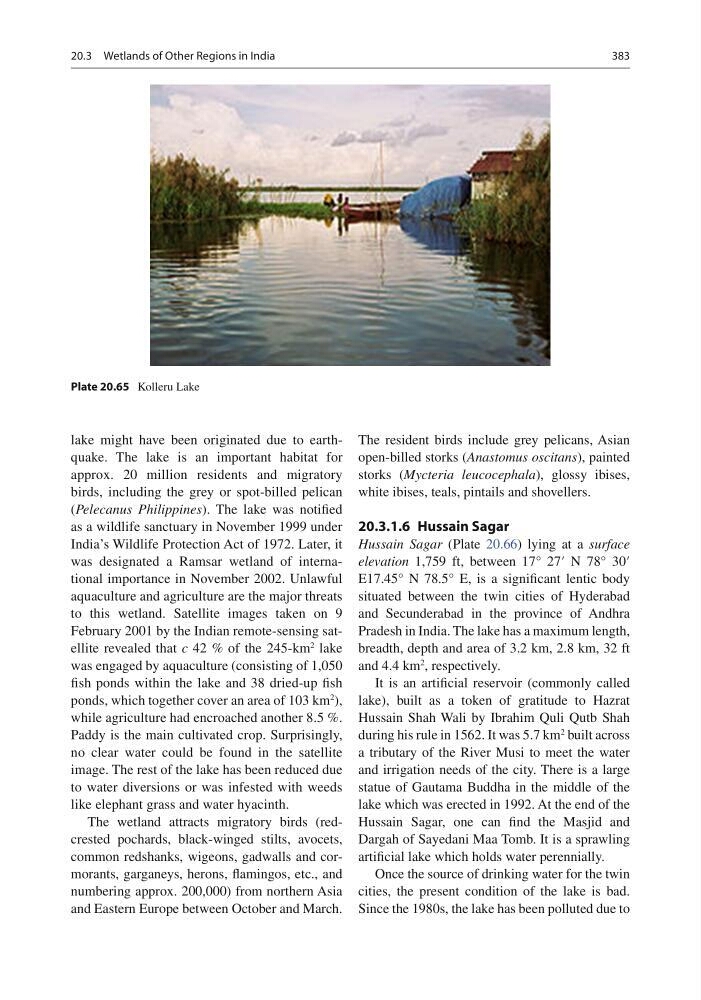
Plate 20.65 Kolleru Lake
20.3 Wetlands of Other Regions in India
lake might have been originated due to earthquake. The lake is an important habitat for
approx. 20 million residents and migratory
birds, including the grey or spot- billed pelican
( Pelecanus Philippines ). The lake was notifi ed
as a wildlife sanctuary in November 1999 under
India’s Wildlife Protection Act of 1972. Later, it
was designated a Ramsar wetland of international importance in November 2002. Unlawful
aquaculture and agriculture are the major threats
to this wetland. Satellite images taken on 9
February 2001 by the Indian remote- sensing satellite revealed that c 42 % of the 245- km
2 lake
was engaged by aquaculture (consisting of 1,050
fi sh ponds within the lake and 38 dried- up fi sh
ponds, which together cover an area of 103 km
2 ),
while agriculture had encroached another 8.5 %.
Paddy is the main cultivated crop. Surprisingly,
no clear water could be found in the satellite
image. The rest of the lake has been reduced due
to water diversions or was infested with weeds
like elephant grass and water hyacinth.
The wetland attracts migratory birds (redcrested pochards, black-winged stilts, avocets,
common redshanks, wigeons, gadwalls and cormorants, garganeys, herons, fl amingos, etc., and
numbering approx. 200,000) from northern Asia
and Eastern Europe between October and March.
The resident birds include grey pelicans, Asian
open-billed storks ( Anastomus oscitans ), painted
storks ( Mycteria leucocephala ), glossy ibises,
white ibises, teals, pintails and shovellers.
20.3.1.6 Hussain Sagar
Hussain Sagar (Plate 20.66 ) lying at a surface
elevation 1,759 ft, between 17° 27′ N 78° 30′
E17.45° N 78.5° E, is a signifi cant lentic body
situated between the twin cities of Hyderabad
and Secunderabad in the province of Andhra
Pradesh in India. The lake has a maximum length,
breadth, depth and area of 3.2 km, 2.8 km, 32 ft
and 4.4 km
2 , respectively.
It is an artifi cial reservoir (commonly called
lake), built as a token of gratitude to Hazrat
Hussain Shah Wali by Ibrahim Quli Qutb Shah
during his rule in 1562. It was 5.7 km
2 built across
a tributary of the River Musi to meet the water
and irrigation needs of the city. There is a large
statue of Gautama Buddha in the middle of the
lake which was erected in 1992. At the end of the
Hussain Sagar, one can fi nd the Masjid and
Dargah of Sayedani Maa Tomb. It is a sprawling
artifi cial lake which holds water perennially.
Once the source of drinking water for the twin
cities, the present condition of the lake is bad.
Since the 1980s, the lake has been polluted due to
Plate 20.65 Kolleru Lake
20.3 Wetlands of Other Regions in India