

365
However, nature lovers are attracted by the
surprisingly great variety of wildlife generally
found in this remote area adjoining the
Myanmarese forests. The Palak Lake is home to
many common wetland birds as well as hill birds.
Further, it is believed to be a winter stopover for
migrating Pintail Duck. The diatoms generally
dominate the phytoplankton. Moreover, a few
elephants still move around in the surrounding
virgin forests. There is a jeepable road from Siaha
to Phura along the Indo-Myanmar border. Efforts
are being made to maintain and preserve this lentic body in its pristine state and environment.
20.2.11 Wetlands in Tripura
The province of Tripura has quite a large number of
wetlands. Moreover, the province has some artifi -
cial tanks, called ‘sagar’, which were constructed
by the earlier rulers of Tripura. An account of some
of the lentic bodies in Tripura is given below.
20.2.11.1 Rudrasagar
The Rudrasagar Lake (Plate 20.54 ), lying at
7–16 m MSL, between 23° 28′ and 23° 33′ N and
91° 16′–91° 20′ E, is a signifi cant Ramsar wetland of tourism importance situated in the
Melagarh Development Block of Sonamura subdivision in Sipahijala District, about 50 km away
from Agartala, the capital of Tripura province of
India. The principal rivers of Tripura are the
Manu, Khowai, Gomati, Feni, Muhuri, Haora,
Dholai, Juri, Kakri, etc. Temperature of the province ranges between 35 and 40 °C during summer
and 7 and 15 °C during winter and RH ranging
generally from 70 to 85 %.
This wetland (commonly called lake) is oval
in shape and has a water spread area of 788 ha at
FSL which shrinks to 240 ha at DSL. According
to Wetlands International (WI), the wetland has
a maximum water spread area of about 8.16 km
2
at FSL which reduces to 1.0 km
2 at DSL.
However, the water-holding capacity of the lake
is 1,668 ha at FSL, which is about 8.16 km
2 .
Further, the wetland has a total catchment area
of c 13,336 ha which includes c 716 ha of small
hillocks having human habitation, c 4,942 ha of
crop land, c 175 ha of marshy land, c 178 ha
‘Jhum’ land, c 466 ha of government orchard
land, c 215 ha of pasture land, c 1,340 ha of
reserve forest area and c 4,534 ha of scrub/bamboo/degraded forest. However, the waterholding
capacity of the lake is 1,668 ha at FSL, which
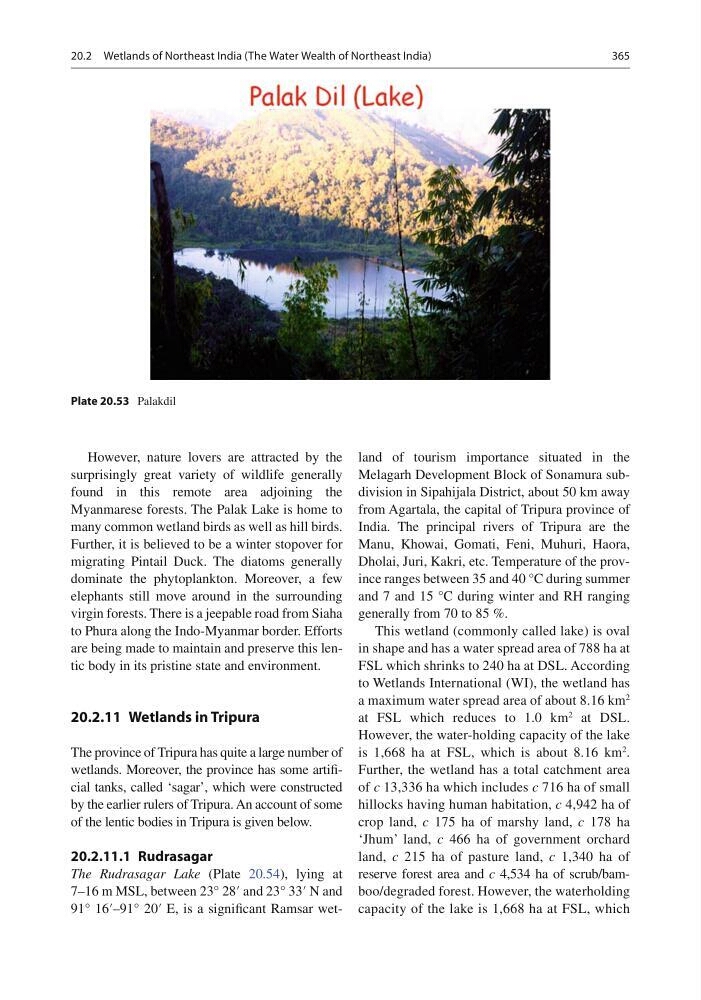
Plate 20.53 Palakdil
20.2 Wetlands of Northeast India (The Water Wealth of Northeast India)
However, nature lovers are attracted by the
surprisingly great variety of wildlife generally
found in this remote area adjoining the
Myanmarese forests. The Palak Lake is home to
many common wetland birds as well as hill birds.
Further, it is believed to be a winter stopover for
migrating Pintail Duck. The diatoms generally
dominate the phytoplankton. Moreover, a few
elephants still move around in the surrounding
virgin forests. There is a jeepable road from Siaha
to Phura along the Indo-Myanmar border. Efforts
are being made to maintain and preserve this lentic body in its pristine state and environment.
20.2.11 Wetlands in Tripura
The province of Tripura has quite a large number of
wetlands. Moreover, the province has some artifi -
cial tanks, called ‘sagar’, which were constructed
by the earlier rulers of Tripura. An account of some
of the lentic bodies in Tripura is given below.
20.2.11.1 Rudrasagar
The Rudrasagar Lake (Plate 20.54 ), lying at
7–16 m MSL, between 23° 28′ and 23° 33′ N and
91° 16′–91° 20′ E, is a signifi cant Ramsar wetland of tourism importance situated in the
Melagarh Development Block of Sonamura subdivision in Sipahijala District, about 50 km away
from Agartala, the capital of Tripura province of
India. The principal rivers of Tripura are the
Manu, Khowai, Gomati, Feni, Muhuri, Haora,
Dholai, Juri, Kakri, etc. Temperature of the province ranges between 35 and 40 °C during summer
and 7 and 15 °C during winter and RH ranging
generally from 70 to 85 %.
This wetland (commonly called lake) is oval
in shape and has a water spread area of 788 ha at
FSL which shrinks to 240 ha at DSL. According
to Wetlands International (WI), the wetland has
a maximum water spread area of about 8.16 km
2
at FSL which reduces to 1.0 km
2 at DSL.
However, the water-holding capacity of the lake
is 1,668 ha at FSL, which is about 8.16 km
2 .
Further, the wetland has a total catchment area
of c 13,336 ha which includes c 716 ha of small
hillocks having human habitation, c 4,942 ha of
crop land, c 175 ha of marshy land, c 178 ha
‘Jhum’ land, c 466 ha of government orchard
land, c 215 ha of pasture land, c 1,340 ha of
reserve forest area and c 4,534 ha of scrub/bamboo/degraded forest. However, the waterholding
capacity of the lake is 1,668 ha at FSL, which
Plate 20.53 Palakdil
20.2 Wetlands of Northeast India (The Water Wealth of Northeast India)