

366
is about 8.16 km
2 . The depth of the wetland
ranges from 1.5 to 2.5 m at DSL and 7.5–8.0 m
at FSL, while it was said to be 12–13 m at FSL
and 5–6 m at DSL during the late 1950s.
According to some, however, Rudrasagar, perhaps, had a water spread area of c 1,000 ha at
DSL during the late 1940s. Rudrasagar Lake
is a natural sedimentation reservoir, which
receives fl ow from three perennial streams,
namely , Noachhara (28 km) (total infl ow 165
M m
3 ), Durlavnarayanchhara (8 km) and
Kemtalichhara/Mayaranichhara (5 km) (total
infl ow 42 M m
3 ).
The air temperature around the wetland generally ranges from 31 to 38 °C during summer
which could sometimes plunge down to 8 °C during winter. The wetland soil is mostly sandy clay
loam admixed with some amount of silt, thus rendering it quite favourable for cultivation of paddy
(Kar 1999 ). Sediments are generally settled in the
wetland. After settling the sediment from the
infl ow, clear water discharges into the River
Gomati through a connective channel known as
Kachigang. Surrounding hillocks, which are part
of the catchment area, are of soft sedimentary
formation. The soil in lake area is silty clay loam
to clay loam. The wetland region has a high rainfall index (2,500 mm/year). As such, the wetland
is regularly fl ooded with 4–5 times annual peak,
assisting in groundwater recharge.
The gross primary productivity and net primary productivity of phytoplankton were estimated to be 93.75 mgC/m
3
/h and 46.88 mgC/
m
3
/h, respectively. The wetland is reported to be
perennially fed with agricultural run-off. Around
20 % of surface area of the lake was covered with
macrophytes with water showing a pH range of
7.6–8.6.
The population density around Rudra Sagar
locality is 650/km
2 (being one of the highest population density areas in the province) as against
304/km
2 of the province. High population density
is due to infl ux of people from East Pakistan
(presently Bangladesh) in the early 1950s. This
had gradually been degrading the wetland.
However, some of the factors affecting the ecology of the lake include (a) continuous siltation
causing shrinking of lake area, (b) increased
human settlement, (c) deforestation in the catchment areas and (d) expansion of agricultural land.
Further, the lake itself is in the process of autogenic succession. As such, the lake, which has lot
of socio-economic importance, faces uncertain
future, unless some urgent management measures are taken up.
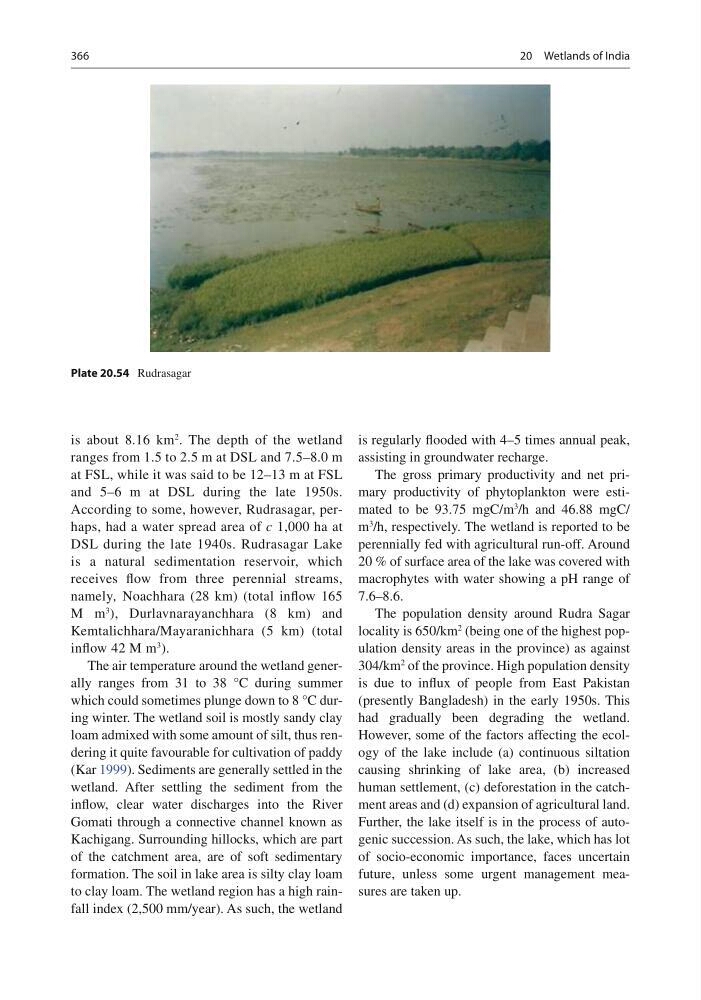
Plate 20.54 Rudrasagar
20 Wetlands of India
is about 8.16 km
2 . The depth of the wetland
ranges from 1.5 to 2.5 m at DSL and 7.5–8.0 m
at FSL, while it was said to be 12–13 m at FSL
and 5–6 m at DSL during the late 1950s.
According to some, however, Rudrasagar, perhaps, had a water spread area of c 1,000 ha at
DSL during the late 1940s. Rudrasagar Lake
is a natural sedimentation reservoir, which
receives fl ow from three perennial streams,
namely , Noachhara (28 km) (total infl ow 165
M m
3 ), Durlavnarayanchhara (8 km) and
Kemtalichhara/Mayaranichhara (5 km) (total
infl ow 42 M m
3 ).
The air temperature around the wetland generally ranges from 31 to 38 °C during summer
which could sometimes plunge down to 8 °C during winter. The wetland soil is mostly sandy clay
loam admixed with some amount of silt, thus rendering it quite favourable for cultivation of paddy
(Kar 1999 ). Sediments are generally settled in the
wetland. After settling the sediment from the
infl ow, clear water discharges into the River
Gomati through a connective channel known as
Kachigang. Surrounding hillocks, which are part
of the catchment area, are of soft sedimentary
formation. The soil in lake area is silty clay loam
to clay loam. The wetland region has a high rainfall index (2,500 mm/year). As such, the wetland
is regularly fl ooded with 4–5 times annual peak,
assisting in groundwater recharge.
The gross primary productivity and net primary productivity of phytoplankton were estimated to be 93.75 mgC/m
3
/h and 46.88 mgC/
m
3
/h, respectively. The wetland is reported to be
perennially fed with agricultural run-off. Around
20 % of surface area of the lake was covered with
macrophytes with water showing a pH range of
7.6–8.6.
The population density around Rudra Sagar
locality is 650/km
2 (being one of the highest population density areas in the province) as against
304/km
2 of the province. High population density
is due to infl ux of people from East Pakistan
(presently Bangladesh) in the early 1950s. This
had gradually been degrading the wetland.
However, some of the factors affecting the ecology of the lake include (a) continuous siltation
causing shrinking of lake area, (b) increased
human settlement, (c) deforestation in the catchment areas and (d) expansion of agricultural land.
Further, the lake itself is in the process of autogenic succession. As such, the lake, which has lot
of socio-economic importance, faces uncertain
future, unless some urgent management measures are taken up.
Plate 20.54 Rudrasagar
20 Wetlands of India