

307
Aquatic Macrophytes (AM)
This wetland is a victim of acute eutrophication
being infested by luxuriant population of
Eichhornia crassipes. Other forms of AM include
Lemna minor, Eleocharis acutangula, Scirpus
eriophorum, Salvinia cucullata, Azolla pinnata
and Ipomoea aquatica .
Plankton
The following genera/species of phytoplankton
generally occur in this wetland: Nostoc, Oscillatoria,
Anabaena, Microcystis, Ankistrodesmus, Chlorella,
Closterium, Euglena, Ceratium, Cosmarium,
Pinnularia, Navicula, etc.
Studies revealed the occurrence of the following genera/species of zooplankton in Satkarakandi
Anua: Arcella sp., Brachionus sp., Lecane sp.,
Keratella sp., Filinia sp., Trichocerca sp.,
Daphnia sp., Moina sp., Alona sp., Chydorus sp .,
Dadaya sp., Cyclops sp ., Diaptomus sp., etc.
Fish Diversity
In Satkarakandi Anua, 32 valid ichthyospecies
belonging to 16 families and 8 orders have been
recorded. Some of the fi sh species are Notopterus
notopterus, Gudusia chapra, Salmophasia bacaila,
Amblypharyngodon mola, Osteobrama cotio,
Puntius chola, P. conchonius, P. ticto, Botia dario,
Mystus cavasius, M. vittatus, Ompok bimaculatus,
Wallago attu, Clarias batrachus, Heteropneustes
fossilis, Anabas testudineus, Xenentodon cancila,
Channa punctatus, Trichogaster fasciatus, Chanda
nama, Mastacembelus armatus, Macrognathus
pancalus, M. aculeatus, etc.
Fish Yield (FY)
Total landing of fi sh ranges from 140 to 425 kg/
year. The total annual fi sh landing was recorded as
2,299 kg, while the average annual landing was
255.44 kg. Gudusia chapra showed maximum
yield (78 %) followed by Puntius ticto (12 %).
The management aspects of Satkarakandi wetland revealed that the wetland suffers from various problems, like overgrowth of aquatic weeds,
closure of feeding channels, unsustained fi shing
and addition of domestic sewage. These could be
overcome by certain steps, like deweeding, opening of the feeding inlets, and sustained fi shing.
Baskandi Anua
Geography
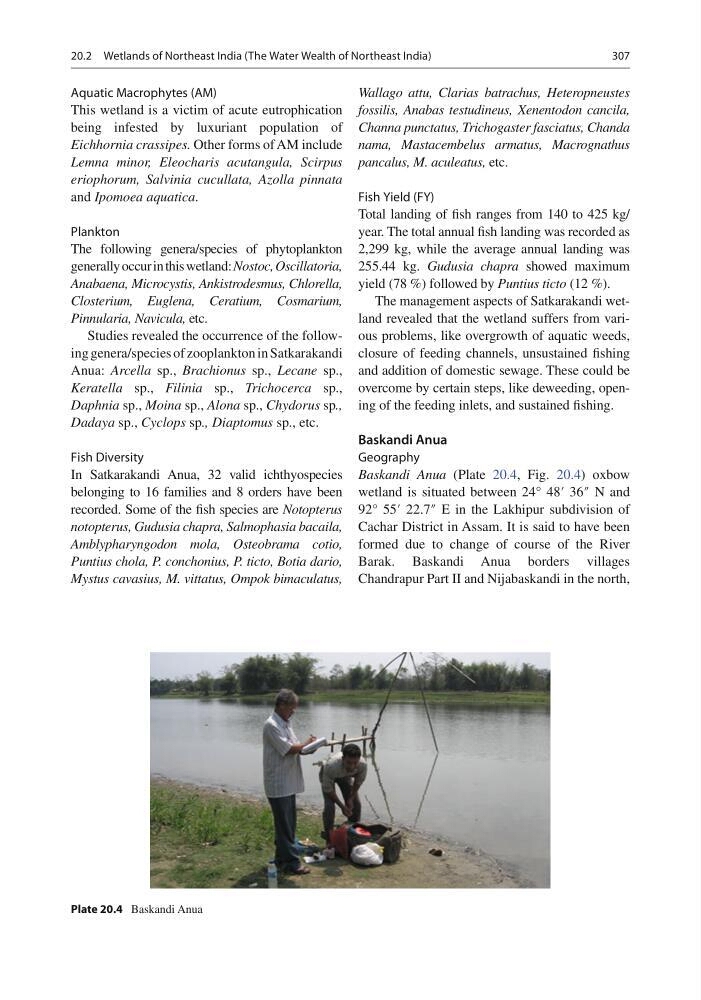
Baskandi Anua (Plate 20.4 , Fig. 20.4 ) oxbow
wetland is situated between 24° 48′ 36″ N and
92° 55′ 22.7″ E in the Lakhipur subdivision of
Cachar District in Assam. It is said to have been
formed due to change of course of the River
Barak. Baskandi Anua borders villages
Chandrapur Part II and Nijabaskandi in the north,
Plate 20.4 Baskandi Anua
20.2 Wetlands of Northeast India (The Water Wealth of Northeast India)
Aquatic Macrophytes (AM)
This wetland is a victim of acute eutrophication
being infested by luxuriant population of
Eichhornia crassipes. Other forms of AM include
Lemna minor, Eleocharis acutangula, Scirpus
eriophorum, Salvinia cucullata, Azolla pinnata
and Ipomoea aquatica .
Plankton
The following genera/species of phytoplankton
generally occur in this wetland: Nostoc, Oscillatoria,
Anabaena, Microcystis, Ankistrodesmus, Chlorella,
Closterium, Euglena, Ceratium, Cosmarium,
Pinnularia, Navicula, etc.
Studies revealed the occurrence of the following genera/species of zooplankton in Satkarakandi
Anua: Arcella sp., Brachionus sp., Lecane sp.,
Keratella sp., Filinia sp., Trichocerca sp.,
Daphnia sp., Moina sp., Alona sp., Chydorus sp .,
Dadaya sp., Cyclops sp ., Diaptomus sp., etc.
Fish Diversity
In Satkarakandi Anua, 32 valid ichthyospecies
belonging to 16 families and 8 orders have been
recorded. Some of the fi sh species are Notopterus
notopterus, Gudusia chapra, Salmophasia bacaila,
Amblypharyngodon mola, Osteobrama cotio,
Puntius chola, P. conchonius, P. ticto, Botia dario,
Mystus cavasius, M. vittatus, Ompok bimaculatus,
Wallago attu, Clarias batrachus, Heteropneustes
fossilis, Anabas testudineus, Xenentodon cancila,
Channa punctatus, Trichogaster fasciatus, Chanda
nama, Mastacembelus armatus, Macrognathus
pancalus, M. aculeatus, etc.
Fish Yield (FY)
Total landing of fi sh ranges from 140 to 425 kg/
year. The total annual fi sh landing was recorded as
2,299 kg, while the average annual landing was
255.44 kg. Gudusia chapra showed maximum
yield (78 %) followed by Puntius ticto (12 %).
The management aspects of Satkarakandi wetland revealed that the wetland suffers from various problems, like overgrowth of aquatic weeds,
closure of feeding channels, unsustained fi shing
and addition of domestic sewage. These could be
overcome by certain steps, like deweeding, opening of the feeding inlets, and sustained fi shing.
Baskandi Anua
Geography
Baskandi Anua (Plate 20.4 , Fig. 20.4 ) oxbow
wetland is situated between 24° 48′ 36″ N and
92° 55′ 22.7″ E in the Lakhipur subdivision of
Cachar District in Assam. It is said to have been
formed due to change of course of the River
Barak. Baskandi Anua borders villages
Chandrapur Part II and Nijabaskandi in the north,
Plate 20.4 Baskandi Anua
20.2 Wetlands of Northeast India (The Water Wealth of Northeast India)