

308
villages Ratangram and Hazarigram in the southwest and village Chandrapur Part III in the south.
The Anua is situated near the Manipur range of
hills. Towards the east lies the Manipur valley,
while the Silchar subdivision is situated in the
west. The North Cachar Hills is situated towards
the north and the province of Mizoram lies towards
the south. The catchment soil is found to be mainly
sandy loam. Rain is the main source of water for
the Anua. The wetland also receives water from
the surrounding catchment having human habitation. The catchment vegetation includes herbs,
shrubs and trees including a lot of bamboos.
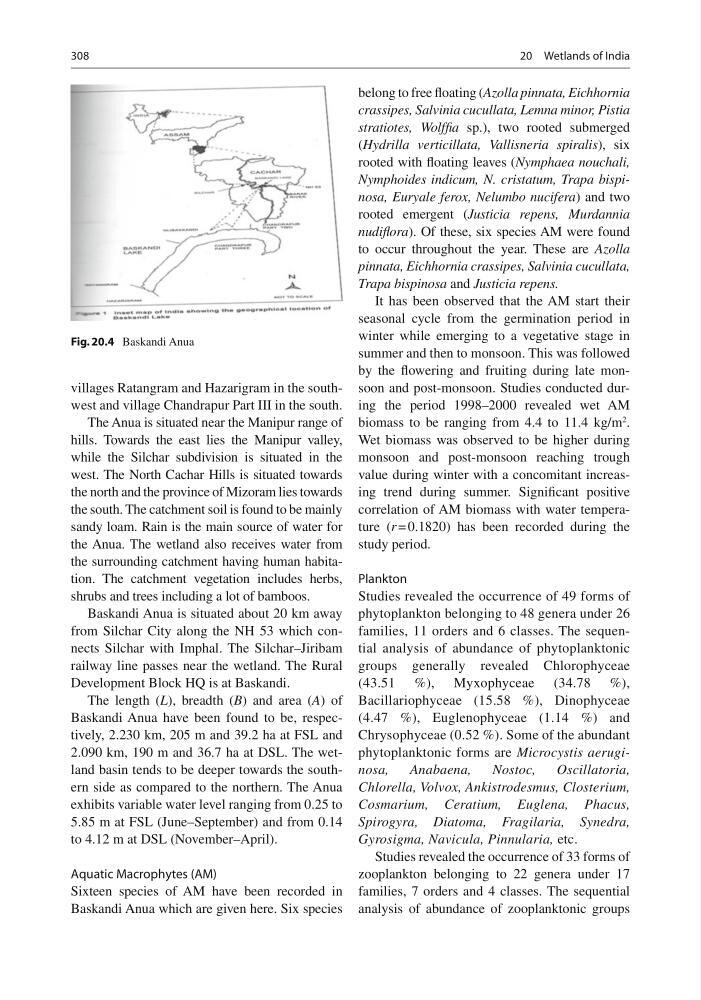
Baskandi Anua is situated about 20 km away
from Silchar City along the NH 53 which connects Silchar with Imphal. The Silchar–Jiribam
railway line passes near the wetland. The Rural
Development Block HQ is at Baskandi.
The length ( L ), breadth ( B ) and area ( A ) of
Baskandi Anua have been found to be, respectively, 2.230 km, 205 m and 39.2 ha at FSL and
2.090 km, 190 m and 36.7 ha at DSL. The wetland basin tends to be deeper towards the southern side as compared to the northern. The Anua
exhibits variable water level ranging from 0.25 to
5.85 m at FSL (June–September) and from 0.14
to 4.12 m at DSL (November–April).
Aquatic Macrophytes (AM)
Sixteen species of AM have been recorded in
Baskandi Anua which are given here. Six species
belong to free fl oating ( Azolla pinnata, Eichhornia
crassipes, Salvinia cucullata, Lemna minor, Pistia
stratiotes, Wolffi a sp.), two rooted submerged
( Hydrilla verticillata, Vallisneria spiralis ), six
rooted with fl oating leaves ( Nymphaea nouchali,
Nymphoides indicum, N. cristatum, Trapa bispinosa, Euryale ferox, Nelumbo nucifera ) and two
rooted emergent ( Justicia repens, Murdannia
nudifl ora ). Of these, six species AM were found
to occur throughout the year. These are Azolla
pinnata, Eichhornia crassipes, Salvinia cucullata,
Trapa bispinosa and Justicia repens.
It has been observed that the AM start their
seasonal cycle from the germination period in
winter while emerging to a vegetative stage in
summer and then to monsoon. This was followed
by the fl owering and fruiting during late monsoon and post-monsoon. Studies conducted during the period 1998–2000 revealed wet AM
biomass to be ranging from 4.4 to 11.4 kg/m
2 .
Wet biomass was observed to be higher during
monsoon and post-monsoon reaching trough
value during winter with a concomitant increasing trend during summer. Signifi cant positive
correlation of AM biomass with water temperature ( r = 0.1820) has been recorded during the
study period.
Plankton
Studies revealed the occurrence of 49 forms of
phytoplankton belonging to 48 genera under 26
families, 11 orders and 6 classes. The sequential analysis of abundance of phytoplanktonic
groups generally revealed Chlorophyceae
(43.51 %), Myxophyceae (34.78 %),
Bacillariophyceae (15.58 %), Dinophyceae
(4.47 %), Euglenophyceae (1.14 %) and
Chrysophyceae (0.52 %). Some of the abundant
phytoplanktonic forms are Microcystis aeruginosa,
Anabaena,
Nostoc,
Oscillatoria,
Chlorella, Volvox, Ankistrodesmus, Closterium,
Cosmarium, Ceratium, Euglena, Phacus,
Spirogyra, Diatoma, Fragilaria, Synedra,
Gyrosigma, Navicula, Pinnularia, etc.
Studies revealed the occurrence of 33 forms of
zooplankton belonging to 22 genera under 17
families, 7 orders and 4 classes. The sequential
analysis of abundance of zooplanktonic groups
Fig. 20.4 Baskandi Anua
20 Wetlands of India
villages Ratangram and Hazarigram in the southwest and village Chandrapur Part III in the south.
The Anua is situated near the Manipur range of
hills. Towards the east lies the Manipur valley,
while the Silchar subdivision is situated in the
west. The North Cachar Hills is situated towards
the north and the province of Mizoram lies towards
the south. The catchment soil is found to be mainly
sandy loam. Rain is the main source of water for
the Anua. The wetland also receives water from
the surrounding catchment having human habitation. The catchment vegetation includes herbs,
shrubs and trees including a lot of bamboos.
Baskandi Anua is situated about 20 km away
from Silchar City along the NH 53 which connects Silchar with Imphal. The Silchar–Jiribam
railway line passes near the wetland. The Rural
Development Block HQ is at Baskandi.
The length ( L ), breadth ( B ) and area ( A ) of
Baskandi Anua have been found to be, respectively, 2.230 km, 205 m and 39.2 ha at FSL and
2.090 km, 190 m and 36.7 ha at DSL. The wetland basin tends to be deeper towards the southern side as compared to the northern. The Anua
exhibits variable water level ranging from 0.25 to
5.85 m at FSL (June–September) and from 0.14
to 4.12 m at DSL (November–April).
Aquatic Macrophytes (AM)
Sixteen species of AM have been recorded in
Baskandi Anua which are given here. Six species
belong to free fl oating ( Azolla pinnata, Eichhornia
crassipes, Salvinia cucullata, Lemna minor, Pistia
stratiotes, Wolffi a sp.), two rooted submerged
( Hydrilla verticillata, Vallisneria spiralis ), six
rooted with fl oating leaves ( Nymphaea nouchali,
Nymphoides indicum, N. cristatum, Trapa bispinosa, Euryale ferox, Nelumbo nucifera ) and two
rooted emergent ( Justicia repens, Murdannia
nudifl ora ). Of these, six species AM were found
to occur throughout the year. These are Azolla
pinnata, Eichhornia crassipes, Salvinia cucullata,
Trapa bispinosa and Justicia repens.
It has been observed that the AM start their
seasonal cycle from the germination period in
winter while emerging to a vegetative stage in
summer and then to monsoon. This was followed
by the fl owering and fruiting during late monsoon and post-monsoon. Studies conducted during the period 1998–2000 revealed wet AM
biomass to be ranging from 4.4 to 11.4 kg/m
2 .
Wet biomass was observed to be higher during
monsoon and post-monsoon reaching trough
value during winter with a concomitant increasing trend during summer. Signifi cant positive
correlation of AM biomass with water temperature ( r = 0.1820) has been recorded during the
study period.
Plankton
Studies revealed the occurrence of 49 forms of
phytoplankton belonging to 48 genera under 26
families, 11 orders and 6 classes. The sequential analysis of abundance of phytoplanktonic
groups generally revealed Chlorophyceae
(43.51 %), Myxophyceae (34.78 %),
Bacillariophyceae (15.58 %), Dinophyceae
(4.47 %), Euglenophyceae (1.14 %) and
Chrysophyceae (0.52 %). Some of the abundant
phytoplanktonic forms are Microcystis aeruginosa,
Anabaena,
Nostoc,
Oscillatoria,
Chlorella, Volvox, Ankistrodesmus, Closterium,
Cosmarium, Ceratium, Euglena, Phacus,
Spirogyra, Diatoma, Fragilaria, Synedra,
Gyrosigma, Navicula, Pinnularia, etc.
Studies revealed the occurrence of 33 forms of
zooplankton belonging to 22 genera under 17
families, 7 orders and 4 classes. The sequential
analysis of abundance of zooplanktonic groups
Fig. 20.4 Baskandi Anua
20 Wetlands of India