

120
wetland in November 2002 on the basis of certain
features like (a) unique faunal diversity with
endemic and vulnerable species, and (b) the lake
is a habitat and a breeding ground for a number of
aquatic birds.
Threats to the Lake
(a) Breeding of birds is, perhaps, affected due to
many tourists, (b) pasture degradation affects
wildlife, (c) an increase in the grazing pressure,
(d) absence of a proper garbage disposal facility,
(e) dogs to be on lead to prevent damage to eggs
of birds.
Conservation Efforts
(a) Action plan is needed to preserve this fragile ecosystem with the help of the stakeholders,
(b) Tsomoriri is already a Wetland Reserve
with necessary restrictions, and (c) WWFIndia works for the conservation of this HAL
with the help of its fi eld offi ce at Korzok in
Rupshu near Tsomoriri. WWF’s works, since
last about four decades, aim to (i) to evolve
Sustainable Model(s) for Management and
conservation of Tsomoriri, Tsokar and Pangong
Tso lakes by involving major stakeholders
(local communities) for Sustainable and
Equitable Development; (ii) socio-economic
surveys be documented for future; (iii) capacity building through training; (d) Wildlife
Institute of India (WII) also has a fi eld station
at Leh to do scientifi c research in the region;
(e) there are also other NGOs and Nature clubs
working for conservation; (f) all these efforts
have encouraged the local community to
declare Tsomoriri as a ‘Sacred Gift for a Living
Planet’ during the Annual Conference held in
Nepal in November 2000; (g) the Indo-Tibetan
Border Police (ITBP), with the help of the tour
operators and local people (Korzok community), have introduced regular garbage cleanup operations; and have also built social
fencing around the wetland to protect breeding
and feeding grounds from vehicular traffi c;
(h) Tsomoriri Conservation Trust has been set
up; (i) the Indian Army has also committed to
support and set up a Nature Interpretation
Centre at ‘Hall of Fame’ at Leh.
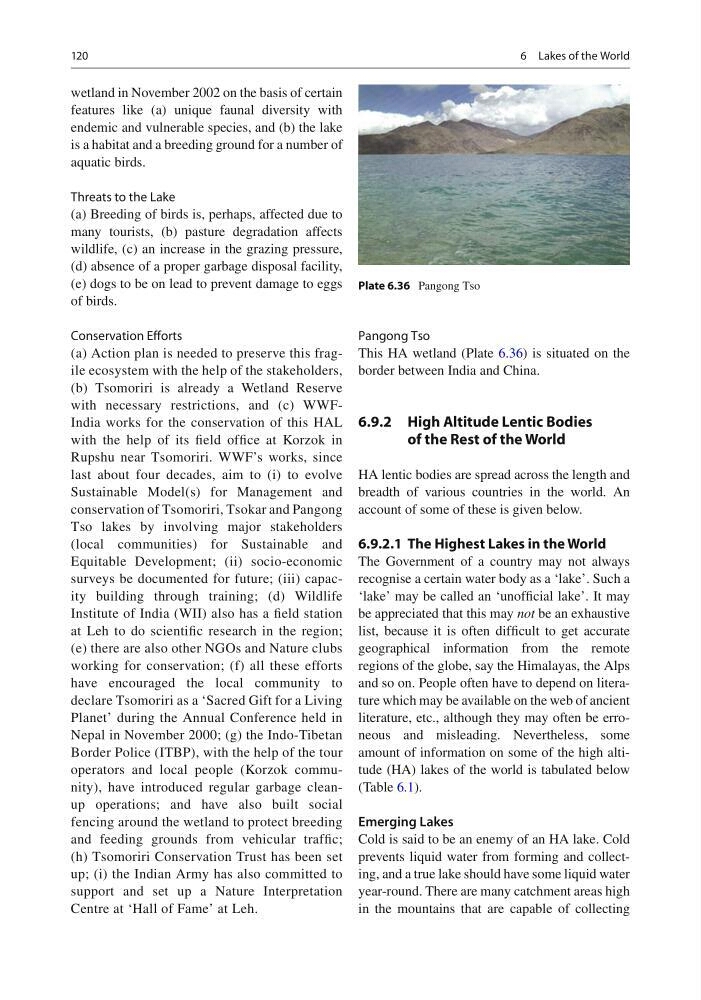
Pangong Tso
This HA wetland (Plate 6.36 ) is situated on the
border between India and China.
6.9.2 High Altitude Lentic Bodies
of the Rest of the World
HA lentic bodies are spread across the length and
breadth of various countries in the world. An
account of some of these is given below.
6.9.2.1 The Highest Lakes in the World
The Government of a country may not always
recognise a certain water body as a ‘lake’. Such a
‘lake’ may be called an ‘unoffi cial lake’. It may
be appreciated that this may not be an exhaustive
list, because it is often diffi cult to get accurate
geographical information from the remote
regions of the globe, say the Himalayas, the Alps
and so on. People often have to depend on literature which may be available on the web of ancient
literature, etc. , although they may often be erroneous and misleading. Nevertheless, some
amount of information on some of the high altitude (HA) lakes of the world is tabulated below
(Table 6.1 ).
Emerging Lakes
Cold is said to be an enemy of an HA lake. Cold
prevents liquid water from forming and collecting, and a true lake should have some liquid water
year-round. There are many catchment areas high
in the mountains that are capable of collecting
Plate 6.36 Pangong Tso
6 Lakes of the World
wetland in November 2002 on the basis of certain
features like (a) unique faunal diversity with
endemic and vulnerable species, and (b) the lake
is a habitat and a breeding ground for a number of
aquatic birds.
Threats to the Lake
(a) Breeding of birds is, perhaps, affected due to
many tourists, (b) pasture degradation affects
wildlife, (c) an increase in the grazing pressure,
(d) absence of a proper garbage disposal facility,
(e) dogs to be on lead to prevent damage to eggs
of birds.
Conservation Efforts
(a) Action plan is needed to preserve this fragile ecosystem with the help of the stakeholders,
(b) Tsomoriri is already a Wetland Reserve
with necessary restrictions, and (c) WWFIndia works for the conservation of this HAL
with the help of its fi eld offi ce at Korzok in
Rupshu near Tsomoriri. WWF’s works, since
last about four decades, aim to (i) to evolve
Sustainable Model(s) for Management and
conservation of Tsomoriri, Tsokar and Pangong
Tso lakes by involving major stakeholders
(local communities) for Sustainable and
Equitable Development; (ii) socio-economic
surveys be documented for future; (iii) capacity building through training; (d) Wildlife
Institute of India (WII) also has a fi eld station
at Leh to do scientifi c research in the region;
(e) there are also other NGOs and Nature clubs
working for conservation; (f) all these efforts
have encouraged the local community to
declare Tsomoriri as a ‘Sacred Gift for a Living
Planet’ during the Annual Conference held in
Nepal in November 2000; (g) the Indo-Tibetan
Border Police (ITBP), with the help of the tour
operators and local people (Korzok community), have introduced regular garbage cleanup operations; and have also built social
fencing around the wetland to protect breeding
and feeding grounds from vehicular traffi c;
(h) Tsomoriri Conservation Trust has been set
up; (i) the Indian Army has also committed to
support and set up a Nature Interpretation
Centre at ‘Hall of Fame’ at Leh.
Pangong Tso
This HA wetland (Plate 6.36 ) is situated on the
border between India and China.
6.9.2 High Altitude Lentic Bodies
of the Rest of the World
HA lentic bodies are spread across the length and
breadth of various countries in the world. An
account of some of these is given below.
6.9.2.1 The Highest Lakes in the World
The Government of a country may not always
recognise a certain water body as a ‘lake’. Such a
‘lake’ may be called an ‘unoffi cial lake’. It may
be appreciated that this may not be an exhaustive
list, because it is often diffi cult to get accurate
geographical information from the remote
regions of the globe, say the Himalayas, the Alps
and so on. People often have to depend on literature which may be available on the web of ancient
literature, etc. , although they may often be erroneous and misleading. Nevertheless, some
amount of information on some of the high altitude (HA) lakes of the world is tabulated below
(Table 6.1 ).
Emerging Lakes
Cold is said to be an enemy of an HA lake. Cold
prevents liquid water from forming and collecting, and a true lake should have some liquid water
year-round. There are many catchment areas high
in the mountains that are capable of collecting
Plate 6.36 Pangong Tso
6 Lakes of the World