

119
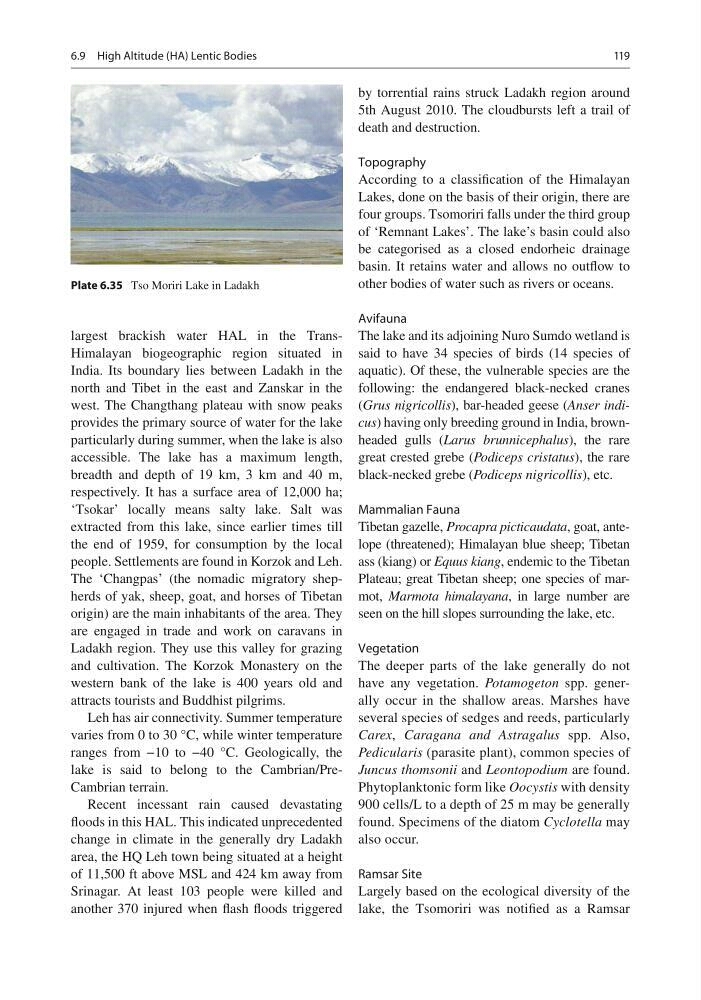
largest brackish water HAL in the TransHimalayan biogeographic region situated in
India. Its boundary lies between Ladakh in the
north and Tibet in the east and Zanskar in the
west. The Changthang plateau with snow peaks
provides the primary source of water for the lake
particularly during summer, when the lake is also
accessible. The lake has a maximum length,
breadth and depth of 19 km, 3 km and 40 m,
respectively. It has a surface area of 12,000 ha;
‘Tsokar’ locally means salty lake. Salt was
extracted from this lake, since earlier times till
the end of 1959, for consumption by the local
people. Settlements are found in Korzok and Leh.
The ‘Changpas’ (the nomadic migratory shepherds of yak, sheep, goat, and horses of Tibetan
origin) are the main inhabitants of the area. They
are engaged in trade and work on caravans in
Ladakh region. They use this valley for grazing
and cultivation. The Korzok Monastery on the
western bank of the lake is 400 years old and
attracts tourists and Buddhist pilgrims.
Leh has air connectivity. Summer temperature
varies from 0 to 30 °C, while winter temperature
ranges from −10 to −40 °C. Geologically, the
lake is said to belong to the Cambrian/PreCambrian terrain.
Recent incessant rain caused devastating
fl oods in this HAL. This indicated unprecedented
change in climate in the generally dry Ladakh
area, the HQ Leh town being situated at a height
of 11,500 ft above MSL and 424 km away from
Srinagar. At least 103 people were killed and
another 370 injured when fl ash fl oods triggered
by torrential rains struck Ladakh region around
5th August 2010. The cloudbursts left a trail of
death and destruction.
Topography
According to a classifi cation of the Himalayan
Lakes, done on the basis of their origin, there are
four groups. Tsomoriri falls under the third group
of ‘Remnant Lakes’. The lake’s basin could also
be categorised as a closed endorheic drainage
basin. It retains water and allows no outfl ow to
other bodies of water such as rivers or oceans.
Avifauna
The lake and its adjoining Nuro Sumdo wetland is
said to have 34 species of birds (14 species of
aquatic). Of these, the vulnerable species are the
following: the endangered black-necked cranes
( Grus nigricollis ), bar-headed geese ( Anser indicus ) having only breeding ground in India, brownheaded gulls ( Larus brunnicephalus ), the rare
great crested grebe ( Podiceps cristatus ), the rare
black-necked grebe ( Podiceps nigricollis ), etc.
Mammalian Fauna
Tibetan gazelle, Procapra picticaudata , goat, antelope (threatened); Himalayan blue sheep; Tibetan
ass (kiang) or Equus kiang , endemic to the Tibetan
Plateau; great Tibetan sheep; one species of marmot, Marmota himalayana , in large number are
seen on the hill slopes surrounding the lake, etc.
Vegetation
The deeper parts of the lake generally do not
have any vegetation. Potamogeton spp. generally occur in the shallow areas. Marshes have
several species of sedges and reeds, particularly
Carex , Caragana and Astragalus spp. Also,
Pedicularis (parasite plant), common species of
Juncus thomsonii and Leontopodium are found.
Phytoplanktonic form like Oocystis with density
900 cells/L to a depth of 25 m may be generally
found. Specimens of the diatom Cyclotella may
also occur.
Ramsar Site
Largely based on the ecological diversity of the
lake, the Tsomoriri was notifi ed as a Ramsar
Plate 6.35 Tso Moriri Lake in Ladakh
6.9 High Altitude (HA) Lentic Bodies
largest brackish water HAL in the TransHimalayan biogeographic region situated in
India. Its boundary lies between Ladakh in the
north and Tibet in the east and Zanskar in the
west. The Changthang plateau with snow peaks
provides the primary source of water for the lake
particularly during summer, when the lake is also
accessible. The lake has a maximum length,
breadth and depth of 19 km, 3 km and 40 m,
respectively. It has a surface area of 12,000 ha;
‘Tsokar’ locally means salty lake. Salt was
extracted from this lake, since earlier times till
the end of 1959, for consumption by the local
people. Settlements are found in Korzok and Leh.
The ‘Changpas’ (the nomadic migratory shepherds of yak, sheep, goat, and horses of Tibetan
origin) are the main inhabitants of the area. They
are engaged in trade and work on caravans in
Ladakh region. They use this valley for grazing
and cultivation. The Korzok Monastery on the
western bank of the lake is 400 years old and
attracts tourists and Buddhist pilgrims.
Leh has air connectivity. Summer temperature
varies from 0 to 30 °C, while winter temperature
ranges from −10 to −40 °C. Geologically, the
lake is said to belong to the Cambrian/PreCambrian terrain.
Recent incessant rain caused devastating
fl oods in this HAL. This indicated unprecedented
change in climate in the generally dry Ladakh
area, the HQ Leh town being situated at a height
of 11,500 ft above MSL and 424 km away from
Srinagar. At least 103 people were killed and
another 370 injured when fl ash fl oods triggered
by torrential rains struck Ladakh region around
5th August 2010. The cloudbursts left a trail of
death and destruction.
Topography
According to a classifi cation of the Himalayan
Lakes, done on the basis of their origin, there are
four groups. Tsomoriri falls under the third group
of ‘Remnant Lakes’. The lake’s basin could also
be categorised as a closed endorheic drainage
basin. It retains water and allows no outfl ow to
other bodies of water such as rivers or oceans.
Avifauna
The lake and its adjoining Nuro Sumdo wetland is
said to have 34 species of birds (14 species of
aquatic). Of these, the vulnerable species are the
following: the endangered black-necked cranes
( Grus nigricollis ), bar-headed geese ( Anser indicus ) having only breeding ground in India, brownheaded gulls ( Larus brunnicephalus ), the rare
great crested grebe ( Podiceps cristatus ), the rare
black-necked grebe ( Podiceps nigricollis ), etc.
Mammalian Fauna
Tibetan gazelle, Procapra picticaudata , goat, antelope (threatened); Himalayan blue sheep; Tibetan
ass (kiang) or Equus kiang , endemic to the Tibetan
Plateau; great Tibetan sheep; one species of marmot, Marmota himalayana , in large number are
seen on the hill slopes surrounding the lake, etc.
Vegetation
The deeper parts of the lake generally do not
have any vegetation. Potamogeton spp. generally occur in the shallow areas. Marshes have
several species of sedges and reeds, particularly
Carex , Caragana and Astragalus spp. Also,
Pedicularis (parasite plant), common species of
Juncus thomsonii and Leontopodium are found.
Phytoplanktonic form like Oocystis with density
900 cells/L to a depth of 25 m may be generally
found. Specimens of the diatom Cyclotella may
also occur.
Ramsar Site
Largely based on the ecological diversity of the
lake, the Tsomoriri was notifi ed as a Ramsar
Plate 6.35 Tso Moriri Lake in Ladakh
6.9 High Altitude (HA) Lentic Bodies