

80
4.4 Early diagenesis and heavy metal mobility in other freshwater
Sediments: a comparison
4.4.1. Major rivers of Germany: Rhine, Main, Weser, and Elbe.
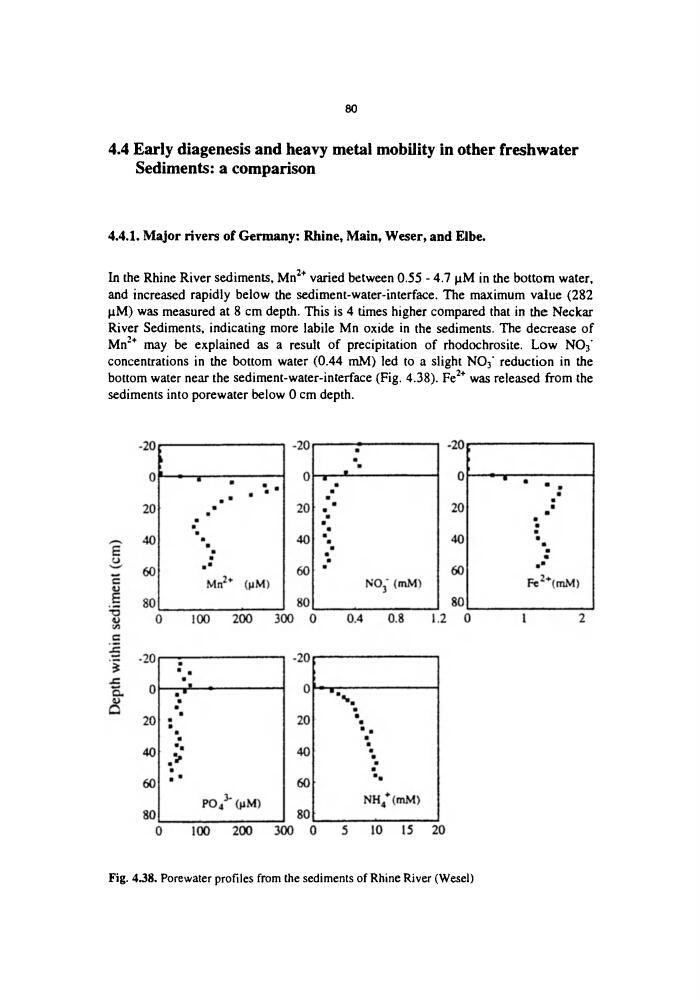
In the Rhine River sediments, Mn :+ varied between 0.55 - 4.7 laM in the bottom water,
and increased rapidly below the sediment-water-interface. The maximum value (282
laM) was measured at 8 cm depth. This is 4 times higher compared that in the Neckar
River Sediments, indicating more labile Mn oxide in the sediments. The decrease of
Mn z+ may be explained as a result of precipitation of rhodochrosite. Low NO3"
concentrations in the bottom water (0.44 raM) led to a slight NO3" reduction in the
bottom water near the sediment-water-interface (Fig. 4.38). Fe z+ was released from the
sediments into porewater below 0 cm depth.
E
eE
e..
e "
-20
0
20
40
60
80
0
-20
0
20
40
60
80
0
i 9
Mn z§ (~M)
1do 2do
i i 9
9
Po43~ (I~M)
36)0
20
0 9
2 0
9 1 4 9
40 9
60 "
%
Im
NO 3- (raM)
8O
0
014
018
-20
1130
2130
300
20
0 ; : mmm 9
2.0
",
UU 9149
40
~
6O
NIt4* (raM)
80
o
o 's
it 15
-20
0
20
40
60
80
1.2
g
9
Fe2+(mM)
0
1
2
Fig. 4J8. Porewater profiles from the sediments of Rhine River (Wesel)
4.4 Early diagenesis and heavy metal mobility in other freshwater
Sediments: a comparison
4.4.1. Major rivers of Germany: Rhine, Main, Weser, and Elbe.
In the Rhine River sediments, Mn :+ varied between 0.55 - 4.7 laM in the bottom water,
and increased rapidly below the sediment-water-interface. The maximum value (282
laM) was measured at 8 cm depth. This is 4 times higher compared that in the Neckar
River Sediments, indicating more labile Mn oxide in the sediments. The decrease of
Mn z+ may be explained as a result of precipitation of rhodochrosite. Low NO3"
concentrations in the bottom water (0.44 raM) led to a slight NO3" reduction in the
bottom water near the sediment-water-interface (Fig. 4.38). Fe z+ was released from the
sediments into porewater below 0 cm depth.
E
eE
e..
e "
-20
0
20
40
60
80
0
-20
0
20
40
60
80
0
i 9
Mn z§ (~M)
1do 2do
i i 9
9
Po43~ (I~M)
36)0
20
0 9
2 0
9 1 4 9
40 9
60 "
%
Im
NO 3- (raM)
8O
0
014
018
-20
1130
2130
300
20
0 ; : mmm 9
2.0
",
UU 9149
40
~
6O
NIt4* (raM)
80
o
o 's
it 15
-20
0
20
40
60
80
1.2
g
9
Fe2+(mM)
0
1
2
Fig. 4J8. Porewater profiles from the sediments of Rhine River (Wesel)