

79
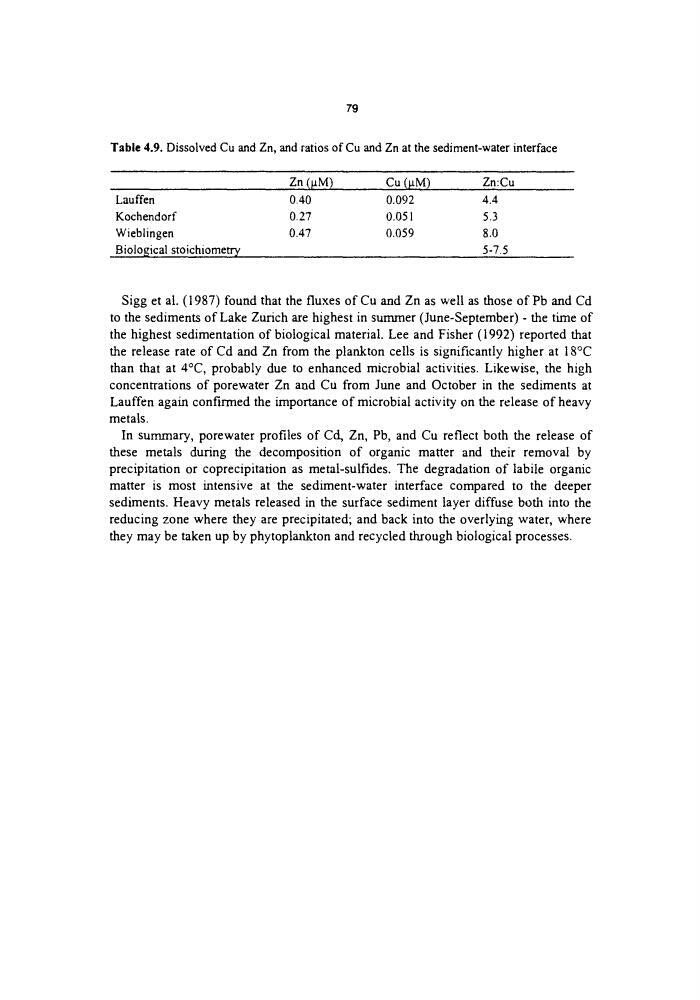
Table 4.9. Dissolved Cu and Zn, and ratios of Cu and Zn at the sediment-water interface
Zn (/aM)
Cu ([tM)
Zn:Cu
Lauffen
0.40
0.092
4.4
Kochendorf
0.27
0.051
5.3
Wieblingen
0.47
0.059
8.0
Biological stoichiometry
5-7.5
Sigg et al. (1987) found that the fluxes of Cu and Zn as well as those of Pb and Cd
to the sediments of Lake Zurich are highest in summer (June-September) - the time of
the highest sedimentation of biological material. Lee and Fisher (1992) reported that
the release rate of Cd and Zn from the plankton cells is significantly higher at 18~
than that at 4~ probably due to enhanced microbial activities. Likewise, the high
concentrations of porewater Zn and Cu from June and October in the sediments at
Lauffen again confirmed the importance of microbial activity on the release of heavy
metals.
In summary, porewater profiles of Cd, Zn, Pb, and Cu reflect both the release of
these metals during the decomposition of organic matter and their removal by
precipitation or coprecipitation as metal-sulfides. The degradation of labile organic
matter is most intensive at the sediment-water interface compared to the deeper
sediments. Heavy metals released in the surface sediment layer diffuse both into the
reducing zone where they are precipitated; and back into the overlying water, where
they may be taken up by phytoplankton and recycled through biological processes.
Table 4.9. Dissolved Cu and Zn, and ratios of Cu and Zn at the sediment-water interface
Zn (/aM)
Cu ([tM)
Zn:Cu
Lauffen
0.40
0.092
4.4
Kochendorf
0.27
0.051
5.3
Wieblingen
0.47
0.059
8.0
Biological stoichiometry
5-7.5
Sigg et al. (1987) found that the fluxes of Cu and Zn as well as those of Pb and Cd
to the sediments of Lake Zurich are highest in summer (June-September) - the time of
the highest sedimentation of biological material. Lee and Fisher (1992) reported that
the release rate of Cd and Zn from the plankton cells is significantly higher at 18~
than that at 4~ probably due to enhanced microbial activities. Likewise, the high
concentrations of porewater Zn and Cu from June and October in the sediments at
Lauffen again confirmed the importance of microbial activity on the release of heavy
metals.
In summary, porewater profiles of Cd, Zn, Pb, and Cu reflect both the release of
these metals during the decomposition of organic matter and their removal by
precipitation or coprecipitation as metal-sulfides. The degradation of labile organic
matter is most intensive at the sediment-water interface compared to the deeper
sediments. Heavy metals released in the surface sediment layer diffuse both into the
reducing zone where they are precipitated; and back into the overlying water, where
they may be taken up by phytoplankton and recycled through biological processes.