

406
Y. Argaman et at.
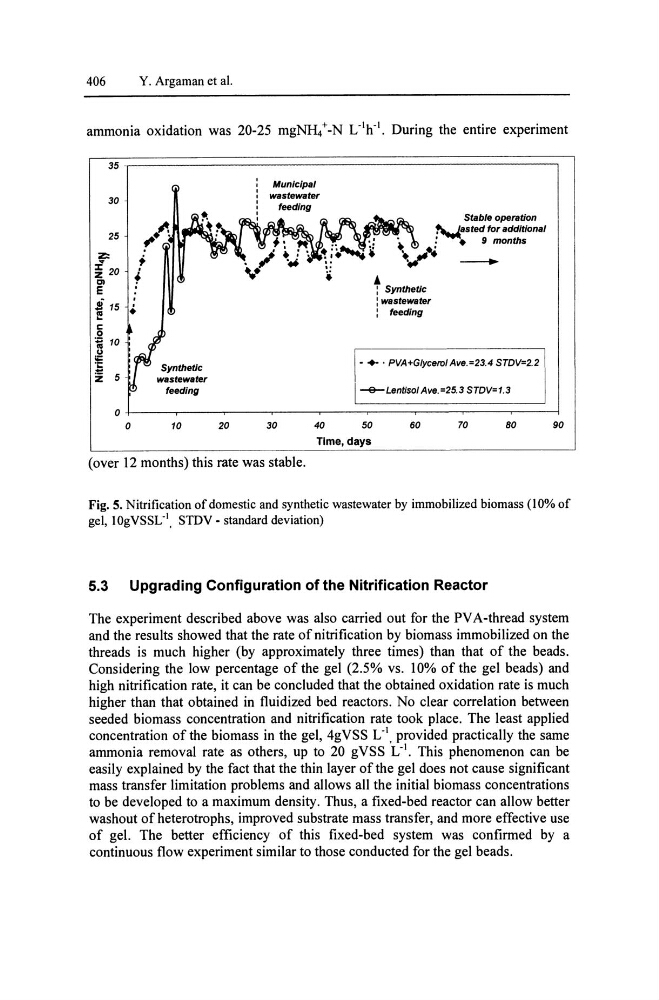
ammonia oxidation was 20-25 mgNH/-N L'lh'l. During the entire experiment
35
30
25
~
i! 20
Cl
E
Synthetic
wastewater
feeding
Municipal
wastewater
feeding
Stable operation
~asted for additional
..
:
•
9 months
.. .."t'.. -
i
: Synthetic
: wastewater
: feeding
- .... PVA+Glycerol Ave.=23.4 STDV=2.2
-€J-Lentisol Ave.=25.3 STDV=1.3
O+-----~-----r----~----~------r_----~----,_----_r----~
o
10
20
30
40
50
60
70
80
90
Time, days
(over 12 months) this rate was stable.
Fig. 5. Nitrification of domestic and synthetic wastewater by immobilized biomass (10% of
gel,lOgVSSL", STOV - standard deviation)
5.3
Upgrading Configuration of the Nitrification Reactor
The experiment described above was also carried out for the PV A-thread system
and the results showed that the rate of nitrification by biomass immobilized on the
threads is much higher (by approximately three times) than that of the beads.
Considering the low percentage of the gel (2.5% vs. 10% of the gel beads) and
high nitrification rate, it can be concluded that the obtained oxidation rate is much
higher than that obtained in fluidized bed reactors. No clear correlation between
seeded biomass concentration and nitrification rate took place. The least applied
concentration of the biomass in the gel, 4gVSS L", provided practically the same
ammonia removal rate as others, up to 20 gVSS L'l, This phenomenon can be
easily explained by the fact that the thin layer of the gel does not cause significant
mass transfer limitation problems and allows all the initial biomass concentrations
to be developed to a maximum density, Thus, a fixed-bed reactor can allow better
washout ofheterotrophs, improved substrate mass transfer, and more effective use
of gel. The better efficiency of this fixed-bed system was confirmed by a
continuous flow experiment similar to those conducted for the gel beads.
Y. Argaman et at.
ammonia oxidation was 20-25 mgNH/-N L'lh'l. During the entire experiment
35
30
25
~
i! 20
Cl
E
Synthetic
wastewater
feeding
Municipal
wastewater
feeding
Stable operation
~asted for additional
..
:
•
9 months
.. .."t'.. -
i
: Synthetic
: wastewater
: feeding
- .... PVA+Glycerol Ave.=23.4 STDV=2.2
-€J-Lentisol Ave.=25.3 STDV=1.3
O+-----~-----r----~----~------r_----~----,_----_r----~
o
10
20
30
40
50
60
70
80
90
Time, days
(over 12 months) this rate was stable.
Fig. 5. Nitrification of domestic and synthetic wastewater by immobilized biomass (10% of
gel,lOgVSSL", STOV - standard deviation)
5.3
Upgrading Configuration of the Nitrification Reactor
The experiment described above was also carried out for the PV A-thread system
and the results showed that the rate of nitrification by biomass immobilized on the
threads is much higher (by approximately three times) than that of the beads.
Considering the low percentage of the gel (2.5% vs. 10% of the gel beads) and
high nitrification rate, it can be concluded that the obtained oxidation rate is much
higher than that obtained in fluidized bed reactors. No clear correlation between
seeded biomass concentration and nitrification rate took place. The least applied
concentration of the biomass in the gel, 4gVSS L", provided practically the same
ammonia removal rate as others, up to 20 gVSS L'l, This phenomenon can be
easily explained by the fact that the thin layer of the gel does not cause significant
mass transfer limitation problems and allows all the initial biomass concentrations
to be developed to a maximum density, Thus, a fixed-bed reactor can allow better
washout ofheterotrophs, improved substrate mass transfer, and more effective use
of gel. The better efficiency of this fixed-bed system was confirmed by a
continuous flow experiment similar to those conducted for the gel beads.