

Biological Nitrogen Removal Using Immobilized Bacteria
407
Although, the gel-thread reactor is expected to provide better performance than
lens beads, one possible weakness of the method should be verified by the pilotplant operation using municipal wastewater. This is required due to the fact that
the fixed-bed reactor is characterized by a high surface that may be occupied by
heterotrophic bacteria, which may affect nitrification and consume organics
required for denitrification. This concern should be verified by the experiment
employing municipal wastewater, which is currently in progress.
5.4 Feasibility Study of Prolonged Nitrification Interruption
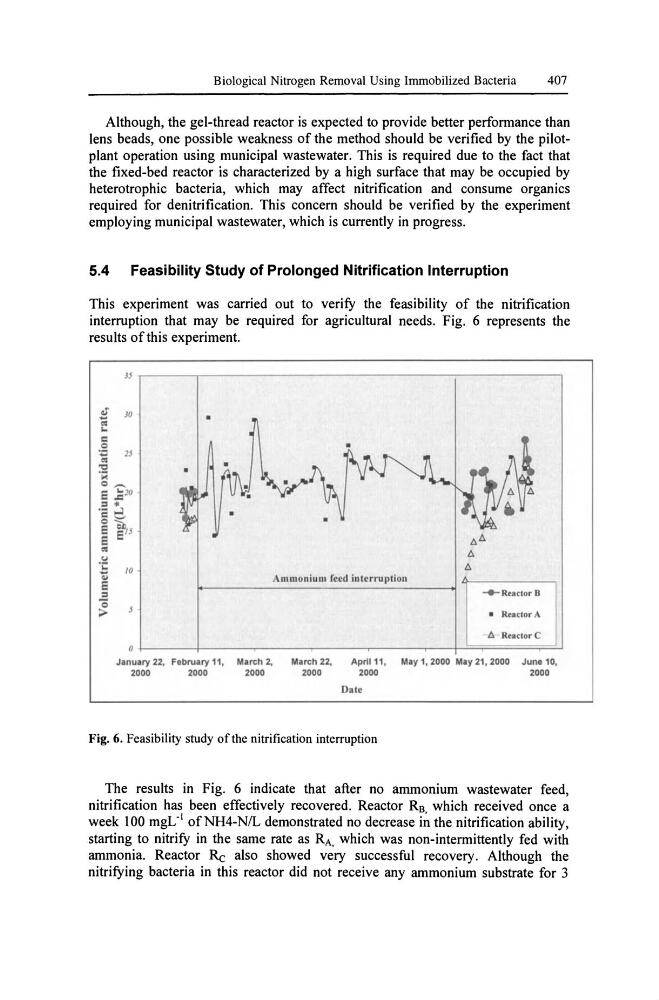
This experiment was carried out to verify the feasibility of the nitrification
interruption that may be required for agricultural needs. Fig. 6 represents the
results of this experiment.
J j.------;r-------------------------------~~----------_,
Ammonium reed interruption
~Reac.torB
• Ruc.torA
J;. Rea •• or C
January 22, February 11, March 2,
March 22,
April 11,
May 1, 2000 May 21, 2000 June 10,
2000
2000
2000
2000
2000
2000
Date
Fig. 6. Feasibility study of the nitrification interruption
The results in Fig. 6 indicate that after no ammonium wastewater feed,
nitrification has been effectively recovered. Reactor RB which received once a
week 100 mgL· 1 ofNH4-NIL demonstrated no decrease i~ the nitrification ability,
starting to nitrify in the same rate as RA, which was non-intermittently fed with
ammonia. Reactor Rc also showed very successful recovery. Although the
nitrifying bacteria in this reactor did not receive any ammonium substrate for 3
407
Although, the gel-thread reactor is expected to provide better performance than
lens beads, one possible weakness of the method should be verified by the pilotplant operation using municipal wastewater. This is required due to the fact that
the fixed-bed reactor is characterized by a high surface that may be occupied by
heterotrophic bacteria, which may affect nitrification and consume organics
required for denitrification. This concern should be verified by the experiment
employing municipal wastewater, which is currently in progress.
5.4 Feasibility Study of Prolonged Nitrification Interruption
This experiment was carried out to verify the feasibility of the nitrification
interruption that may be required for agricultural needs. Fig. 6 represents the
results of this experiment.
J j.------;r-------------------------------~~----------_,
Ammonium reed interruption
~Reac.torB
• Ruc.torA
J;. Rea •• or C
January 22, February 11, March 2,
March 22,
April 11,
May 1, 2000 May 21, 2000 June 10,
2000
2000
2000
2000
2000
2000
Date
Fig. 6. Feasibility study of the nitrification interruption
The results in Fig. 6 indicate that after no ammonium wastewater feed,
nitrification has been effectively recovered. Reactor RB which received once a
week 100 mgL· 1 ofNH4-NIL demonstrated no decrease i~ the nitrification ability,
starting to nitrify in the same rate as RA, which was non-intermittently fed with
ammonia. Reactor Rc also showed very successful recovery. Although the
nitrifying bacteria in this reactor did not receive any ammonium substrate for 3