

404
Y. Argaman et al.
shapes of the gel matrix were produced based on the method reported by Jekel et
al. (1998): lens-shaped beads and thin-layer gel threads.
40 r---------------------------------------~
35
I
g 30
CD
.:;
~ 25
~
z
'" E 20
o
o
/ \
/,.,.0
c 15
A/ "--.; 0,'
.e
• "
•
• •
itOp:····· ...
z .
0
5
0
"
,
" ~
•
,
-3gfL
- • °6 gIL
--6-9 gfL
- -1.5 gIL
o 12
00
_______ - -..I - - - - ----- -
-
o ·~~~~--~----~----~----~----~--------------~
o
5
10
15
20
25
30
35
40
45
Time, days
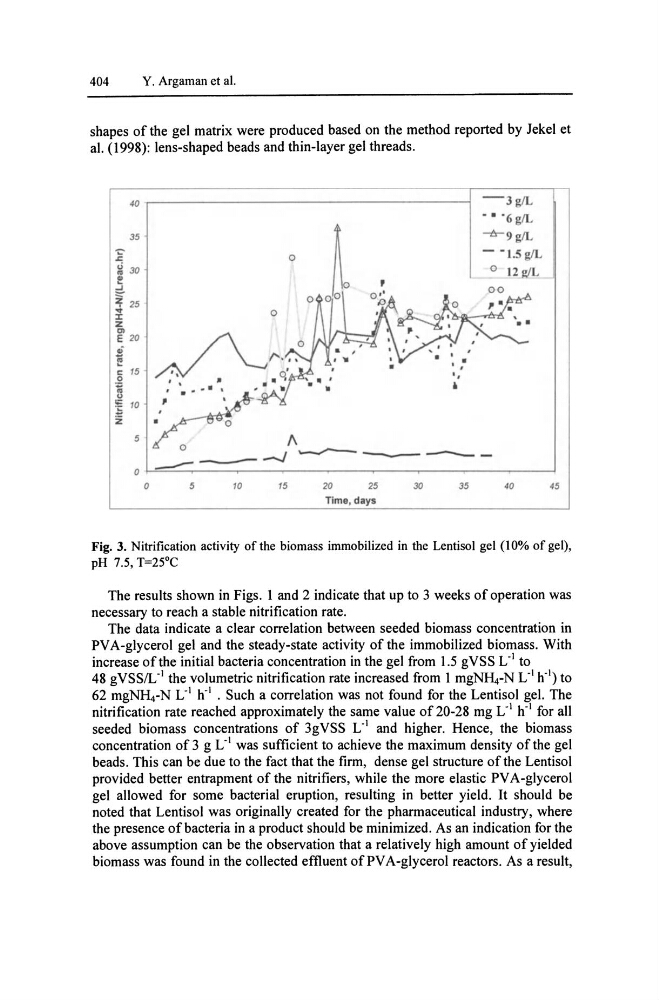
Fig. 3. Nitrification activity of the biomass immobilized in the Lentisol gel (10% of gel),
pH 7.5, T=25°C
The results shown in Figs. 1 and 2 indicate that up to 3 weeks of operation was
necessary to reach a stable nitrification rate.
The data indicate a clear correlation between seeded biomass concentration in
PV A-glycerol gel and the steady-state activity of the immobilized biomass. With
increase of the initial bacteria concentration in the gel from 1.5 gVSS L· I to
48 gVSS/L'1 the volumetric nitrification rate increased from 1 mg~-N L'I h'l) to
62 mg~-N L'I h-I . Such a correlation was not found for the Lentisol gel. The
nitrification rate reached approximately the same value of 20-28 mg L' I h'l for all
seeded biomass concentrations of 3gVSS L'I and higher. Hence, the biomass
concentration of 3 g L'I was sufficient to achieve the maximum density of the gel
beads. This can be due to the fact that the firm, dense gel structure of the Lentisol
provided better entrapment of the nitrifiers, while the more elastic PVA-glycerol
gel allowed for some bacterial eruption, resulting in better yield. It should be
noted that Lentisol was originally created for the pharmaceutical industry, where
the presence of bacteria in a product should be minimized. As an indication for the
above assumption can be the observation that a relatively high amount of yielded
biomass was found in the collected effluent ofPVA-glycerol reactors. As a result,
Y. Argaman et al.
shapes of the gel matrix were produced based on the method reported by Jekel et
al. (1998): lens-shaped beads and thin-layer gel threads.
40 r---------------------------------------~
35
I
g 30
CD
.:;
~ 25
~
z
'" E 20
o
o
/ \
/,.,.0
c 15
A/ "--.; 0,'
.e
• "
•
• •
itOp:····· ...
z .
0
5
0
"
,
" ~
•
,
-3gfL
- • °6 gIL
--6-9 gfL
- -1.5 gIL
o 12
00
_______ - -..I - - - - ----- -
-
o ·~~~~--~----~----~----~----~--------------~
o
5
10
15
20
25
30
35
40
45
Time, days
Fig. 3. Nitrification activity of the biomass immobilized in the Lentisol gel (10% of gel),
pH 7.5, T=25°C
The results shown in Figs. 1 and 2 indicate that up to 3 weeks of operation was
necessary to reach a stable nitrification rate.
The data indicate a clear correlation between seeded biomass concentration in
PV A-glycerol gel and the steady-state activity of the immobilized biomass. With
increase of the initial bacteria concentration in the gel from 1.5 gVSS L· I to
48 gVSS/L'1 the volumetric nitrification rate increased from 1 mg~-N L'I h'l) to
62 mg~-N L'I h-I . Such a correlation was not found for the Lentisol gel. The
nitrification rate reached approximately the same value of 20-28 mg L' I h'l for all
seeded biomass concentrations of 3gVSS L'I and higher. Hence, the biomass
concentration of 3 g L'I was sufficient to achieve the maximum density of the gel
beads. This can be due to the fact that the firm, dense gel structure of the Lentisol
provided better entrapment of the nitrifiers, while the more elastic PVA-glycerol
gel allowed for some bacterial eruption, resulting in better yield. It should be
noted that Lentisol was originally created for the pharmaceutical industry, where
the presence of bacteria in a product should be minimized. As an indication for the
above assumption can be the observation that a relatively high amount of yielded
biomass was found in the collected effluent ofPVA-glycerol reactors. As a result,