

Biological Nitrogen Removal Using Immobilized Bacteria
403
Table 2. Details of the appropriate gel matrix selection
Type of gel material
PYA drying
PV A boric acid
PV A freezing
PAA (polyacrylamide)
PEG (polyethylene glycol)
PU (polyurethane)
K-carragenan
Agarose
Alginate
Properties Summary based on lab tests
Low toxicity/good physical properties
Low toxicity/poor stability
Moderate toxicity/poor physical properties
High toxicity/good physical properties
Moderate toxicity/good physical properties
High toxicity/poor physical properties
Low toxicity/poor stability
Low toxicity/poor stability
Low toxicity/poor stability
ror---------------------------~==========~
60
50
o
10
20
30
40
Time. days
50
-+-1 .5 giL
....... 3 giL
..... Sg/L
.......... 12 giL
""24 giL
+ 12g1L.20%
--48 giL
60
70
80
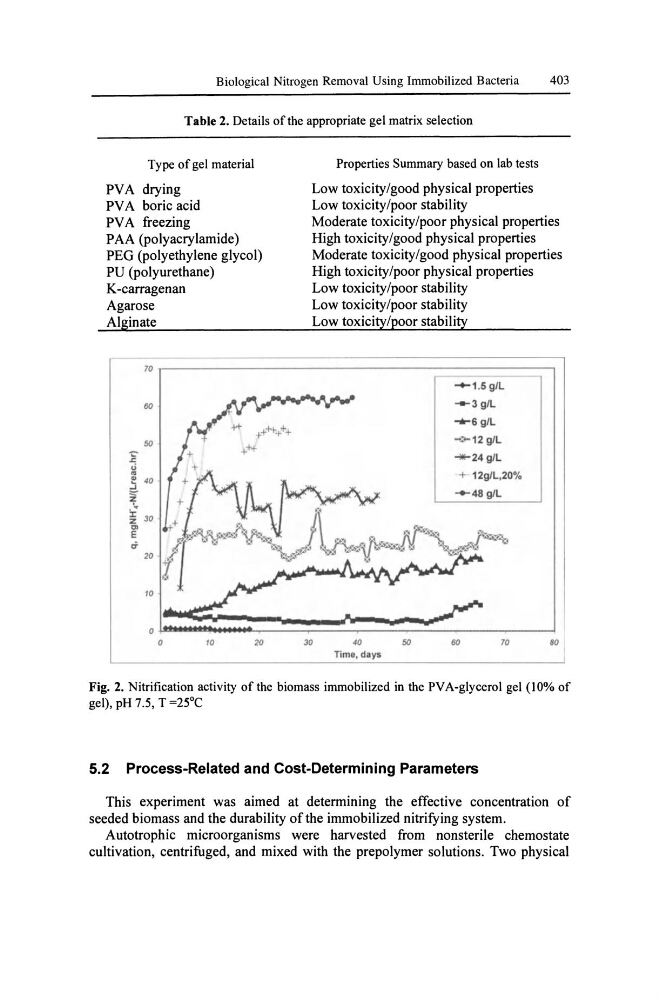
Fig. 2. Nitrification activity of the biomass immobilized in the PYA-glycerol gel (10% of
gel), pH 7.5, T =25°C
5.2 Process-Related and Cost-Determining Parameters
This experiment was aimed at determining the effective concentration of
seeded biomass and the durability of the immobilized nitrifying system.
Autotrophic microorganisms were harvested from nonsterile chemostate
cultivation, centrifuged, and mixed with the prepolymer solutions. Two physical
403
Table 2. Details of the appropriate gel matrix selection
Type of gel material
PYA drying
PV A boric acid
PV A freezing
PAA (polyacrylamide)
PEG (polyethylene glycol)
PU (polyurethane)
K-carragenan
Agarose
Alginate
Properties Summary based on lab tests
Low toxicity/good physical properties
Low toxicity/poor stability
Moderate toxicity/poor physical properties
High toxicity/good physical properties
Moderate toxicity/good physical properties
High toxicity/poor physical properties
Low toxicity/poor stability
Low toxicity/poor stability
Low toxicity/poor stability
ror---------------------------~==========~
60
50
o
10
20
30
40
Time. days
50
-+-1 .5 giL
....... 3 giL
..... Sg/L
.......... 12 giL
""24 giL
+ 12g1L.20%
--48 giL
60
70
80
Fig. 2. Nitrification activity of the biomass immobilized in the PYA-glycerol gel (10% of
gel), pH 7.5, T =25°C
5.2 Process-Related and Cost-Determining Parameters
This experiment was aimed at determining the effective concentration of
seeded biomass and the durability of the immobilized nitrifying system.
Autotrophic microorganisms were harvested from nonsterile chemostate
cultivation, centrifuged, and mixed with the prepolymer solutions. Two physical