

318
F. Hell and 1. Lahnsteiner
For the same nitrate removal performance, a lower total desalination is required
when applying monovalent selective membranes. (Fig.2)
The quality of the brine is mainly determined by the raw water composition, the
amount of dilution water and the type of membrane. Due to the fact that only ions
pass the membranes, the brine loop has to be replenished with a certain amount of
raw water. The lower limit for this dilution water is the precipitation potential of
the salts transferred to the brine loop. In the case of drinking water, these are
mainly calcium salts such as calcium carbonate or calcium sulphate. Nevertheless,
it is possible to operate the brine loop at a certain degree of oversaturation, which
is usually higher than that for reverse osmosis (Rautenbach et a1.1986). A special
mode of operation for dealing with beginning precipitation is so-called
electrodialysis reversal (EDR). Polarity, and consequently diluate and concentrate
chambers, are changed. Thus, the direction of the ion penetration reverses and
precipitation on the brine side of the membrane is dissolved. Furthermore, the
precipitation point can be shifted to higher concentrations by means of pH
adjustment or the addition of inhibiting agents.
3 Nitrate and Hardness Removal
3.1 Nitrate Removal Processes for Drinking Water
Nitrogen in its different appearances is an important element for all biological
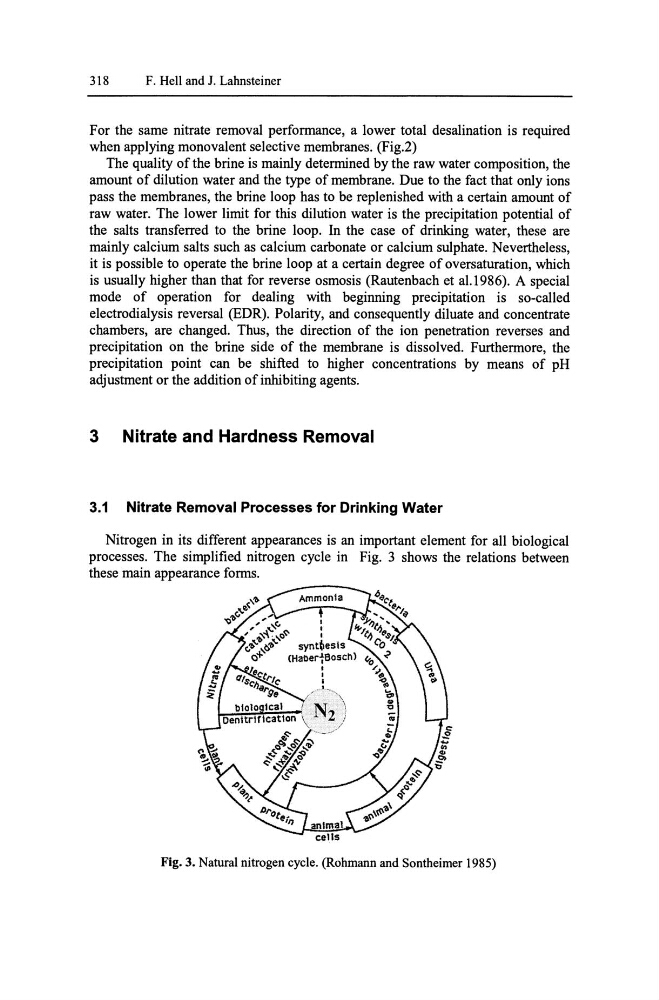
processes. The simplified nitrogen cycle in Fig. 3 shows the relations between
these main appearance forms.
Fig. 3. Natural nitrogen cycle. (Rohmann and Sontheimer 1985)
F. Hell and 1. Lahnsteiner
For the same nitrate removal performance, a lower total desalination is required
when applying monovalent selective membranes. (Fig.2)
The quality of the brine is mainly determined by the raw water composition, the
amount of dilution water and the type of membrane. Due to the fact that only ions
pass the membranes, the brine loop has to be replenished with a certain amount of
raw water. The lower limit for this dilution water is the precipitation potential of
the salts transferred to the brine loop. In the case of drinking water, these are
mainly calcium salts such as calcium carbonate or calcium sulphate. Nevertheless,
it is possible to operate the brine loop at a certain degree of oversaturation, which
is usually higher than that for reverse osmosis (Rautenbach et a1.1986). A special
mode of operation for dealing with beginning precipitation is so-called
electrodialysis reversal (EDR). Polarity, and consequently diluate and concentrate
chambers, are changed. Thus, the direction of the ion penetration reverses and
precipitation on the brine side of the membrane is dissolved. Furthermore, the
precipitation point can be shifted to higher concentrations by means of pH
adjustment or the addition of inhibiting agents.
3 Nitrate and Hardness Removal
3.1 Nitrate Removal Processes for Drinking Water
Nitrogen in its different appearances is an important element for all biological
processes. The simplified nitrogen cycle in Fig. 3 shows the relations between
these main appearance forms.
Fig. 3. Natural nitrogen cycle. (Rohmann and Sontheimer 1985)