

The Application of Electrodialysis for Drinking Water Treatment
319
It can clearly be seen that nitrate is essential for the production of proteins and
hence for human nutrition. Nevertheless, the direct uptake of nitrate should be
limited due to possible health effects such as methaemoglobinaemia for infants
and cancer risks caused by nitrosamines and nitrosamides (Packham 1991).
Besides other nutrients, drinking water is a main source of nitrate in human food.
With an average nutrition and water consumption of 1.5 Idai1, the nitrate uptake
from drinking water amounts to approximately 50%, when the drinking water
contains 50 mg NOil (Packer et.a1.1995). For this reason, nitrate uptake can be
most easily controlled by the regulation of nitrate in the drinking water.
Nitrate salts are highly soluble, so that nitrate is washed out from the soil.
Normally, natural denitrification processes in the soil and groundwater control this
washout and hence keep the nitrate content of the groundwater low. Nevertheless,
the excessive application of artificial fertilizer and manure causes elevated nitrate
concentrations in the drinking water. Sanitation programs are time-consuming and
not always applicable. Therefore, treatment processes for the nitrate removal are
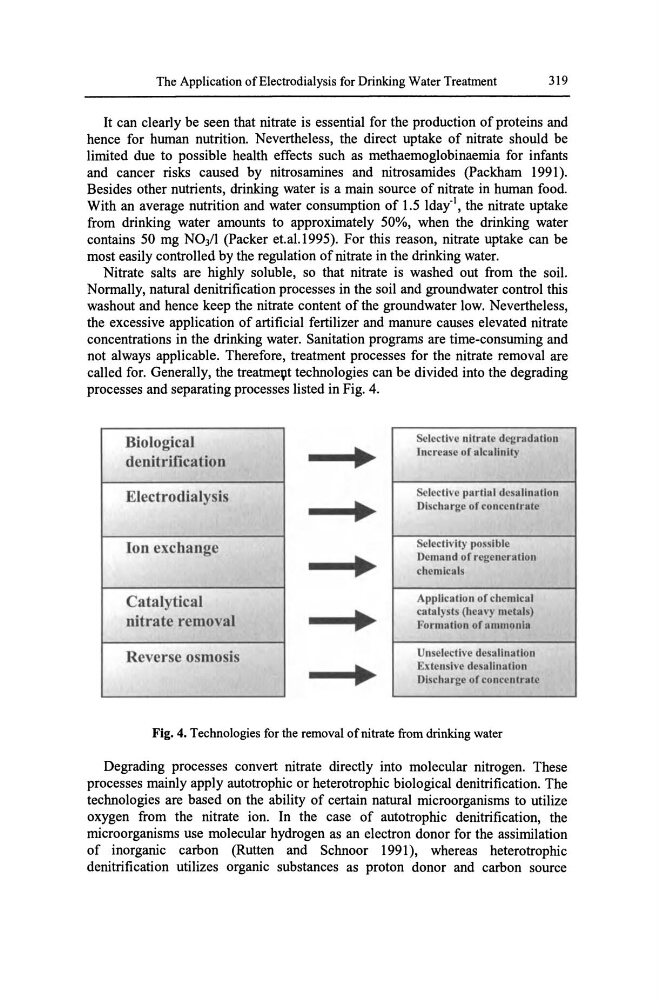
called for. Generally, the treatmevt technologies can be divided into the degrading
processes and separating processes listed in Fig. 4.
Biological
denitrification
Selective nitrate degradation
Increase of alcalinity
Electrodialysis
Selective partial desalination
Discharge of concentrate
Ion exchange
Sclectlvity possible
Demand of regencration
chemicals
Catalytical
nitrate removal
Appllcallon of chemical
catalysts (heavy metal)
Formation of :lmmonin
Reverse osmosis
Unselectivc desalination
Extensive desalination
Discha rge of concentrate
Fig. 4. Technologies for the removal of nitrate from drinking water
Degrading processes convert nitrate directly into molecular nitrogen. These
processes mainly apply autotrophic or heterotrophic biological denitrification. The
technologies are based on the ability of certain natural microorganisms to utilize
oxygen from the nitrate ion. In the case of autotrophic denitrification, the
microorganisms use molecular hydrogen as an electron donor for the assimilation
of inorganic carbon (Rutten and Schnoor 1991), whereas heterotrophic
denitrification utilizes organic substances as proton donor and carbon source
319
It can clearly be seen that nitrate is essential for the production of proteins and
hence for human nutrition. Nevertheless, the direct uptake of nitrate should be
limited due to possible health effects such as methaemoglobinaemia for infants
and cancer risks caused by nitrosamines and nitrosamides (Packham 1991).
Besides other nutrients, drinking water is a main source of nitrate in human food.
With an average nutrition and water consumption of 1.5 Idai1, the nitrate uptake
from drinking water amounts to approximately 50%, when the drinking water
contains 50 mg NOil (Packer et.a1.1995). For this reason, nitrate uptake can be
most easily controlled by the regulation of nitrate in the drinking water.
Nitrate salts are highly soluble, so that nitrate is washed out from the soil.
Normally, natural denitrification processes in the soil and groundwater control this
washout and hence keep the nitrate content of the groundwater low. Nevertheless,
the excessive application of artificial fertilizer and manure causes elevated nitrate
concentrations in the drinking water. Sanitation programs are time-consuming and
not always applicable. Therefore, treatment processes for the nitrate removal are
called for. Generally, the treatmevt technologies can be divided into the degrading
processes and separating processes listed in Fig. 4.
Biological
denitrification
Selective nitrate degradation
Increase of alcalinity
Electrodialysis
Selective partial desalination
Discharge of concentrate
Ion exchange
Sclectlvity possible
Demand of regencration
chemicals
Catalytical
nitrate removal
Appllcallon of chemical
catalysts (heavy metal)
Formation of :lmmonin
Reverse osmosis
Unselectivc desalination
Extensive desalination
Discha rge of concentrate
Fig. 4. Technologies for the removal of nitrate from drinking water
Degrading processes convert nitrate directly into molecular nitrogen. These
processes mainly apply autotrophic or heterotrophic biological denitrification. The
technologies are based on the ability of certain natural microorganisms to utilize
oxygen from the nitrate ion. In the case of autotrophic denitrification, the
microorganisms use molecular hydrogen as an electron donor for the assimilation
of inorganic carbon (Rutten and Schnoor 1991), whereas heterotrophic
denitrification utilizes organic substances as proton donor and carbon source