

310
N. Narkis et al.
more efficient in producing bridges between the particles than the coiled nonionic
parts of the copolymers.
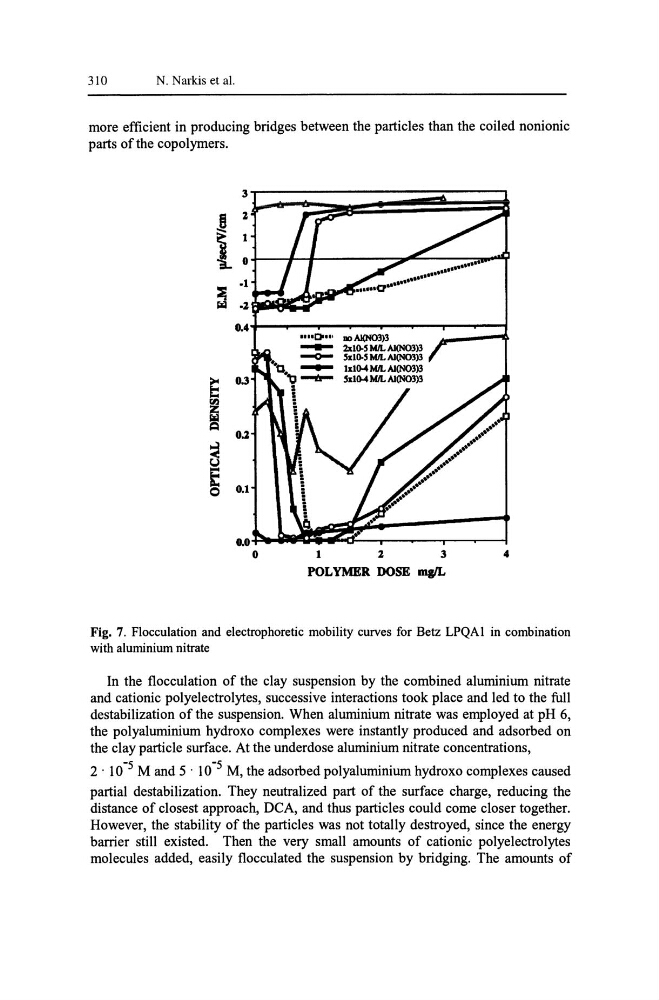
Fig. 7. Flocculation and electrophoretic mobility curves for Betz LPQAI in combination
with aluminium nitrate
In the flocculation of the clay suspension by the combined aluminium nitrate
and cationic polyelectrolytes, successive interactions took place and led to the full
destabilization of the suspension. When aluminium nitrate was employed at pH 6,
the polyaluminium hydroxo complexes were instantly produced and adsorbed on
the clay particle surface. At the underdose aluminium nitrate concentrations,
2 . 10- 5 M and 5 . 10- 5 M, the adsorbed polyaluminium hydroxo complexes caused
partial destabilization. They neutralized part of the surface charge, reducing the
distance of closest approach, DCA, and thus particles could come closer together.
However, the stability of the particles was not totally destroyed, since the energy
barrier still existed. Then the very small amounts of cationic polyelectrolytes
molecules added, easily flocculated the suspension by bridging. The amounts of
N. Narkis et al.
more efficient in producing bridges between the particles than the coiled nonionic
parts of the copolymers.
Fig. 7. Flocculation and electrophoretic mobility curves for Betz LPQAI in combination
with aluminium nitrate
In the flocculation of the clay suspension by the combined aluminium nitrate
and cationic polyelectrolytes, successive interactions took place and led to the full
destabilization of the suspension. When aluminium nitrate was employed at pH 6,
the polyaluminium hydroxo complexes were instantly produced and adsorbed on
the clay particle surface. At the underdose aluminium nitrate concentrations,
2 . 10- 5 M and 5 . 10- 5 M, the adsorbed polyaluminium hydroxo complexes caused
partial destabilization. They neutralized part of the surface charge, reducing the
distance of closest approach, DCA, and thus particles could come closer together.
However, the stability of the particles was not totally destroyed, since the energy
barrier still existed. Then the very small amounts of cationic polyelectrolytes
molecules added, easily flocculated the suspension by bridging. The amounts of