

Turbidity Removal by Polyelectrolytes as Flocculant Aids
311
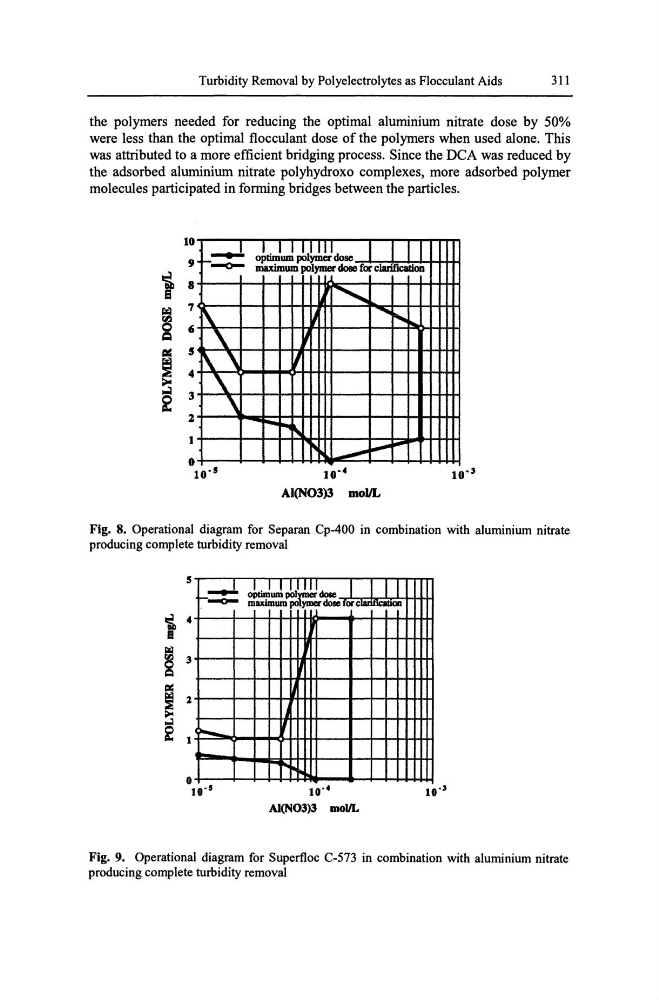
the polymers needed for reducing the optimal aluminium nitrate dose by 50%
were less than the optimal flocculant dose of the polymers when used alone. This
was attributed to a more efficient bridging process. Since the DCA was reduced by
the adsorbed aluminium nitrate polyhydroxo complexes, more adsorbed polymer
molecules participated in forming bridges between the particles.
10
,
~ 8
e
7
,
5
4
3
2
-..l otmJuu! .!,lUl1 dose
I
r---o- maximum polymer dose for clarificalion
~.
\
~ ,
\. ,
-~
~ ........
~
... ,
---,.""..
10. 4
AI(N03)3 mollL
.....
I""""
Fig. 8. Operational diagram for Separan Cp-400 in combination with aluminium nitrate
producing complete turbidity removal
IS
....L Jw.lun! ~~ cIofe
I
- - - maximWD po ymer dose lot ClatlllClIIiOn
100-.,
-
'I
10. 4
Al(N03)3 mollL
Fig. 9. Operational diagram for Superfloc C-573 in combination with aluminium nitrate
producing complete turbidity removal
311
the polymers needed for reducing the optimal aluminium nitrate dose by 50%
were less than the optimal flocculant dose of the polymers when used alone. This
was attributed to a more efficient bridging process. Since the DCA was reduced by
the adsorbed aluminium nitrate polyhydroxo complexes, more adsorbed polymer
molecules participated in forming bridges between the particles.
10
,
~ 8
e
7
,
5
4
3
2
-..l otmJuu! .!,lUl1 dose
I
r---o- maximum polymer dose for clarificalion
~.
\
~ ,
\. ,
-~
~ ........
~
... ,
---,.""..
10. 4
AI(N03)3 mollL
.....
I""""
Fig. 8. Operational diagram for Separan Cp-400 in combination with aluminium nitrate
producing complete turbidity removal
IS
....L Jw.lun! ~~ cIofe
I
- - - maximWD po ymer dose lot ClatlllClIIiOn
100-.,
-
'I
10. 4
Al(N03)3 mollL
Fig. 9. Operational diagram for Superfloc C-573 in combination with aluminium nitrate
producing complete turbidity removal