

Turbidity Removal by Polyelectrolytes as Flocculant Aids
309
The mechanism of the flocculation of negatively charged stable clay mineral
suspensions with cationic polyelectrolytes is adsorption and bridging (Rebhun
1966; Rebhun et al. 1968; Narkis 1968; Narkis and Rebhun 1975). Others
suggested a modified charge neutralization model called "charge patch model"
(Kasper 1971; Gregory 1976; Shun and Gregory 1990).
3
~
2
i
1
0
~
-1
-2
0.5
0.'
i: ...
r2 0.3
~
~ 0.2
~ 0.1
0.0
•
noAl(N03)3
:lxlo-, MIL AI(N03)3
5xJo-S MIL AI(N03)3
lxJ().4 MIL AI(N03)3
5xl().4 MIL AI(N03)3
1
2
3
,
POLYMER DOSE mgIL
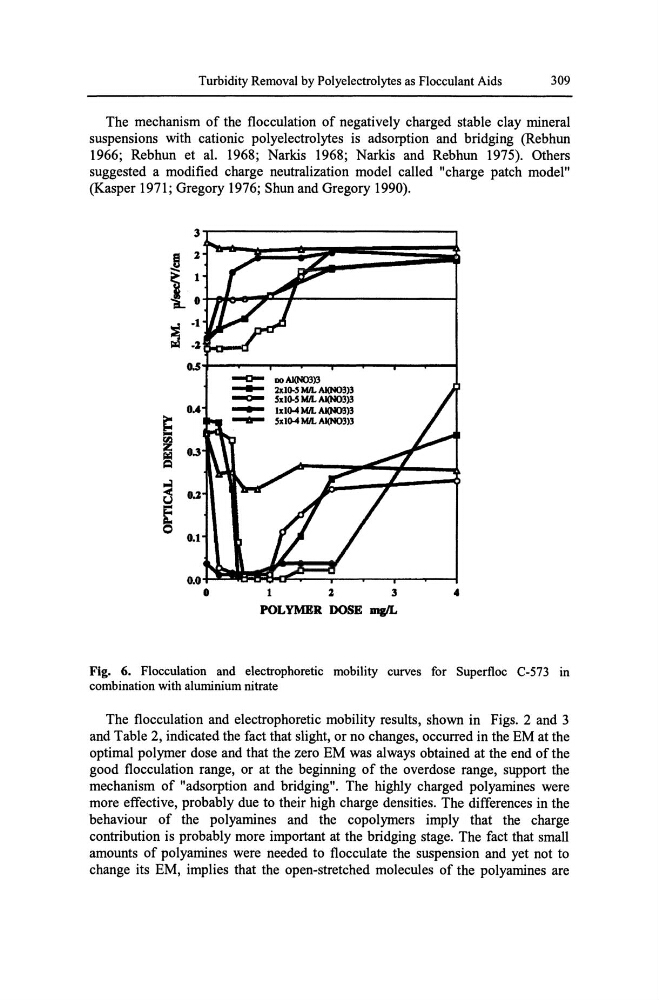
Fig. 6. Flocculation and electrophoretic mobility curves for Superfloc C-S73 in
combination with aluminium nitrate
The flocculation and electrophoretic mobility results, shown in Figs. 2 and 3
and Table 2, indicated the fact that slight, or no changes, occurred in the EM at the
optimal polymer dose and that the zero EM was always obtained at the end of the
good flocculation range, or at the beginning of the overdose range, support the
mechanism of "adsorption and bridging". The highly charged polyamines were
more effective, probably due to their high charge densities. The differences in the
behaviour of the polyamines and the copolymers imply that the charge
contribution is probably more important at the bridging stage. The fact that small
amounts of polyamines were needed to flocculate the suspension and yet not to
change its EM, implies that the open-stretched molecules of the polyamines are
309
The mechanism of the flocculation of negatively charged stable clay mineral
suspensions with cationic polyelectrolytes is adsorption and bridging (Rebhun
1966; Rebhun et al. 1968; Narkis 1968; Narkis and Rebhun 1975). Others
suggested a modified charge neutralization model called "charge patch model"
(Kasper 1971; Gregory 1976; Shun and Gregory 1990).
3
~
2
i
1
0
~
-1
-2
0.5
0.'
i: ...
r2 0.3
~
~ 0.2
~ 0.1
0.0
•
noAl(N03)3
:lxlo-, MIL AI(N03)3
5xJo-S MIL AI(N03)3
lxJ().4 MIL AI(N03)3
5xl().4 MIL AI(N03)3
1
2
3
,
POLYMER DOSE mgIL
Fig. 6. Flocculation and electrophoretic mobility curves for Superfloc C-S73 in
combination with aluminium nitrate
The flocculation and electrophoretic mobility results, shown in Figs. 2 and 3
and Table 2, indicated the fact that slight, or no changes, occurred in the EM at the
optimal polymer dose and that the zero EM was always obtained at the end of the
good flocculation range, or at the beginning of the overdose range, support the
mechanism of "adsorption and bridging". The highly charged polyamines were
more effective, probably due to their high charge densities. The differences in the
behaviour of the polyamines and the copolymers imply that the charge
contribution is probably more important at the bridging stage. The fact that small
amounts of polyamines were needed to flocculate the suspension and yet not to
change its EM, implies that the open-stretched molecules of the polyamines are