

308
N. Narkis et al.
flocculation curves illustrated in Figs. 4 to 7, dose relationships for complete
clarification could be obtained.
For example, Figs. 8 and 9 present the relationship between the cationic
polymers and Al(III) doses producing good clarification of the suspension, when
flocculated with aluminium nitrate in combination with Separan Cp-402 and
Superfloc C-573, respectively.
6~--------------------------~
J 4
i
1
O~--~--~~------------------~
O.4+--r--o.....,. ...... _ ..... ...,..-or-..-,,....-.,. ..... -j
0.3
0.1
- 0 - DO Al(M03)3
- - 2xlC>-SMAl(N03)3
- 0 - SxlG-S M Al(N03)3
....... lxl04MA1(N03)3
-a- Sd04 M AI(N03)3
0.o~~~3 o 1 1 3 4 5 6 7
POLYMER DOSE mgIL
8
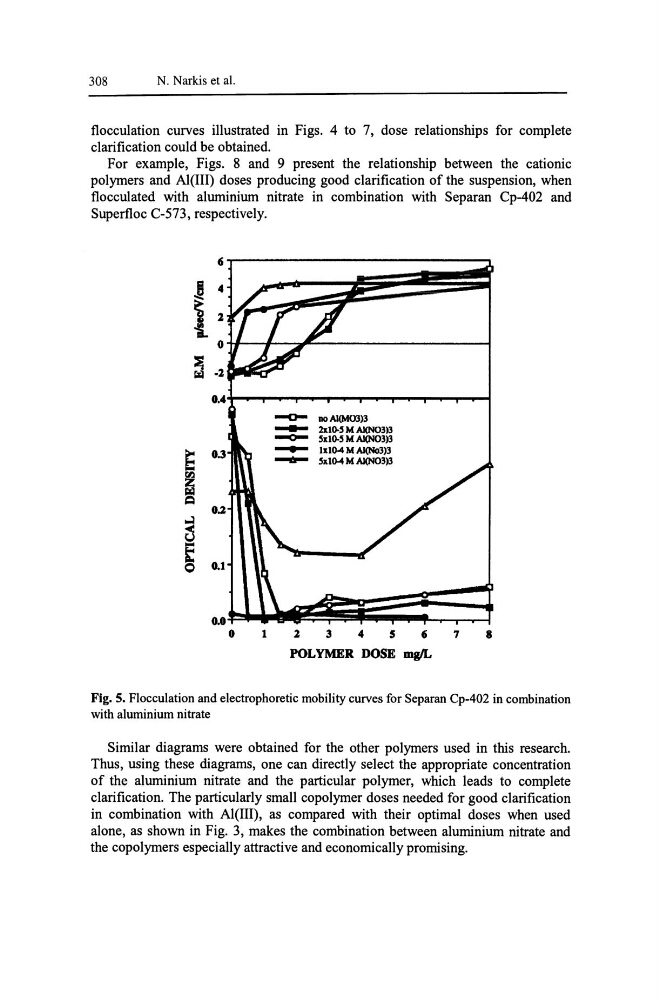
Fig. 5. Flocculation and electrophoretic mobility curves for Separan Cp-402 in combination
with aluminium nitrate
Similar diagrams were obtained for the other polymers used in this research.
Thus, using these diagrams, one can directly select the appropriate concentration
of the aluminium nitrate and the particular polymer, which leads to complete
clarification. The particularly small copolymer doses needed for good clarification
in combination with AI(III) , as compared with their optimal doses when used
alone, as shown in Fig. 3, makes the combination between aluminium nitrate and
the copolymers especially attractive and economically promising.
N. Narkis et al.
flocculation curves illustrated in Figs. 4 to 7, dose relationships for complete
clarification could be obtained.
For example, Figs. 8 and 9 present the relationship between the cationic
polymers and Al(III) doses producing good clarification of the suspension, when
flocculated with aluminium nitrate in combination with Separan Cp-402 and
Superfloc C-573, respectively.
6~--------------------------~
J 4
i
1
O~--~--~~------------------~
O.4+--r--o.....,. ...... _ ..... ...,..-or-..-,,....-.,. ..... -j
0.3
0.1
- 0 - DO Al(M03)3
- - 2xlC>-SMAl(N03)3
- 0 - SxlG-S M Al(N03)3
....... lxl04MA1(N03)3
-a- Sd04 M AI(N03)3
0.o~~~3 o 1 1 3 4 5 6 7
POLYMER DOSE mgIL
8
Fig. 5. Flocculation and electrophoretic mobility curves for Separan Cp-402 in combination
with aluminium nitrate
Similar diagrams were obtained for the other polymers used in this research.
Thus, using these diagrams, one can directly select the appropriate concentration
of the aluminium nitrate and the particular polymer, which leads to complete
clarification. The particularly small copolymer doses needed for good clarification
in combination with AI(III) , as compared with their optimal doses when used
alone, as shown in Fig. 3, makes the combination between aluminium nitrate and
the copolymers especially attractive and economically promising.